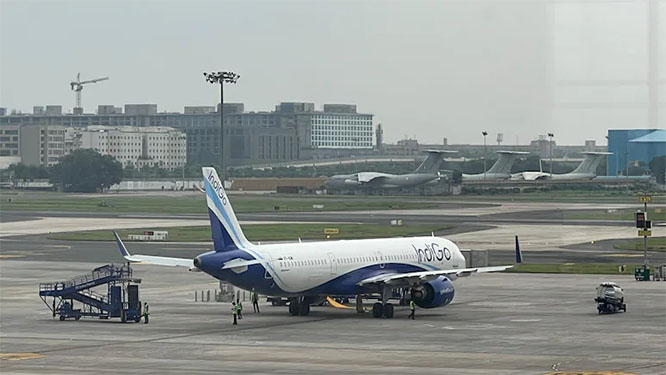
IndiGo, India’s largest airline, is battling one of its worst operational disruptions in recent years, with hundreds of delays and cancellations throwing domestic travel into chaos.
Government data on Tuesday showed its on-time performance plunging to 35%, an unusual dip for a carrier long associated with punctuality.
By Wednesday afternoon, airports in Delhi, Mumbai, Bengaluru and Hyderabad had collectively reported close to 200 cancellations, stranding travellers across the country.
Crew Shortage After New Duty Norms
A major trigger behind the meltdown is a severe crew shortage, especially among pilots, following the rollout of revised Flight Duty Time Limitation (FDTL) norms last month.
The rules mandate longer rest hours and more humane rosters — a shift IndiGo has struggled to incorporate across its vast network.
Sources said several flights were grounded due to lack of cabin crew, while some delays stretched upwards of eight hours.
With IndiGo controlling over 60% of India’s domestic aviation market, the ripple effect has impacted airports nationwide.
IndiGo Issues Apology, Lists “Compounding Factors”
In a statement, IndiGo acknowledged the large-scale disruption:
“We sincerely apologise to customers. A series of unforeseen operational challenges — technology glitches, winter schedule changes, adverse weather, system congestion and updated FDTL norms — created a compounding impact that could not have been anticipated.”
To stabilise operations, the airline has begun calibrated schedule adjustments for the next 48 hours, aiming to restore punctuality. Affected passengers are being offered refunds or alternate travel arrangements, IndiGo said.
What the FDTL Rules Require
The FDTL norms, designed to reduce pilot fatigue, cap duty and flying hours as follows:
• Maximum 8 hours of flying per day
• 35 hours per week
• 125 hours per month
• 1,000 hours per year
Crew must also receive rest equalling twice the flight duration, with a minimum 10-hour rest period in any 24-hour window.
The DGCA introduced these limits to enhance flight safety.
Hyderabad: 33 Flights Cancelled, Long Queues Reported
Hyderabad’s Rajiv Gandhi International Airport saw heavy early-morning crowds as 33 IndiGo flights (arrivals and departures) were cancelled.
The airport clarified on X that operations were normal, advising passengers to contact IndiGo directly for latest flight status.
Cancellations included flights to and from Visakhapatnam, Goa, Ahmedabad, Delhi, Bengaluru, Chennai, Madurai, Hubli, Bhopal and Bhubaneswar.
Bengaluru: 42 Flights Disrupted
Bengaluru’s Kempegowda International Airport recorded 42 cancellations — 22 arrivals and 20 departures — affecting routes to Delhi, Mumbai, Chennai, Hyderabad, Goa, Kolkata and Lucknow.
Passengers Vent on Social Media
Irate travellers took to X to share their experiences. One passenger stranded in Hyderabad wrote: “I have been here since 3 a.m. and missed an important meeting.”
Another said: “My flight was pushed from 1:55 PM to 2:55 PM and now 4:35 PM. I was informed only three minutes before entering the airport.”
Delhi Airport Hit by Tech Glitch
At Delhi Airport, the disruption deepened due to a slowdown in the Amadeus system — used for reservations, check-ins and departure control.
The technical issue led to longer queues and sluggish processing, adding to delays already worsened by staff shortages.





Comments
An Indian Haj subsidy that did not exist!
Thank you Prime Minister Modi for ending Haj subsidy that never existed.
I completely welcome this move making the announcement, minister Mukhtar Abbas Naqvi said: “We believe in empowerment without appeasement.”Naqvi did not elaborate what he meant by “appeasement” but for decades, Haj subsidy remained a whip in the hands of right-wing parties to attack political rivals. Bharatiya Janata Party to embarrass rivals by accusing them of “appeasing” Muslims by subsiding expenses involved in the pilgrimage to Makkah and Madina. Angered by this attack, several Muslims have been demanding an end to the subsidy.
However, it is important to understand what this subsidy was and whether Muslims actually benefitted from it. In 2016-17, the government budgeted Rs 4.5 billion subsidy for around 100,000 Muslims who performed Haj last year. Each pilgrim paid around Rs 220,000 (amount varies each year) for airfare; stay in Makkah and Madina and for miscellaneous expenses. This money is paid to government-managed Haj committees which then transfers this money to other agencies. In other words, each Muslim pays for his/her own Haj expenses.
A significant chunk of money paid by Muslims goes to India’s government-owned national carrier Air India which enjoys a virtual monopoly on Haj circuit. The airline picks up passengers from around a dozen cities and flies them to Jeddah. The Air India inflates India-Jeddah tickets during the Haj season. This so-called government subsidy is used to pay for tickets that are always higher than the prevailing airfare charged by other airlines. A breakdown would show that an Air India ticket to Jeddah would cost more than a trip to Los Angeles from India. Essentially, the government takes money from one pocket and puts it back in another. Muslim have always demanded global tenders for Haj flights and for providing accommodation in Makkah and Madina..
However, while Naqvi sought to take a high moral ground by claiming that his party appeases no section of the society, his own government spends billions of rupees on organizing Hindu pilgrimages every year
Naqvi saab, this is what you learnt in Madrasa? U r Back-Stabbing Muslims. There is no 1% quality of muslim in you. After joining BJP you have lost it. First learn humanity. Almighty will give answers for all problems you have created for others.
Add new comment