



PM Modi arrives in B'desh; Hasina receives him at airport

June 6, 2015

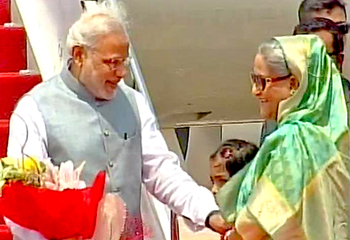
Dhaka, Jun 6: Prime Minister Narendra Modi today arrived here to a red carpet welcome on his maiden visit which is expected to put ties with Bangladesh in a new trajectory, as the two sides will firm up a number of pacts to boost cooperation besides ratifying the long-pending Land Boundary Agreement.
Modi Bdesh
In a special gesture, Modi was received at the Hazrat Shahjalal International Airport by Prime Minister Sheikh Hasina and a number of her Ministerial colleagues including Finance Minister AMA Muhith, Commerce Minister Tofail Ahmed and Agriculture Minister Moti Choudhury.

Prime Minister Modi was given a guard of honour at the airport.

Reflecting high expectations from the visit, the capital has been decked up with big hoardings carrying photographs of Modi besides life-size cutouts of him, West Bengal Chief Minister Mamata Banerjee and Hasina. Banerjee arrived here last night.

"Leaving for Bangladesh. This visit is going to strengthen the bond between our Nations, benefitting people of our countries & our region," Modi had tweeted ahead of his departure from New Delhi.

During his two-day visit, part of his policy to deepen engagement with India's immediate neighbourhood, Modi will hold wide-ranging talks with Hasina on the whole gamut of ties and ways to move forward further.

In Dhaka, the Prime Minister is expected to send a strong message to strengthen the hand of his Bangladesh counterpart who has been steadfastly helping India in curbing various Northeast militant groups who used to take refuge in that country besides coming down hard on radical Muslim outfits.

Ahead of the visit, Modi had lauded Hasina for playing an "important role" in making the bilateral ties "strong" and said, "I am certain my visit will be beneficial for the people of both our nations and in the larger good of the South Asian neighbourhood."

Bangladesh and India share a 4096-km-long border, most of which is porous, and both the countries are likely to try and find ways to enhance security cooperation, particularly to further contain northeast insurgent groups.

Ratification of the Land Boundary Agreement will be a major highlight of Modi's visit to Dhaka.

Earlier this month, Parliament had passed a historic constitution amendment bill seeking to settle India's 41-year-old border issue with Bangladesh. The bill paved way for operationalisation of the 1974 India-Bangladesh Land Boundary Agreement (LBA) that provides for exchange of 161 enclaves between the two countries.

Enhancing rail, road and water connectivity and boosting economic engagement will find priority and a number of pacts are likely to be signed in these areas. A pact to supply diesel to Bangladesh has also been finalised and would be inked.

Bangladesh is an important trading partner for India. The two-way trade in 2012-2013 was USD 5.34 billion with India's exports to Bangladesh accounting for USD 4.776 billion and imports USD 0.564 million.

Modi, Banerjee and Hasina will flag off bus service between Kolkata and Agartala via Dhaka and the Dhaka-Shillong-Guwahati bus service.

The two countries are keen to strengthen railway connectivity, particularly to revive railway links which were in existence prior to 1965. They are also set to sign a coastal shipping agreement to facilitate sailing of small vessels from India to various ports in Bangladesh which now go through Singapore.

India will also push for involvement of Indian companies in setting up of ports in that country.

The issue of Bangladesh, Bhutan, India and Nepal (BBIN) Motor Vehicle Agreement is also likely to figure in the talks Modi will have with Hasina. India feels improving connectivity with Bangladesh will help linking the Northeastern region with Southeast Asia.

On the trade front, there will be efforts to spur Indian investment in Bangladesh and an enabling MoU may be signed to facilitate setting up of Special Economic Zones by Indian companies in that country.

India has already announced that the long-pending Teesta water-sharing pact with Bangladesh will not be signed during the visit. However, issues relating to sharing of other river waters and waterways was expected to figure in the talks.

The Teesta deal was set to be inked during the then Prime Minister Manmohan Singh's visit to Bangladesh in September 2011 but was postponed at the last minute due to objections by Banerjee, who had also dropped out of the Prime Ministerial delegation.

Teesta water is crucial for Bangladesh, especially in the leanest period from December to March when the water flow often temporarily comes down to less than 1,000 cusecs from 5,000 cusecs.

Comments

Add new comment

  • Coastaldigest.com reserves the right to delete or block any comments.
  • Coastaldigset.com is not responsible for its readers’ comments.
  • Comments that are abusive, incendiary or irrelevant are strictly prohibited.
  • Please use a genuine email ID and provide your name to avoid reject.
News Network
December 5,2025

indigoCEO.jpg

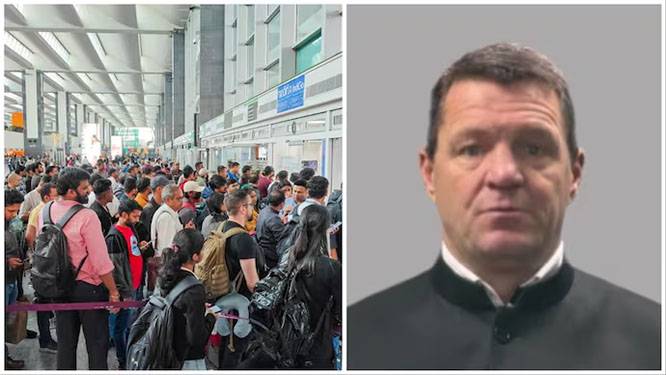
New Delhi, Dec 5: IndiGo CEO Pieter Elbers issued a public apology this evening after more than a thousand flights were cancelled today, making it the "most severely impacted day" in terms of cancellations. The biggest airline of the country cancelled "more than half" of its daily number of flights on Friday, said Elbers. He also said that even though the crisis will persist on Saturday, the airline anticipates fewer than 1,000 flight cancellations.

"Full normalisation is expected between December 10 and 15, though IndiGo cautions that recovery will take time due to the scale of operations," the IndiGo CEO said. 

IndiGo operates around 2,300 domestic and international flights daily.

Pieter Elbers, while apologising for the major inconvenience due to delays and cancellations, said the situation is a result of various causes.

The crisis at IndiGo stems from new regulations that boost pilots' weekly rest requirements by 12 hours to 48 and allow only two night-time landings per week, down from six. IndiGo has attributed the mass cancellations to "misjudgment and planning gaps".

Elbers also listed three lines of action that the airline will adopt to address the issue.

"Firstly, customer communication and addressing your needs, for this, messages have been sent on social media. And just now, a more detailed communication with information, refunds, cancellations and other customer support measures was sent," he said.

The airline has also stepped up its call centre capacity.

"Secondly, due to yesterday's situation, we had customers stranded mostly at the nation's largest airports. Our focus was for all of them to be able to travel today itself, which will be achieved. For this, we also ask customers whose flights are cancelled not to come to the airports as notifications are sent," the CEO said.

"Thirdly, cancellations were made for today to align our crew and planes to be where they need to start tomorrow morning afresh. Earlier measures of the last few days, regrettable, have proven not to be enough, but we have decided today to reboot all our systems and schedules, resulting in the highest numbers of cancellations so far, but imperative for progressive improvements starting from tomorrow," he added.

As airports witnessed chaotic scenes, the Directorate General of Civil Aviation (DGCA) stepped in to grant IndiGo a temporary exemption from stricter night duty rules for pilots. It also allowed substitution of leaves with a weekly rest period. 

Civil Aviation Minister Ram Mohan Naidu has said a high-level inquiry will be ordered and accountability will be fixed.

Comments

Add new comment

  • Coastaldigest.com reserves the right to delete or block any comments.
  • Coastaldigset.com is not responsible for its readers’ comments.
  • Comments that are abusive, incendiary or irrelevant are strictly prohibited.
  • Please use a genuine email ID and provide your name to avoid reject.
News Network
December 6,2025

pilot.jpg

New Delhi: IndiGo, India’s largest airline, faced major operational turbulence this week after failing to prepare for new pilot-fatigue regulations issued by the Directorate General of Civil Aviation (DGCA). The stricter rules—designed to improve flight safety—took effect in phases through 2024, with the latest implementation on November 1. IndiGo has acknowledged that inadequate roster planning led to widespread cancellations and delays.

Below are the key DGCA rules that affected IndiGo’s operations:

1. Longer Mandatory Weekly Rest

Weekly rest for pilots has been increased from 36 hours to 48 hours.

The government says the extended break is essential to curb cumulative fatigue. This rule remains in force despite the current crisis.

2. Cap on Night Landings

Pilots can now perform only two night landings per week—a steep reduction from the earlier limit of six.

Night hours, defined as midnight to early morning, are considered the least alert period for pilots.

Given the disruptions, this rule has been temporarily relaxed for IndiGo until February 10.

3. Reduced Maximum Night Flight Duty

Flight duty that stretches into the night is now capped at 10 hours.

This measure has also been kept on hold for IndiGo until February 10 to stabilize operations.

4. Weekly Rest Cannot Be Replaced With Personal Leave

Airlines can no longer count a pilot’s personal leave as part of the mandatory 48-hour rest.

Pilots say this closes a loophole that previously reduced actual rest time.

Currently, all airlines are exempt from this rule to normalise travel.

5. Mandatory Fatigue Monitoring

Airlines must submit quarterly fatigue reports along with corrective actions to DGCA.

This system aims to create a transparent fatigue-tracking framework across the industry.

The DGCA has stressed that these rules were crafted to strengthen flight safety and align India with global fatigue-management standards. The temporary relaxations are expected to remain until February 2025, giving IndiGo time to stabilise its schedules and restore normal air travel.

Comments

Add new comment

  • Coastaldigest.com reserves the right to delete or block any comments.
  • Coastaldigset.com is not responsible for its readers’ comments.
  • Comments that are abusive, incendiary or irrelevant are strictly prohibited.
  • Please use a genuine email ID and provide your name to avoid reject.
News Network
December 16,2025

bengal.jpg

The deletion of over 58 lakh names from West Bengal’s draft electoral rolls following a Special Intensive Revision (SIR) has sparked widespread concern and is likely to deepen political tensions in the poll-bound state.

According to the Election Commission, the revision exercise has identified 24 lakh voters as deceased, 19 lakh as relocated, 12 lakh as missing, and 1.3 lakh as duplicate entries. The draft list, published after the completion of the first phase of SIR, aims to remove errors and duplication from the electoral rolls.

However, the scale of deletions has raised fears that a large number of eligible voters may have been wrongly excluded. The Election Commission has said that individuals whose names are missing can file objections and seek corrections. The final voter list is scheduled to be published in February next year, after which the Assembly election announcement is expected. Notably, the last Special Intensive Revision in Bengal was conducted in 2002.

The development has intensified the political row over the SIR process. Chief Minister Mamata Banerjee and her Trinamool Congress have strongly opposed the exercise, accusing the Centre and the Election Commission of attempting to disenfranchise lakhs of voters ahead of the elections.

Addressing a rally in Krishnanagar earlier this month, Banerjee urged people to protest if their names were removed from the voter list, alleging intimidation during elections and warning of serious consequences if voting rights were taken away.

The BJP, meanwhile, has defended the revision and accused the Trinamool Congress of politicising the issue to protect what it claims is an illegal voter base. Leader of the Opposition Suvendu Adhikari alleged that the ruling party fears losing power due to the removal of deceased, fake, and illegal voters.

The controversy comes amid earlier allegations by the Trinamool Congress that excessive work pressure during the SIR led to the deaths by suicide of some Booth Level Officers (BLOs), for which the party blamed the Election Commission. With the draft list now out, another round of political confrontation appears imminent.

As objections begin to be filed, the focus will be on whether the correction mechanism is accessible, transparent, and timely—critical factors in ensuring that no eligible voter is denied their democratic right ahead of a crucial election.

Comments

Add new comment

  • Coastaldigest.com reserves the right to delete or block any comments.
  • Coastaldigset.com is not responsible for its readers’ comments.
  • Comments that are abusive, incendiary or irrelevant are strictly prohibited.
  • Please use a genuine email ID and provide your name to avoid reject.

