



Qatar mulls seeking damages over Gulf blockade

Agencies
July 19, 2017

Doha, Jul 19: Qatar has announced that it is considering legal action against four Arab countries led by Saudi Arabia and the UAE, demanding compensation for losses incurred owing to the ongoing blockade.

Ahmed bin Jassim Al Thani, Qatar's economy minister, met on Tuesday the heads of international trade organisations in Geneva, Switzerland, to discuss the case for compensation.

Qatar has contracted a specialised legal team to study the actions taken by the blockading countries against it, according to a statement from the economy ministry in Doha.

Separately, Khalid bin Mohammed al-Attiyah, Qatar's defence minister, said the country may even its case to the International Court of Justice (ICJ), also known as the World Court, at The Hague.

Because of its financial reserves and as long as it can continue exporting liquefied natural gas, Qatar has avoided any crippling economic crisis because of the blockade.

But it has been forced to rely on planes to import food, after Saudi Arabia and the UAE blocked shipment of goods into Qatar.

Several other businesses were also disrupted, including the country's national flag carrier Qatar Airways, whose flights to Saudi Arabia, the UAE, Egypt and Bahrain remain suspended.

Legal measures

The development comes a day after Qatar officials said the government was considering "legal measures" locally and internationally over the alleged hacking of the state news agency.

Speaking to Al Jazeera on Tuesday, Marwan Kabalan of the Doha Institute said that over the past weeks, Qatar has been trying to use "different tools to undermine the blockade".

The "balance of power" within the Gulf region is now "tilting towards Qatar", particularly after the Washington Post revelation of UAE's role in the hacking that precipitated the crisis.

With the Gulf crisis entering its eighth week, however, there is no sign of the dispute being resolved soon.

Earlier, Mohammed Cherkaoui, professor of conflict resolution at George Mason University in Virginia, told Al Jazeera that regional and international mediation have faced "several setbacks". Saudi Arabia, the UAE, Bahrain and Egypt imposed a land, sea and air blockade on Qatar on June 5.

The quartet accuse Qatar of funding "terrorism", an accusation Qatar rejects as "baseless".

On June 22, the Saudi-led group issued a 13-point list of demands, including the shutdown of Al Jazeera, limiting ties with Iran and expelling Turkish troops stationed in the country, as a prerequisite to lift the sanctions.

Qatar rejected the demands and the countries now consider the list "null and void".

Kuwait is trying to mediate in the dispute, and countries such as the US and France have urged the parties to engage in direct talks.

Qatar and several countries have called for the lifting of the sanctions before face-to-face talks can proceed.

Daniel Hannan, a Conservative British member of the European Parliament who visited Qatar on Monday, said the continuing blockade on Qatar is not helpful in resolving the crisis.

"There is almost no situation in the world that isn't made worse by an economic blockade," Hannan told Al Jazeera.

Hannan said an "immediate lifting" of the sanctions could pave the way for talks, saying: "It is very difficult to negotiate with a gun to your head."

Comments

Add new comment

  • Coastaldigest.com reserves the right to delete or block any comments.
  • Coastaldigset.com is not responsible for its readers’ comments.
  • Comments that are abusive, incendiary or irrelevant are strictly prohibited.
  • Please use a genuine email ID and provide your name to avoid reject.
News Network
November 24,2025

lebanon.jpg

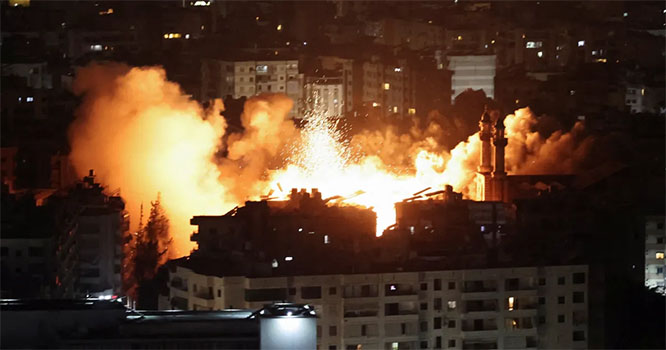
Israel has launched a new act of aggression on a residential neighborhood in Lebanon's capital, Beirut, killing and injuring about two dozen civilians.

The Israeli regime's military said in a statement that its forces carried out a so-called precise strike in a residential apartment in Dahiyeh in the southern suburbs of Beirut on Sunday.

The aggression targeted residential areas, killing at least five people and injuring more than 28 people, Lebanon's Health Ministry said. 

Hezbollah announced the martyrdom of senior Hezbollah commander Haytham Ali Tabatabai and four resistance fighters.

Lebanese President Michel Aoun condemned the airstrike, calling it a clear demonstration of Tel Aviv’s disregard for repeated international calls to halt violations on Lebanese soil.

“Israel refuses to implement international resolutions and all efforts aimed at ending the escalation and restoring stability,” Aoun said, urging the international community to take action to prevent further aggression.

The Palestinian Islamic Jihad movement also condemned the attack, holding the international community accountable. 

“The international community bears responsibility and continues to provide cover for these attacks as long as it does not restrain the occupiers,” said Ali Abu Shahin, a member of the group’s political bureau.

Israeli prime minister Benjamin Netanyahu’s office announced that the Israeli army carried out a strike “in the heart of Beirut."

Netanyahu reportedly approved the operation following recommendations from top Israeli security officials.

Two senior US officials commented on the Israeli strike.

The first official said that Israel did not notify Americans in advance about the attack. "We were informed immediately after the strike was carried out."

The second senior official said that the "US knew for several days that Israel was planning to escalate its strikes in Lebanon, but did not know in advance the timing, location, or target of the strike."

Speaking from the site of the Israeli strike, Lebanese MP Ali Ammar condemned the attack as part of a broader campaign of aggression that has targeted "all of Lebanon since the Washington-sponsored ceasefire."

He stated that "any attack on Lebanon is a violation of red lines; this aggression is part and parcel of the entity that targets Lebanon's dignity, sovereignty, and security of citizens."

Ammar went on to say the resistance is responding with "utmost wisdom, patience, and will confront the enemy at the appropriate time."

"Unfortunately, the enemy is emboldened to commit its aggression by voices within Lebanon that have turned themselves into tools that support its aggression," he added.

The Israeli attack on the southern suburbs of the Lebanese capital is the latest blatant violation of the ceasefire Israel signed with Hezbollah in November 2024, which was intended to end hostilities that had escalated into full-scale war.

An Israeli strike on the Ain al-Hilweh camp near Sidon in southern Lebanon late Tuesday killed at least 14 people. It wounded several others, including young students, according to the Lebanese health ministry.

The military claimed the attack targeted “a Hamas training compound” used to plan and carry out attacks against the regime -- a claim that has frequently been made without evidence.

Hamas rejected the allegations as “a blatant lie aimed at justifying the massacre,” stating it had “no military installations in the Palestinian camps in Lebanon” and that the targeted site was merely “an open sports field.”

According to Lebanese authorities, Israeli attacks have killed approximately 4,000 people and displaced more than 1.2 million residents across the country since October 2023.

Comments

Add new comment

  • Coastaldigest.com reserves the right to delete or block any comments.
  • Coastaldigset.com is not responsible for its readers’ comments.
  • Comments that are abusive, incendiary or irrelevant are strictly prohibited.
  • Please use a genuine email ID and provide your name to avoid reject.