Rajapaksa sworn in as Sri Lanka's President

News Network
November 18, 2019

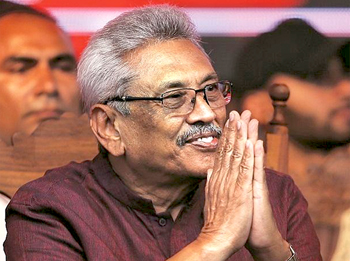
Colombo, Nov 18: Gotabaya Rajapaksa was on Monday sworn in as Sri Lanka's seventh President at an ancient Buddhist temple, a venue chosen to reflect the massive mandate he got from the Sinhalese majority, as he vowed to protect all communities while giving foremost priority to Buddhism.
The swearing-in ceremony took place at the Ruwanweli Seya, a stupa and a hemispherical structure containing relics and considered sacred to Buddhists all over the world, in the ancient north central town of Anuradhapura, around 200 kms from the national capital Colombo.

Rajapaksa is the first president to be sworn in outside Colombo.

Clad in immaculate white, Rajapaksa, 70, signed the official document in the presence of Chief Justice Jayantha Jayasuriya at the auspicious time of 11:49 am after being administered the oath by the president's secretary Udaya R Seneviratne.

In a short speech, he thanked the powerful Buddhist clergy in the country for backing his presidential bid.

He also thanked the Sinhala-majority people for electing him.

“I knew I would win the presidency with support coming only from the Sinhala majority. I told the minorities to join me. I did not receive their support. But I will make sure that I will be president for everyone,” he said.

Rajapaksa said he would protect all communities while giving foremost position to Buddhism.

His selection of the venue, the Ruwanwelisaya stupa and a hemispherical structure containing relics, is one of the eight most prominent Buddhist shrines and in line with the massive mandate he won form the island's Buddhist majority.

The stupa which is considered sacred to Buddhists all over the world was built by King Dutugemunu in the 140 B.C., who reigned over the country after defeating Tamil King Elara.

Rajapaksa was credited for ending the military campaign of the Liberation Tigers of Tamil Eelam (LTTE) who ran a 30-year war to create a separate Tamil homeland in the north and east of the island.

Rajapaksa is the younger brother of the former President Mahinda Rajapaksa who was a special guest at the ceremony.

Later today, he is expected to appoint Mahinda the new prime minister.

He was a colonel in the Sri Lankan Army before leaving it to migrate to the US in 1992. He was until then in the battlefield against the LTTE in the north.

Rajapaksa returned to Sri Lanka when older brother Mahinda was named the presidential candidate in 2005. With his brother's victory he was appointed to the powerful position of Secretary to the Defense Ministry.

His sharp leadership skills and incise decision makings were largely responsible for ending the LTTE's armed campaign. In 2006, he survived an assassination attempt carried out by the LTTE with minor injuries.

Rajapaksa is also the first civil servant to become president, only the first sibling of a president to win presidency, the first president in the history to be inducted in office without even spending a day as a parliamentarian.

Analysts said his large mandate on Saturday with over 1.3 million votes reflected the public confidence in his strong leadership and his ability for precise decision making.


Comments

Add new comment

  • Coastaldigest.com reserves the right to delete or block any comments.
  • Coastaldigset.com is not responsible for its readers’ comments.
  • Comments that are abusive, incendiary or irrelevant are strictly prohibited.
  • Please use a genuine email ID and provide your name to avoid reject.
News Network
December 6,2025

pilot.jpg

New Delhi: IndiGo, India’s largest airline, faced major operational turbulence this week after failing to prepare for new pilot-fatigue regulations issued by the Directorate General of Civil Aviation (DGCA). The stricter rules—designed to improve flight safety—took effect in phases through 2024, with the latest implementation on November 1. IndiGo has acknowledged that inadequate roster planning led to widespread cancellations and delays.

Below are the key DGCA rules that affected IndiGo’s operations:

1. Longer Mandatory Weekly Rest

Weekly rest for pilots has been increased from 36 hours to 48 hours.

The government says the extended break is essential to curb cumulative fatigue. This rule remains in force despite the current crisis.

2. Cap on Night Landings

Pilots can now perform only two night landings per week—a steep reduction from the earlier limit of six.

Night hours, defined as midnight to early morning, are considered the least alert period for pilots.

Given the disruptions, this rule has been temporarily relaxed for IndiGo until February 10.

3. Reduced Maximum Night Flight Duty

Flight duty that stretches into the night is now capped at 10 hours.

This measure has also been kept on hold for IndiGo until February 10 to stabilize operations.

4. Weekly Rest Cannot Be Replaced With Personal Leave

Airlines can no longer count a pilot’s personal leave as part of the mandatory 48-hour rest.

Pilots say this closes a loophole that previously reduced actual rest time.

Currently, all airlines are exempt from this rule to normalise travel.

5. Mandatory Fatigue Monitoring

Airlines must submit quarterly fatigue reports along with corrective actions to DGCA.

This system aims to create a transparent fatigue-tracking framework across the industry.

The DGCA has stressed that these rules were crafted to strengthen flight safety and align India with global fatigue-management standards. The temporary relaxations are expected to remain until February 2025, giving IndiGo time to stabilise its schedules and restore normal air travel.

Comments

Add new comment

  • Coastaldigest.com reserves the right to delete or block any comments.
  • Coastaldigset.com is not responsible for its readers’ comments.
  • Comments that are abusive, incendiary or irrelevant are strictly prohibited.
  • Please use a genuine email ID and provide your name to avoid reject.
News Network
December 1,2025

hindutvaboy.jpg

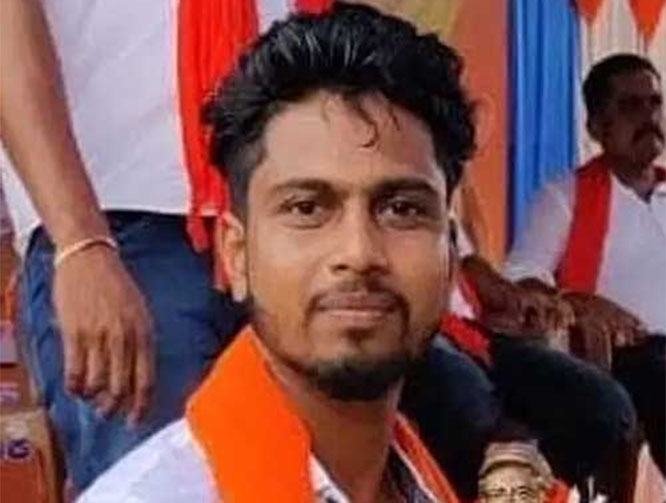
Udupi, Dec 1: A horrific case of alleged rape has unfolded in Udupi, where a worker from a Hindutva organisation, previously arrested and released on bail for harassing a young woman, is now accused of waylaying and sexually assaulting her.

The arrested individual has been identified as Pradeep Poojary (26), a member of the Hindu Jagarana Vedike's Nairkode unit in Perdur.

Poojary had allegedly been relentlessly harassing the young woman, pressuring her to marry him. When she bravely stood up to him and refused his demands, she filed a formal complaint at the Hiriyadka police station. He was subsequently arrested in that initial harassment case but was later granted bail.

According to police reports, driven by the same malicious grudge, Poojary allegedly intercepted the woman again on November 29. While she was walking through a deserted area, the accused is claimed to have threatened her by grabbing her neck. When she again refused to marry him, he allegedly proceeded to rape her.

The survivor immediately informed her family about the traumatic assault. Following this, her parents lodged a complaint at the Udupi women’s police station.

Police arrested Poojary again and produced him before the court. He has since been remanded to judicial custody.

Comments

Add new comment

  • Coastaldigest.com reserves the right to delete or block any comments.
  • Coastaldigset.com is not responsible for its readers’ comments.
  • Comments that are abusive, incendiary or irrelevant are strictly prohibited.
  • Please use a genuine email ID and provide your name to avoid reject.
News Network
December 7,2025

envoy.jpg

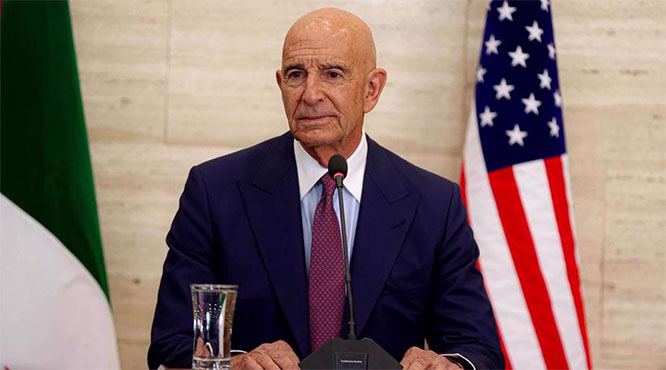
Since 1946, the United States has attempted 93 coups or “regime change” operations across the world — including two in Iran, US Special Envoy for Syria Tom Barrack has admitted.

Speaking to the UAE-based IMI Media Group, in remarks published by The National, Barrack said Washington tried twice to overthrow the Iranian government but failed both times. 

“For (Trump) then to be imputed with regime change — we had two regime changes in Iran already. Neither one worked. So I think wisely leave it to the region to solve,” said Barrack, who also serves as the US ambassador to Turkey.

His comments come six months after the US joined Israel in airstrikes against Iran during ongoing indirect nuclear negotiations between Tehran and Washington.

On June 13, Israel launched an attack on Iran that killed at least 1,064 people and hit civilian infrastructure. Days later, the United States targeted three nuclear facilities — Fordow, Natanz and Isfahan — in what Iran called a clear violation of international law. Iranian retaliation eventually forced a halt to the assault on June 24.

Barrack further claimed that US President Donald Trump and Foreign Secretary Marco Rubio are “not into regime change” and prefer a regional approach driven by Middle Eastern countries themselves. According to him, regional dialogue and non-interference by outside powers offer a more durable path forward.

He added that Washington is still open to an agreement with Tehran if Iranian authorities show “seriousness” and willingness to engage constructively.

However, Iran maintains the US has not shown readiness for meaningful talks. In an interview with Japan’s Kyodo News, Iranian Foreign Minister Abbas Araghchi said negotiations could advance only if Washington acknowledges Iran’s right to peaceful nuclear energy and lifts unilateral sanctions.

Comments

Add new comment

  • Coastaldigest.com reserves the right to delete or block any comments.
  • Coastaldigset.com is not responsible for its readers’ comments.
  • Comments that are abusive, incendiary or irrelevant are strictly prohibited.
  • Please use a genuine email ID and provide your name to avoid reject.