



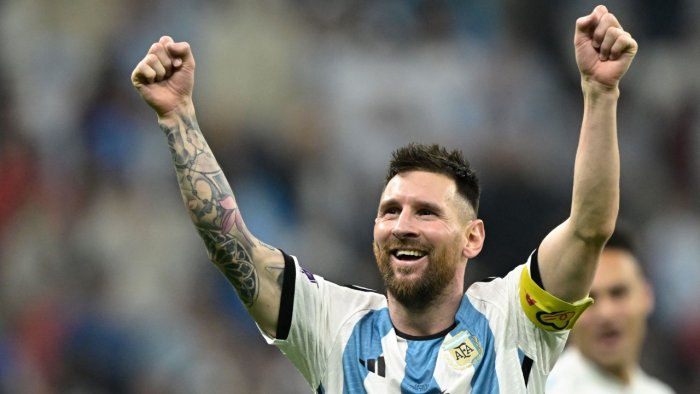
It was the second time that Lionel Messi was starring for the Argentina men’s national soccer team in the province where he grew up — a sort of coming-home party for him, a maestro who had left this corner of the world when he was 13.
But as Argentina played to a 0-0 draw against Colombia in the 2011 match, the stadium reverberated with boos.
“He’s a failure,” one fan said outside the match. “Since he arrived, we haven’t won a thing,” another said. “He should never be compared to Maradona,” said a third, referring to Diego Maradona, the Argentine legend who never faced such jeers by his fellow countrymen.
Few nations are as soccer-obsessed as Argentina, and few humans have ever been as talented with a soccer ball as Messi. Yet the relationship between the two — a man and his homeland — has been deeply complicated.
Messi was born in Argentina but became an adult and a star in Europe. He piled up awards and titles with Barcelona’s renowned club team but for many years struggled to win with Argentina’s national team. And despite his status as perhaps the world’s best player, in Argentina, he has lived and played in the shadow of Maradona, whose brash style endeared him to Argentines, unlike the reserved Messi.
Now, on Sunday, this nation of 47 million will turn its hopes to the boy from Rosario, Argentina, to deliver its first World Cup title in 36 years, in what he has said would be the last attempt of his storied career.
No matter the outcome, after years of criticism that even led to Messi’s brief departure from the national team, the dynamic has changed.
After a scintillating performance at this year’s tournament at age 35 and the emergence of a sharper edge in Messi’s personality on the pitch, Argentina has unequivocally embraced its native son.
“We went all over the world, and people were desperate for Lionel. Here, at our airport, they didn’t even greet him,” said Adrián Coria, Messi’s childhood coach before he moved to Barcelona, Spain, in 2001 to pursue a professional soccer career and later was one of Messi’s coaches on the national team. “But all that has changed remarkably.”
Messi’s face adorns murals up and down the country. At times, it appears that half of the nation is dressed in his No. 10 jersey. And any criticism of the man has given way to praise, adoration and pride.
“Messi has nothing against him,” said Sergio Duri, the owner of a restaurant in Rosario with Messi’s signature on the wall, five blocks from the hospital where Messi was born. “We Argentines see him as perfect.”
Winning, of course, has helped.
Last year, Messi led Argentina to win South America’s premier soccer tournament, the Copa América, its first international title in 28 years. And this year, he has helped put Argentina in the World Cup final Sunday versus France.
But many Argentines in Rosario and beyond this past week insisted that, win or lose, Messi’s status as a national hero has been cemented.
“No matter the results, there’s something that no one can take from you, and that is the fact you resonated with Argentines,” Sofia Martinez, an Argentine sports reporter, told Messi after Argentina’s semifinal victory Tuesday. “Every single one.”
Messi was visibly moved.
“I believe that we Argentines have learned that it’s not just the result, but the road traveled to get there,” he replied.
And his road to Sunday has, at times, been bumpy.
Messi was born in 1987, a year after Argentina’s last World Cup title, in Rosario, the nation’s third-largest city, an agricultural hub about a four-hour drive north of Buenos Aires. He was a child prodigy on the soccer field, yet undersized.
“Everything he does now, he did at the age of 12,” Coria said. “But 40 centimeters shorter and very skinny.”
In 2001, at 13, Messi left Argentina for Barcelona to pursue both training and growth hormone therapy. He has lived in Europe since.
At 17, Messi exploded onto the soccer scene, a dazzling talent that over the next two decades won dozens of European titles with Barcelona and broke various individual records, including seven Ballon d’Or awards for the best men’s soccer player of the year.
But the same success eluded him with Argentina’s national team. With Messi the team’s star player, Argentina’s championship drought got longer, leading to mounting criticism that he was not playing as hard for Argentina as he did for Barcelona.
Fabián Basualdo, a former Argentine national team player and manager of Messi when he was a child in Rosario, said that if he had found himself in Messi’s situation, he might have given up on Argentina.
“In the group of friends,” he said, “we used to say, ‘Don’t come back; stay in Europe.’”
Messi’s national team lost in the World Cup finals in 2014 and then in the Copa América finals in 2015 and 2016. After that, Messi announced that he was done playing for Argentina.
“I’ve done all I can,” he said. “There will be no going back.”
Even though he quickly changed his mind, his brief retirement drew more barbs.
One of the issues that Messi has faced in Argentina is that he is not the first Argentine to be declared the best soccer player in the world — and the first one has been seen as far more Argentine.
Maradona, who led Argentina to the 1986 World Cup title, was outspoken, raw and freewheeling — characteristics that Argentines saw in themselves. Messi, by contrast, is polite, polished and guarded, and some Argentines have struggled to identify with that.
So Messi’s trash talk in Argentina’s quarterfinal match against the Netherlands, when he was filmed telling an opposing player, “What are you looking at, dummy?” has become a moment of national celebration in Argentina.
Newspapers said he was acting more “Maradonian.” Various Argentines interviewed for this article cited it proudly. And a mural leading to Messi’s childhood neighborhood had already added the phrase a week after the game.
“Did you see when he said ‘dummy’ the other day?” said Raul Oliveri, 63, a custodian for the past 25 years at Messi’s childhood soccer club in Rosario, stopping his sweeping outside a field Messi once played on. “That shows you that he’s from here. He never left.”
That is how Messi feels. In an interview last year, he said he still feels a strong connection to his hometown despite spending all his adult life away.
“I don’t know how to explain it. I love being in Rosario, being with my people, meeting friends, family, eating barbecue with them,” he said. “Perhaps having left as a child and not having enjoyed the country and my friends as I would have liked.”
Messi married a woman from Rosario, Antonela Roccuzzo, and they have three children together. The family has multiple residences there, and both Messi and Roccuzzo still visit relatives there every year.
On Thursday, a man who said he was the brother-in-law of one of Messi’s siblings was entering the humble two-story home where Messi grew up.
“He feels he belongs here,” said Sergio Vallejos, 45, from behind mirrored sunglasses. “He’s like one of us. A neighborhood kid.”
He lifted his shirt to show a tattoo more than 1 foot long of Messi down his torso. Then he pulled up a music video from his rock band on his phone. The song was about Rosario’s pride in Messi, using the same line that adorns a massive mural at the entrance to the street: “From another galaxy and from my neighborhood.”
Moments earlier, about two dozen children from low-income neighborhoods in Rosario were brought through on a tour of their city, which mostly consists of Messi landmarks, part of various government programs that celebrate the city’s connection with the global soccer star. The children posed for a photo in front of the home where Messi lived when he was their age and pointed to the sky, like he does after most goals.
“If Messi loses, it doesn’t matter,” said one 9-year-old boy, Alan. “Because at least he got us to the final. And he’s the best.”
Ezequiel Fernández Moores, an Argentine sports journalist since 1978, said that the bond between Messi and his country is now one of love.
“It was a complicated relationship, but Messi’s link with Argentina is no longer complicated,” he said. “And it’s going to hold despite what happens on Sunday. That relationship is here to stay.”


Comments
Add new comment