



Students disrupt movie screening at JNU for spreading hate in the name of Love Jihad

Agencies
April 28, 2018

New Delhi, Apr 28: A film screening at the Jawaharlal Nehru University (JNU) here on the contentious issue of 'love jihad' was disrupted on Saturday by a few students' groups, who alleged that a hate campaign was being propagated in the guise of showing the movie.
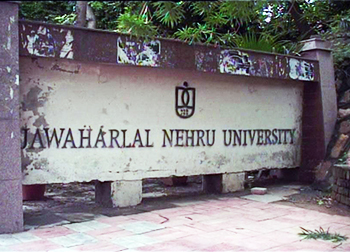
The screening of the film, titled In the name of love - melancholy of God's own country, was organised by the Global Indian Foundation and Vivekanand Vichar Manch of JNU.

Members of the Jawaharlal Nehru Students Union (JNUSU) and Gender Sensitisation Committee Against Sexual Harassment (GSCASH) disrupted the screening, alleging that a hate campaign was being propagated in the guise of the film screening.

According to the organisers of the programme, the film focused on religious conversion of girls in Kerala and the issue of love jihad.

However, the students opposing the screening assembled at Sabarmati dhaba to protest against the "hate propaganda in the name of love jihad".

The students breached the security cordons and disrupted the screening by holding placards in front of the screen.

"Why is the ABVP/RSS hiding behind Vivekanand Vichar Manch? We won't let the RSS's venomous 'Love Jihad' myth be propagated," said a statement issued by the protesters.

"No more Dhanyashree will die because of their hate campaign. No more Hadiya will be imprisoned because of their hate campaign. No girl from Meerut will be forced to suffer because she loved," it said.

Minor scuffles also ensued between the protesters and ABVP members.

Former JNUSU president Geeta Kumari said the movie "spreading communal venom and bigotry" has been screened by the Vivekananda Vichar Mach, a frontal organisation of the ABVP.

"JNU students standing up for gender justice and against politics of hate in the name of Love Jihad protested against such politics. The peaceful demonstrators were showered with eggs and stones to create a situation of chaos," she said. 

"The JNUSU condemns these anti-social elements that have vitiated the university's atmosphere. It is reminiscent of Ramjas College where the ABVP beat up university students," she added.

Meanwhile, the police said they have received complaints from both the sides over the scuffle and were looking into the matter.

"Those who have suffered injuries will be sent for medical examination following which appropriate action will be initiated by us," a senior police officer said.


Comments

Add new comment

  • Coastaldigest.com reserves the right to delete or block any comments.
  • Coastaldigset.com is not responsible for its readers’ comments.
  • Comments that are abusive, incendiary or irrelevant are strictly prohibited.
  • Please use a genuine email ID and provide your name to avoid reject.
News Network
December 6,2025

pilot.jpg

New Delhi: IndiGo, India’s largest airline, faced major operational turbulence this week after failing to prepare for new pilot-fatigue regulations issued by the Directorate General of Civil Aviation (DGCA). The stricter rules—designed to improve flight safety—took effect in phases through 2024, with the latest implementation on November 1. IndiGo has acknowledged that inadequate roster planning led to widespread cancellations and delays.

Below are the key DGCA rules that affected IndiGo’s operations:

1. Longer Mandatory Weekly Rest

Weekly rest for pilots has been increased from 36 hours to 48 hours.

The government says the extended break is essential to curb cumulative fatigue. This rule remains in force despite the current crisis.

2. Cap on Night Landings

Pilots can now perform only two night landings per week—a steep reduction from the earlier limit of six.

Night hours, defined as midnight to early morning, are considered the least alert period for pilots.

Given the disruptions, this rule has been temporarily relaxed for IndiGo until February 10.

3. Reduced Maximum Night Flight Duty

Flight duty that stretches into the night is now capped at 10 hours.

This measure has also been kept on hold for IndiGo until February 10 to stabilize operations.

4. Weekly Rest Cannot Be Replaced With Personal Leave

Airlines can no longer count a pilot’s personal leave as part of the mandatory 48-hour rest.

Pilots say this closes a loophole that previously reduced actual rest time.

Currently, all airlines are exempt from this rule to normalise travel.

5. Mandatory Fatigue Monitoring

Airlines must submit quarterly fatigue reports along with corrective actions to DGCA.

This system aims to create a transparent fatigue-tracking framework across the industry.

The DGCA has stressed that these rules were crafted to strengthen flight safety and align India with global fatigue-management standards. The temporary relaxations are expected to remain until February 2025, giving IndiGo time to stabilise its schedules and restore normal air travel.

Comments

Add new comment

  • Coastaldigest.com reserves the right to delete or block any comments.
  • Coastaldigset.com is not responsible for its readers’ comments.
  • Comments that are abusive, incendiary or irrelevant are strictly prohibited.
  • Please use a genuine email ID and provide your name to avoid reject.