



Supreme Court to hear Centre's plea after violent Dalit protests

News Network
April 3, 2018

New Delhi, Apr 3: The Supreme Court on Tuesday said that it will hear the Centre's plea for the recall of its judgement holding that arrest on a complaint under the SC/ST (Prevention of Atrocities) Act was not mandatory.

Directing the listing of the matter at 2pm, before a bench of Justice Adarsh Kumar Goel and Justice Uday Umesh Lalit, Chief Justice Dipak Misra said the hearing will be in open court.

Lok Sabha adjourned till noon

The Lok Sabha was disrupted once again today amid protests, with Speaker Sumitra Mahajan adjourning the House till noon within minutes of meeting.

As soon as the House met, AIADMK members started protesting near the Speaker's podium, demanding the setting up of the Cauvery Management Board.

Members of opposition parties were seen standing on their seats.

Speaker Mahajan tried to run the Question Hour, but as protests continued, she adjourned the House.

9 dead, thousands arrested as protests turn violent

Nine persons were killed and dozens injured as Dalit protests during a day-long nation-wide shutdown on Monday turned violent in India amid anger against a Supreme Court order that dilutes a law aimed at preventing atrocities against Dalits and Tribes.

The government, in a bid to pacify the agitated activists, said it had filed a petition in the apex court seeking a review of its March 20 order that bars automatic arrest and registration of cases for alleged harassment of Dalits and others. But the top court denied an urgent hearing of the matter.

Protesters clashed with police in Gujarat, Madhya Pradesh, Rajasthan, Punjab, Uttar Pradesh, Uttarakhand, Jharkhand, Bihar and Odisha -- states where normal life was paralysed in varying degrees amid incidences of violence and arson.

The central government rushed 800 anti-riot policemen to violence-hit Uttar Pradesh and Madhya Pradesh.

A Home Ministry official in Delhi said two companies of Rapid Action Force (RAF) were sent to Meerut and one company each to Agra and Hapur in Uttar Pradesh.

Clashes turned deadly in Madhya Pradesh where six persons were killed and dozens injured, forcing officials to impose curfew in Morena, Gwalior and Bhind districts. Protests were also held Bhopal as agitators blocked roads in the state capital.

Madhya Pradesh Chief Minister Shivraj Singh Chouhan made a passionate appeal for peace.

 Police said two were killed in Bhind and one in Morena while three died in Gwalior. The dead in Morena was identified as Rahul Pathak, a student leader.

Gwalior District Magistrate Rahul Jain said that at least 65 persons have been injured in violence, including policemen, and the condition of a few injured is said to be serious.

"Three people have been conformed dead in Gwalior," he said.

A man identified as Pawan Kumar was killed in Rajasthan's Alwar as violence was also reported from other parts of the state including Jaipur, Ajmer. Jaisalmer, Barmer, Jodhpur and Udaipur.

Punjab and Haryana also saw widespread protests.

Shops, educational institutions and other establishments remained closed and Class 10 and 12 examinations were deferred in Punjab, which has the highest concentration of Scheduled Castes, constituting nearly 32 per cent its 2.8 crore population.

Hundreds of protesters carrying swords, sticks, baseball bats and flags forced shopkeepers and other establishments in Jalandhar, Amritsar and Bathinda too shut down.

Protests also took place in Rohtak and other towns of neighbouring Haryana.

In Bihar, activists disrupted rail and road traffic. Mobs shut down markets and shops as well as educational institutions, police said.

Supporters of the Bhim Army and other Dalit outfits halted over three dozen long-distance and local trains, stranding thousands of passengers.

Violence was reported from Vaishali, Muzaffarpur, Nawada, Patna and Bhagalpur when protestors clashed with police.

One person was killed and over 100 were injured as violence also erupted in parts of Uttar Pradesh as protesters attacked shops, looted some and pelted stones at police in Hapur, Agra, Meerut, Saharanpur and Prime Minister Narendra Modi's Lok Sabha constituency Varanasi.

Maximum violence in the state was reported from western Uttar Pradesh, where the protesters took to the streets and went on rampage. Two persons were critically injured in police firing in Muzaffaranagar, one of whom later succumbed.

More than 450 people, including a former Bahujan Samaj Party (BSP) legislator, have been arrested.

Many cars were targeted and their window panes smashed. At some places, government property was targeted.

Some people reportedly fired at a police team in Meerut while a passenger bus was set on fire.

Also in Meerut, over 500 Dalit youths targeted the media and broke their cameras as they were trying to photograph the protests.

 Gujarat's major towns and cities also saw protests by Dalits amid reports of vandalism from Ahmedabad and Jamnagar.

Amid widespread anger and violence, the Modi government filed a review petition in the Supreme Court to seek recall of its judgment that ruled that there would be no automatic arrest of an accused following a complaint moved under the Scheduled Castes and Scheduled Tribes (Prevention of Atrocities) Act, 1989.

The Supreme Court had held on March 20 that police will hold an inquiry to ascertain the veracity of the complaint filed under the act before acting on it.

Union Law Minister Ravi Shankar Prasad said the government "with due respect, does not agree with the reasoning given by the apex court".

Comments

Add new comment

  • Coastaldigest.com reserves the right to delete or block any comments.
  • Coastaldigset.com is not responsible for its readers’ comments.
  • Comments that are abusive, incendiary or irrelevant are strictly prohibited.
  • Please use a genuine email ID and provide your name to avoid reject.
News Network
December 3,2025

arrival.jpg

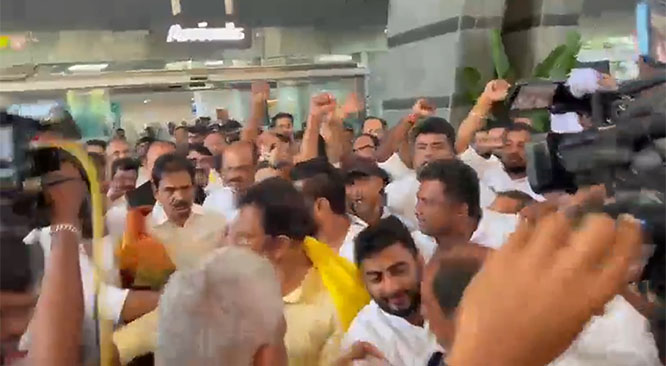
Mangaluru, Dec 3: A group of Congress workers gathered at the Mangaluru International Airport on Wednesday to welcome AICC general secretary K C Venugopal, but the reception quickly turned into a display of support for Deputy Chief Minister D K Shivakumar.

Venugopal arrived in the city to participate in the centenary commemoration of the historic dialogue between Mahatma Gandhi and Narayana Guru. The event, organised by the Sivagiri Mutt, Varkala, in association with the Mangalore University Sri Narayana Guru Study Chair, is being held on the university’s Konaje campus.

KPCC general secretary Mithun Rai and several party workers had assembled at the airport to receive Venugopal. However, the moment he stepped out, workers began raising slogans backing Shivakumar.

The university programme will be inaugurated by Chief Minister Siddaramaiah.

This show of support comes just a day after Siddaramaiah remarked that Shivakumar would lead the government “when the high command decides.” The chief minister made the comment after a breakfast meeting at Shivakumar’s residence—another public display of camaraderie between the two leaders amid ongoing attempts by the party high command to downplay their leadership rivalry.

Comments

Add new comment

  • Coastaldigest.com reserves the right to delete or block any comments.
  • Coastaldigset.com is not responsible for its readers’ comments.
  • Comments that are abusive, incendiary or irrelevant are strictly prohibited.
  • Please use a genuine email ID and provide your name to avoid reject.
News Network
November 26,2025

Mangaluru, Nov 26: Assembly Speaker and local MLA U.T. Khader has initiated a high-level push to resolve one of Mangaluru’s longest-standing traffic headaches: the narrow, high-density stretch of National Highway-66 between Nanthoor and Talapady.

He announced on Tuesday that a formal proposal has been submitted to the Union Ministry of Road Transport and Highways (MoRTH) seeking approval to prepare a Detailed Project Report (DPR) for the widening of this crucial corridor.

The plan specifically aims to expand the existing 45-meter road width to a full 60 meters, coupled with the construction of dedicated service roads. Khader highlighted that land for a 60-meter highway was originally acquired during the initial four-laning project, but only 45 meters were developed, leading to a perpetual bottleneck.

"With vehicle density rising sharply, the expansion has become unavoidable," Khader stated, stressing that the upgrade is essential for ensuring smoother traffic flow and improving safety at the city's main entry and exit points.

The stretch between Nanthoor and Talapady is a vital link on the busy Kochi-Panvel coastal highway and connects to major city junctions. The move to utilize the previously acquired land for the full 60-meter width is seen as a necessary measure to catch up with the region's rapid vehicular growth and prevent further traffic gridlocks.

Comments

Add new comment

  • Coastaldigest.com reserves the right to delete or block any comments.
  • Coastaldigset.com is not responsible for its readers’ comments.
  • Comments that are abusive, incendiary or irrelevant are strictly prohibited.
  • Please use a genuine email ID and provide your name to avoid reject.
News Network
December 6,2025

pilot.jpg

New Delhi: IndiGo, India’s largest airline, faced major operational turbulence this week after failing to prepare for new pilot-fatigue regulations issued by the Directorate General of Civil Aviation (DGCA). The stricter rules—designed to improve flight safety—took effect in phases through 2024, with the latest implementation on November 1. IndiGo has acknowledged that inadequate roster planning led to widespread cancellations and delays.

Below are the key DGCA rules that affected IndiGo’s operations:

1. Longer Mandatory Weekly Rest

Weekly rest for pilots has been increased from 36 hours to 48 hours.

The government says the extended break is essential to curb cumulative fatigue. This rule remains in force despite the current crisis.

2. Cap on Night Landings

Pilots can now perform only two night landings per week—a steep reduction from the earlier limit of six.

Night hours, defined as midnight to early morning, are considered the least alert period for pilots.

Given the disruptions, this rule has been temporarily relaxed for IndiGo until February 10.

3. Reduced Maximum Night Flight Duty

Flight duty that stretches into the night is now capped at 10 hours.

This measure has also been kept on hold for IndiGo until February 10 to stabilize operations.

4. Weekly Rest Cannot Be Replaced With Personal Leave

Airlines can no longer count a pilot’s personal leave as part of the mandatory 48-hour rest.

Pilots say this closes a loophole that previously reduced actual rest time.

Currently, all airlines are exempt from this rule to normalise travel.

5. Mandatory Fatigue Monitoring

Airlines must submit quarterly fatigue reports along with corrective actions to DGCA.

This system aims to create a transparent fatigue-tracking framework across the industry.

The DGCA has stressed that these rules were crafted to strengthen flight safety and align India with global fatigue-management standards. The temporary relaxations are expected to remain until February 2025, giving IndiGo time to stabilise its schedules and restore normal air travel.

Comments

Add new comment

  • Coastaldigest.com reserves the right to delete or block any comments.
  • Coastaldigset.com is not responsible for its readers’ comments.
  • Comments that are abusive, incendiary or irrelevant are strictly prohibited.
  • Please use a genuine email ID and provide your name to avoid reject.
