



These ‘activists’ oppose death penalty for rape of minors

Agencies
April 21, 2018

New Delhi, Apr 21: Even as a number of leaders have advocated the death penalty for rape of girls aged below 12, child rights activists across the country have come out against the government's decision to amend the Protection of Children from Sexual Offences (POCSO) Act for this purpose.

The Union Cabinet on Saturday approved an ordinance to allow courts to award death penalty to those convicted of raping children up to 12 years of age.

The criminal law amendment ordinance seeks to amend the Indian Penal Code (IPC), the Evidence Act, the Code of Criminal Procedure (CrPC), and the Protection of Children from Sexual Offences (POCSO) Act to introduce a new provision to sentence convicts of such crimes punishment of death.

"In a country where there is no certainty of conviction, this government wants to bring in more stringent laws. In a country where most rapes are perpetrated by family members, invoking death penalty will only increase the chances of acquittal.

"Most of the cases will not be reported. There is a reason why the death penalty for child rape exists in only about 13 countries or so, most of them Islamic," said Bharti Ali of HAQ centre for child rights.

According to the data of the National Crime Records Bureau, 95 percent of the rapes are committed by family members. The conviction rate in cases of rapes of women is around 24 percent. It is 20 percent under the POCSO Act.

"I believe that the only deterrent in rape cases is a conviction in not more than 90 days. Worldwide we have seen that more than strict punishment, it is speedy justice that works as a deterrent.

"I fear that with the death penalty, most people will not report child rapes, as in most cases the accused are family members. The conviction rate will come down further," Vinod Tikoo, a former member of the National Commission for Protection of Child Rights, said.

According to a recent study by Kailash Satyarthi Children’s Foundation, it would take the courts two decades to clear the backlog of cases related to child sex abuse.

Activists say the government should focus more on strengthening the existing laws, ensuring the safety of victims and witnesses, speedy trials, and awareness generation.

"We already have the death penalty for several offences and that has not led to any deterrence. If we are looking to create a deterrent, then we have to create it where it works.

"Creating a supportive and enabling environment for the victim to report the crime on their terms, effective and meaningful victim and witness protection, sensitive criminal justice system - including courts, legal aid and police, rehabilitation and ensuring certainty of conviction of the accused are among the areas which will generate deterrence," said Ananth Kumar Asthana, advocate and child rights activist.

The government's move to amend the law to award the death penalty for rape of girls aged below 12 comes amid a nationwide furore over the brutal rape of an eight-year-old girl in Jammu and Kashmir's Kathua district, the alleged rape of a minor in UP's Unnao by a BJP MLA, and other incidents of sexual violence reported from different parts of the country recently.

Union minister of Women and Children Development Maneka Gandhi had a few days ago asked her department to work on a proposal to amend the POCSO Act to bring in the provision of the death penalty for the rape of a minor below the age of 12 years.

Delhi Commission for Women chief Swati Maliwal has been on a hunger strike at Samta Sthal here demanding death penalty for rapists.

Countries which have the provision of the death penalty for raping minors include China, Qatar, Sudan, UAE, Tajikistan, Tunisia, Bangladesh, Kuwait.

Comments

Add new comment

  • Coastaldigest.com reserves the right to delete or block any comments.
  • Coastaldigset.com is not responsible for its readers’ comments.
  • Comments that are abusive, incendiary or irrelevant are strictly prohibited.
  • Please use a genuine email ID and provide your name to avoid reject.
News Network
December 13,2025

New Delhi: School-going children are picking up drug and smoking habits and engaging in consumption of alcohol, with the average age of introduction to such harmful substances found to be around 13 years, suggesting a need for earlier interventions as early as primary school, a multi-city survey by AIIMS-Delhi said.

The findings also showed substance use increased in higher grades, with grade XI/XII students two times more likely to report use of substances when compared with grade VIII students. This emphasised the importance of continued prevention and intervention through middle and high school.

The study led by Dr Anju Dhawan of AIIMS's National Drug Dependence Treatment Centre, published in the National Medical Journal of India this month, looks at adolescent substance use across diverse regions.

The survey included 5,920 students from classes 8, 9, 11 and 12 in urban government, private and rural schools across 10 cities -- Bengaluru, Chandigarh, Delhi, Dibrugarh, Hyderabad, Imphal, Jammu, Lucknow, Mumbai, and Ranchi. The data were collected between May 2018 and June 2019.

The average age of initiation for any substance was 12.9 (2.8) years. It was lowest for inhalants (11.3 years) followed by heroin (12.3 years) and opioid pharmaceuticals (without prescription; 12.5 years).

Overall, 15.1 per cent of participants reported lifetime use, 10.3 per cent reported past year use, and 7.2 per cent reported use in the past month of any substance, the study found.

The most common substances used in the past year, after tobacco (4 per cent) and alcohol (3.8 per cent), were opioids (2.8 per cent), followed by cannabis (2 per cent) and inhalants (1.9 per cent). Use of non-prescribed pharmaceutical opioids was most common among opioid users (90.2 per cent).

On being asked, 'Do you think this substance is easily available for a person of your age' separately for each substance category, nearly half the students (46.3 per cent) endorsed that tobacco products and more than one-third of the students (36.5 per cent) agreed that a person of their age can easily procure alcohol products.

Similarly, for Bhang (21.9 per cent), ganja/charas (16.1 per cent), inhalants (15.2 per cent), sedatives (13.7 per cent), opium and heroin (10 per cent each), the students endorsed that these can be easily procured.

About 95 per cent of the children, irrespective of their grade, agreed with the statement that 'drug use is harmful'.

The rates of substance use (any) among boys were significantly higher than those of girls for substance use (ever), use in the past year and use in the past 30 days. Compared to grade VIII students, grade IX students were more likely, and grade XI/XII students were twice as likely to have used any substance (ever).

The likelihood of past-year use of any substance was also higher for grade IX students and for grade XI/XII students as compared to grade VIII students.

About 40 per cent of students mentioned that they had a family member who used tobacco or alcohol each. The use of cannabis (any product) and opioid (any product) by a family member was reported by 8.2 per cent and 3.9 per cent of students, respectively, while the use of other substances, such as inhalants/sedatives by family was 2-3 per cent, the study found.

A relatively smaller percentage of students reported use of tobacco or alcohol among peers as compared to among family members, while a higher percentage reported inhalants, sedatives, cannabis or opioid use among peers.

Children using substances (past year) compared to non-users reported significantly higher any substance use by their family members and peers.

There were 25.7 per cent students who replied 'yes' to the question 'conflicts/fights often occur in your family'. Most students also replied affirmatively to 'family members are aware of how their time is being spent' and 'damily members are aware of with whom they spend their time'.

Comments

Add new comment

  • Coastaldigest.com reserves the right to delete or block any comments.
  • Coastaldigset.com is not responsible for its readers’ comments.
  • Comments that are abusive, incendiary or irrelevant are strictly prohibited.
  • Please use a genuine email ID and provide your name to avoid reject.
News Network
December 15,2025

Mangaluru, Dec 15: Educational institutions in Mangaluru that rely on the popular Mangala Stadium for their annual sports events are bracing for an inconvenience as the city's key sporting venue is set to close its gates for a significant upgrade. The stadium is expected to be unavailable for approximately two months starting from January 15, 2026.

The closure is necessitated by a proposed overhaul of the stadium's facilities, with a special focus on upgrading the synthetic track. Pradeep Dsouza, Assistant Director of the District of Youth Empowerment and Sports (DYES), Dakshina Kannada, confirmed the development.

"Experts have visited the stadium, conducted a thorough inspection, and have given the go-ahead for a complete makeover," Dsouza stated. "Funds have been allocated for the project, and we are currently awaiting the final green signal from state officials to commence the work. We anticipate that the work will likely begin in the second week of January. Consequently, we have stopped renting out the stadium to colleges and other organizations in preparation for the upgrade."

The timing presents a logistical challenge for colleges, as many schools have already concluded their sports meets.

"Colleges will now be organizing their events and will need to find alternative locations to host their sports meets," Dsouza added. He suggested a few potential venues, including the Dakshina Kannada police ground, University College grounds, Panambur grounds, Swaraj Maidan in Moodbidri, and the Mangalore University sports grounds in Konaje.

However, many institutions note that finding a comparable venue will be difficult. While the DK police ground and University College grounds are closer to the city center, they do not possess the extensive facilities and infrastructure offered by Mangala Stadium.

Dr. P Dayananda Pai - P Satisha Govt First Grade College, Carstreet, is one such institution dependent on the stadium. Principal Jayakar Bhandary expressed hope for a swift completion of the work. "We expect the work to be completed at the earliest. If not, we will be forced to look for other venues to host the sports day for our students," Bhandary said, highlighting the pressing need for the city's main sporting facility.

Comments

Add new comment

  • Coastaldigest.com reserves the right to delete or block any comments.
  • Coastaldigset.com is not responsible for its readers’ comments.
  • Comments that are abusive, incendiary or irrelevant are strictly prohibited.
  • Please use a genuine email ID and provide your name to avoid reject.
News Network
December 7,2025

envoy.jpg

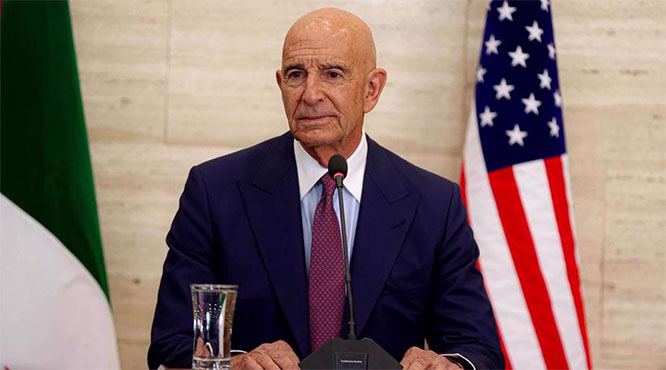
Since 1946, the United States has attempted 93 coups or “regime change” operations across the world — including two in Iran, US Special Envoy for Syria Tom Barrack has admitted.

Speaking to the UAE-based IMI Media Group, in remarks published by The National, Barrack said Washington tried twice to overthrow the Iranian government but failed both times. 

“For (Trump) then to be imputed with regime change — we had two regime changes in Iran already. Neither one worked. So I think wisely leave it to the region to solve,” said Barrack, who also serves as the US ambassador to Turkey.

His comments come six months after the US joined Israel in airstrikes against Iran during ongoing indirect nuclear negotiations between Tehran and Washington.

On June 13, Israel launched an attack on Iran that killed at least 1,064 people and hit civilian infrastructure. Days later, the United States targeted three nuclear facilities — Fordow, Natanz and Isfahan — in what Iran called a clear violation of international law. Iranian retaliation eventually forced a halt to the assault on June 24.

Barrack further claimed that US President Donald Trump and Foreign Secretary Marco Rubio are “not into regime change” and prefer a regional approach driven by Middle Eastern countries themselves. According to him, regional dialogue and non-interference by outside powers offer a more durable path forward.

He added that Washington is still open to an agreement with Tehran if Iranian authorities show “seriousness” and willingness to engage constructively.

However, Iran maintains the US has not shown readiness for meaningful talks. In an interview with Japan’s Kyodo News, Iranian Foreign Minister Abbas Araghchi said negotiations could advance only if Washington acknowledges Iran’s right to peaceful nuclear energy and lifts unilateral sanctions.

Comments

Add new comment

  • Coastaldigest.com reserves the right to delete or block any comments.
  • Coastaldigset.com is not responsible for its readers’ comments.
  • Comments that are abusive, incendiary or irrelevant are strictly prohibited.
  • Please use a genuine email ID and provide your name to avoid reject.