


Choosing My Religion: ‘Freedom of Religion Laws’ to Curb Liberty

Ram Puniyani
December 27, 2020

Indian Constitution gives us the right to practice, preach and propagate our religion. To not to follow any religion is also a matter of right for the individual. Now in our country as we are facing declining GDP, worsening economic situation, rising prices-unemployment-farmers suicides and currently farmer’s agitation, some of our state Governments are more worried about the interfaith marriages and conversions. Some of them are busy putting forth the laws to prevent conversions. As such conversions have been nagging issue since last few decades but currently they are being attributed as the goal behind inter faith marriages. BJP ruled states and particularly UP, are busy formulating the laws to punish those who are involved in the process of conversions. Parallel to the efforts of state Governments, the vigilante groups are having a gala time harassing couples to ‘save their religion’!

Conversion, mainly away from Hinduism, is yet again coming to fore. The UP Government is planning an ordinance against organizations which are involved in conversion process. As per this organizations will lose their registration and face dire consequences. The ordinance demands a two-month notice to be given to the local administration. The local administration will have the power to decide whether your intended act is legal or not. And of course the burden of proof will be on the converts and the persons converting them. There is a special; mention of SC/ST and women. Many states are now vying to bring in anti ‘Love jihad’ and anti-conversion laws. There are many individual cases where couples and their relatives are being tormented by groups in the name of conversion and love jihad. Many of the laws being framed by the states are mostly against many provisions of Indian constitution.

During freedom movement, Arya Samaj had started Shuddhi movement to bring back those who had embraced other religions. Similarly Tablighi Jamat was active with the parallel campaign of Tanzim to convert people into Islam. The biggest conversion of twentieth Century was of course the one undertaken by Bhimrao Ambedkar. This conversion as such tells us the real cause of the conversions into other religions. Ambedkar, a dalit, got the highest of degrees and on return he had to face the ignominy of being and untouchable. In his struggles for social justice and for dignified life his, his major conclusions were that Hindus cannot be a nation due to the caste hierarchy. Hinduism is dominated by Brahmanical values. This is what made him declare that ‘I was born a Hindu that was not in my hands but I will not die a Hindu’.

His exploration led him to Buddhism, which formed that basis of his decision to embrace Buddhism along with over three lakh followers. Law Professor Sameena Dalwai, in her article draws our attention to the fact that had the present type of laws would have been there, Ambedkar might be behind the bars by now. The architect of Indian Constitution was for Liberty. Liberty does include right to our choice to follow any faith of our liking, or to be an agnostic or atheist as well.

While many people have not been exercising their right to choose their religion, many have done so in the past. That’s how Islam, Christianity, Sikhism and Buddhism spread in India. Buddhism did face a painful trajectory as it was attacked by elite intolerant traditions within Hinduism, which are totally against the concept of equality as propounded by Buddhism. Birth based inequality is peculiar feature of some sects prevailing here, with the sanction of Holy Scriptures. As a practice it is also part of other religions to some extent.

While today so many obstacles are being erected for the odd one opting to change one’s religion, history has seen streams of conversions, minor and major, to Islam and Christianity. Indian history has seen conversions mainly due to two factors. One is the tyranny of caste oppression. Swami Vivekananda tells us, “and The Mohammedan conquest of India came as a salvation of the downtrodden, to the poor. That is why one fifth of our people have become Mohammedans. It was not the sword that did it all. It would be the height of madness to think that it was all the work of sword and fire. It was to gain their liberty from the… zaminders and from the Priest, and as a consequence you find in Bengal there are more Mohammedans than Hindus amongst cultivators, because there were so many zaminders there.” (Selected Works of Swami Vivekanand, Vol.3, 12th edition, 1979.p.294.Extracted from the sayings of Swami Vivekananda compiled in `Proletariat! Win Equal Rights’ Advaita Ashram, Calcutta, 1984 p.16.).  

Many a conversions did take place also due to the social interaction and spiritual quest also. Some victor Kings also put humiliating condition of acceptance of their religion by the defeated kings. In India it was mainly the interaction with Sufi saints that many took to Islam. One interesting example is that of Dileep Kumar becoming A. R. Rahman, under the influence of a Sufi saint.

The second phenomenon is that of Christian missionaries. They have been working on issues of health and education in remote areas also. A couple of decades ago Pastor Stains was done to death on pretext of conversion (1999) and in 2008 anti Christian violence has been orchestrated in places like Kandhamal in particular. The extent of this conversion is not very huge if we see that despite centuries of work, the Christian population in India as per the census of 2011 is 2.3%. (First Church was set up by St. Thomas in AD 52).

Political phenomena of ‘reconversion to Hinduism’ are not far behind as witnessed in Agra, where the pavement dwellers were promised the BPL card and ration card. They were lured to come to a puja and declared that now they are Hindus. Ghar Wapsi by giving bath in hot springs in Adivasi areas is very much there. This is a political move to bring these sections into the fold of caste hierarchy, yet again.

Comments

Add new comment

  • Coastaldigest.com reserves the right to delete or block any comments.
  • Coastaldigset.com is not responsible for its readers’ comments.
  • Comments that are abusive, incendiary or irrelevant are strictly prohibited.
  • Please use a genuine email ID and provide your name to avoid reject.
News Network
December 3,2025

indigo.jpg

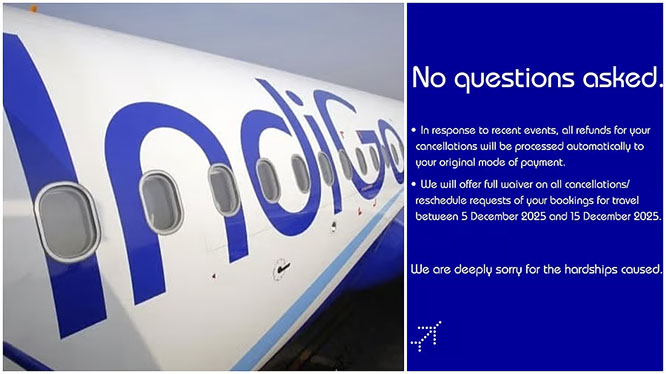
IndiGo, India’s largest airline, is battling one of its worst operational disruptions in recent years, with hundreds of delays and cancellations throwing domestic travel into chaos.

Government data on Tuesday showed its on-time performance plunging to 35%, an unusual dip for a carrier long associated with punctuality.

By Wednesday afternoon, airports in Delhi, Mumbai, Bengaluru and Hyderabad had collectively reported close to 200 cancellations, stranding travellers across the country.

Crew Shortage After New Duty Norms

A major trigger behind the meltdown is a severe crew shortage, especially among pilots, following the rollout of revised Flight Duty Time Limitation (FDTL) norms last month.

The rules mandate longer rest hours and more humane rosters — a shift IndiGo has struggled to incorporate across its vast network.

Sources said several flights were grounded due to lack of cabin crew, while some delays stretched upwards of eight hours.

With IndiGo controlling over 60% of India’s domestic aviation market, the ripple effect has impacted airports nationwide.

IndiGo Issues Apology, Lists “Compounding Factors”

In a statement, IndiGo acknowledged the large-scale disruption:

“We sincerely apologise to customers. A series of unforeseen operational challenges — technology glitches, winter schedule changes, adverse weather, system congestion and updated FDTL norms — created a compounding impact that could not have been anticipated.”

To stabilise operations, the airline has begun calibrated schedule adjustments for the next 48 hours, aiming to restore punctuality. Affected passengers are being offered refunds or alternate travel arrangements, IndiGo said.

What the FDTL Rules Require

The FDTL norms, designed to reduce pilot fatigue, cap duty and flying hours as follows:
•    Maximum 8 hours of flying per day
•    35 hours per week
•    125 hours per month
•    1,000 hours per year

Crew must also receive rest equalling twice the flight duration, with a minimum 10-hour rest period in any 24-hour window.

The DGCA introduced these limits to enhance flight safety.

Hyderabad: 33 Flights Cancelled, Long Queues Reported

Hyderabad’s Rajiv Gandhi International Airport saw heavy early-morning crowds as 33 IndiGo flights (arrivals and departures) were cancelled.

The airport clarified on X that operations were normal, advising passengers to contact IndiGo directly for latest flight status.

Cancellations included flights to and from Visakhapatnam, Goa, Ahmedabad, Delhi, Bengaluru, Chennai, Madurai, Hubli, Bhopal and Bhubaneswar.

Bengaluru: 42 Flights Disrupted

Bengaluru’s Kempegowda International Airport recorded 42 cancellations — 22 arrivals and 20 departures — affecting routes to Delhi, Mumbai, Chennai, Hyderabad, Goa, Kolkata and Lucknow.

Passengers Vent on Social Media

Irate travellers took to X to share their experiences. One passenger stranded in Hyderabad wrote: “I have been here since 3 a.m. and missed an important meeting.”

Another said: “My flight was pushed from 1:55 PM to 2:55 PM and now 4:35 PM. I was informed only three minutes before entering the airport.”

Delhi Airport Hit by Tech Glitch

At Delhi Airport, the disruption deepened due to a slowdown in the Amadeus system — used for reservations, check-ins and departure control.

The technical issue led to longer queues and sluggish processing, adding to delays already worsened by staff shortages.

Comments

Add new comment

  • Coastaldigest.com reserves the right to delete or block any comments.
  • Coastaldigset.com is not responsible for its readers’ comments.
  • Comments that are abusive, incendiary or irrelevant are strictly prohibited.
  • Please use a genuine email ID and provide your name to avoid reject.
Agencies
November 22,2025

indiapak.jpg

New York/Washington: US President Donald Trump has again claimed to have solved the conflict between India and Pakistan, repeating his assertion during a meeting with New York City Mayor-elect Zohran Mamdani in the Oval Office.

Mamdani flew to Washington DC for his first meeting with Trump in the White House on Friday. Trump said he “enjoyed” the meeting, which he described as “great.”

During remarks in the Oval Office, with Mamdani standing next to him, Trump repeated his claim that he solved the May conflict between India and Pakistan.

"I did eight peace deals of countries, including India and Pakistan,” he said.

On Wednesday, Trump had said he threatened to put 350 per cent tariffs on India and Pakistan if they did not end their conflict, repeating his claim that he solved the fighting between the nuclear-armed neighbours and that Prime Minister Narendra Modi had called him to say “we're not going to go to war.”

Since May 10, when Trump announced on social media that India and Pakistan had agreed to a “full and immediate” ceasefire after a “long night” of talks mediated by Washington, he has repeated his claim over 60 times that he “helped settle” the tensions between India and Pakistan.

India has consistently denied any third-party intervention. India launched Operation Sindoor on May 7, targeting terror infrastructure in Pakistan and Pakistan-occupied Kashmir in retaliation for the April 22 Pahalgam attack that killed 26 civilians. India and Pakistan reached an understanding on May 10 to end the conflict after four days of intense cross-border drone and missile strikes.

Mamdani emerged victorious in the closely-watched battle for New York City Mayor, becoming the first South Asian and Muslim to be elected to sit at the helm of the largest city in the US.

He had been the front-runner in the NYC Mayoral election for months and defeated Republican nominee Curtis Sliwa and political heavyweight former New York State Governor Andrew Cuomo, who ran as an independent candidate and was officially endorsed by Trump just hours before the elections.

Indian-descent Mamdani is the son of renowned filmmaker Mira Nair and Columbia University professor Mahmood Mamdani. He was born and raised in Kampala, Uganda and moved to New York City with his family when he was 7. Mamdani became a naturalised US citizen only recently, in 2018.

Comments

Add new comment

  • Coastaldigest.com reserves the right to delete or block any comments.
  • Coastaldigset.com is not responsible for its readers’ comments.
  • Comments that are abusive, incendiary or irrelevant are strictly prohibited.
  • Please use a genuine email ID and provide your name to avoid reject.
News Network
December 4,2025

Mangaluru: Chaos erupted at Mangaluru International Airport (MIA) after IndiGo flight 6E 5150, bound for Mumbai, was repeatedly delayed and ultimately cancelled, leaving around 100 passengers stranded overnight. The incident highlights the ongoing country-wide operational disruptions affecting the airline, largely due to the implementation of new Flight Duty Time Limitations (FDTL) norms for crew.

The flight was initially scheduled for 9:25 PM on Tuesday but was first postponed to 11:40 PM, then midnight, before being cancelled around 3:00 AM. Passengers expressed frustration over last-minute communication and the lack of clarity, with elderly and ailing travellers particularly affected. “Though the airline arranged food, there was no proper communication, leaving us confused,” said one family member.

An IndiGo executive at MIA cited the FDTL rules, designed to prevent pilot fatigue by limiting crew working hours, as the cause of the cancellation. While alternative arrangements, including hotel stays, were offered, about 100 passengers chose to remain at the airport, creating tension. A replacement flight was arranged but also faced delays due to the same constraints, finally departing for Mumbai around 1:45 PM on Wednesday. Passengers either flew, requested refunds, or postponed their travel.

The Mangaluru delay is part of a broader crisis for IndiGo. The airline has been forced to make “calibrated schedule adjustments”—a euphemism for widespread cancellations and delays—after stricter FDTL norms came into effect on November 1.

While an IndiGo spokesperson acknowledged unavoidable flight disruptions due to technology issues, operational requirements, and the updated crew rostering rules, the DGCA has intervened, summoning senior airline officials to explain the chaos and outline corrective measures.

The ripple effect has been felt across the country, with major hubs like Bengaluru and Mumbai reporting numerous cancellations. The Mangaluru incident underscores the systemic operational strain currently confronting India’s largest carrier, leaving passengers nationwide grappling with uncertainty and delays.

Comments

Add new comment

  • Coastaldigest.com reserves the right to delete or block any comments.
  • Coastaldigset.com is not responsible for its readers’ comments.
  • Comments that are abusive, incendiary or irrelevant are strictly prohibited.
  • Please use a genuine email ID and provide your name to avoid reject.