



What impact is COVID-19 having on Middle East conflicts?

News Network
April 5, 2020

Beirut, Apr 5: The novel coronavirus has put global trade on hold, placed half of the world population in confinement and has the potential to topple governments and reshape diplomatic relations.

The United Nations has appealed for ceasefires in all the major conflicts rocking the planet, with its chief Antonio Guterres on Friday warning "the worst is yet to come". But it remains unclear what the pandemic's impact will be on the multiple wars roiling the Middle East.

Here is an overview of the impact so far on the conflicts in Syria, Yemen, Libya and Iraq:

The COVID-19 outbreak turned into a pandemic just as a ceasefire reached by the two main foreign power brokers in Syria's nine-year-old war -- Russia and Turkey -- was taking effect.

The three million people living in the ceasefire zone, in the country's northwestern region of Idlib, had little hope the deal would hold.

Yet fears the coronavirus could spread like wildfire across the devastated country appear to have given the truce an extended lease of life.

According to the Syrian Observatory for Human Rights, the month of March saw the lowest civilian death toll since the conflict started in 2011, with 103 deaths.

The ability of the multiple administrations in Syria -- the Damascus government, the autonomous Kurdish administration in the northeast and the jihadist-led alliance that runs Idlib -- to manage the coronavirus threat is key to their credibility.

"This epidemic is a way for Damascus to show that the Syrian state is efficient and all territories should be returned under its governance," analyst Fabrice Balanche said.

However the pandemic and the global mobilisation it requires could precipitate the departure of US-led troops from Syria and neighbouring Iraq.

This in turn could create a vacuum in which the Islamic State jihadist group, still reeling from the demise of its "caliphate" a year ago, could seek to step up its attacks.

The Yemeni government and the Huthi rebels initially responded positively to the UN appeal for a ceasefire, as did neighbouring Saudi Arabia, which leads a military coalition in support of the government.

That rare glimmer of hope in the five-year-old conflict was short-lived however and last week Saudi air defences intercepted ballistic missiles over Riyadh and a border city fired by the Iran-backed rebels.

The Saudi-led coalition retaliated by striking Huthi targets in the rebel-held capital Sanaa on Monday.

Talks have repeatedly faltered but the UN envoy Martin Griffiths is holding daily consultations in a bid to clinch a nationwide ceasefire.

More flare-ups in Yemen could compound a humanitarian crisis often described as the worst in the world and invite a coronavirus outbreak of catastrophic proportions.

In a country where the health infrastructure has collapsed, where water is a rare commodity and where 24 million people require humanitarian assistance, the population fears being wiped out if a ceasefire doesn't allow for adequate aid.

"People will end up dying on the streets, bodies will be rotting in the open," said Mohammed Omar, a taxi driver in the Red Sea port city of Hodeida.

Much like Yemen, the main protagonists in the Libyan conflict initially welcomed the UN ceasefire call but swiftly resumed hostilities.

Fierce fighting has rocked the south of the capital Tripoli in recent days, suggesting the risk of a major coronavirus outbreak is not enough to make guns fall silent.

Turkey has recently played a key role in the conflict, throwing its weight behind the UN-recognised Government of National Accord.

Fabrice Balanche predicted that accelerated Western disengagement from Middle East conflicts could limit Turkish support to the GNA.

That could eventually favour forces loyal to eastern-based strongman Khalifa Haftar, who launched an assault on Tripoli one year ago and has the backing of Russia, Egypt and the United Arab Emirates.

Western countries have been hit hardest by the pandemic, which could prompt them to divert both military resources and peace-brokering capacity from foreign conflicts.

A report by the International Crisis Group said European officials had reported that efforts to secure a ceasefire in Libya were no longer receiving high-level attention due to the pandemic.

Iraq is no longer gripped by fully-fledged conflict but it remains vulnerable to an IS resurgence in some regions and its two main foreign backers are at each other's throats.

Iran and the United States are two of the countries most affected by the coronavirus but there has been no sign of any let-up in their battle for influence that has largely played out on Iraqi soil.

With most non-US troops in the coalition now gone and some bases evacuated, American personnel are now regrouped in a handful of locations in Iraq.

Washington has deployed Patriot air defence missiles, prompting fears of a fresh escalation with Tehran, whose proxies it blames for a spate of rocket attacks on bases housing US troops.

Comments

Add new comment

  • Coastaldigest.com reserves the right to delete or block any comments.
  • Coastaldigset.com is not responsible for its readers’ comments.
  • Comments that are abusive, incendiary or irrelevant are strictly prohibited.
  • Please use a genuine email ID and provide your name to avoid reject.
News Network
November 24,2025

lebanon.jpg

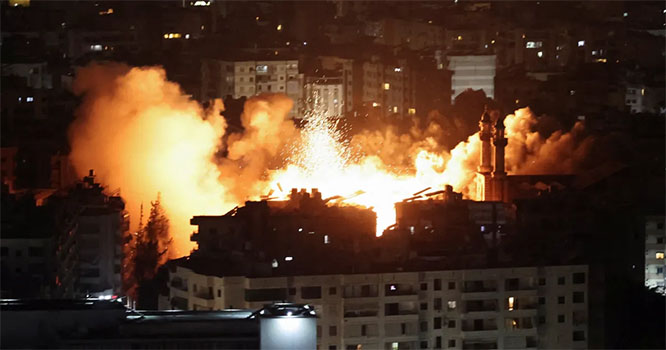
Israel has launched a new act of aggression on a residential neighborhood in Lebanon's capital, Beirut, killing and injuring about two dozen civilians.

The Israeli regime's military said in a statement that its forces carried out a so-called precise strike in a residential apartment in Dahiyeh in the southern suburbs of Beirut on Sunday.

The aggression targeted residential areas, killing at least five people and injuring more than 28 people, Lebanon's Health Ministry said. 

Hezbollah announced the martyrdom of senior Hezbollah commander Haytham Ali Tabatabai and four resistance fighters.

Lebanese President Michel Aoun condemned the airstrike, calling it a clear demonstration of Tel Aviv’s disregard for repeated international calls to halt violations on Lebanese soil.

“Israel refuses to implement international resolutions and all efforts aimed at ending the escalation and restoring stability,” Aoun said, urging the international community to take action to prevent further aggression.

The Palestinian Islamic Jihad movement also condemned the attack, holding the international community accountable. 

“The international community bears responsibility and continues to provide cover for these attacks as long as it does not restrain the occupiers,” said Ali Abu Shahin, a member of the group’s political bureau.

Israeli prime minister Benjamin Netanyahu’s office announced that the Israeli army carried out a strike “in the heart of Beirut."

Netanyahu reportedly approved the operation following recommendations from top Israeli security officials.

Two senior US officials commented on the Israeli strike.

The first official said that Israel did not notify Americans in advance about the attack. "We were informed immediately after the strike was carried out."

The second senior official said that the "US knew for several days that Israel was planning to escalate its strikes in Lebanon, but did not know in advance the timing, location, or target of the strike."

Speaking from the site of the Israeli strike, Lebanese MP Ali Ammar condemned the attack as part of a broader campaign of aggression that has targeted "all of Lebanon since the Washington-sponsored ceasefire."

He stated that "any attack on Lebanon is a violation of red lines; this aggression is part and parcel of the entity that targets Lebanon's dignity, sovereignty, and security of citizens."

Ammar went on to say the resistance is responding with "utmost wisdom, patience, and will confront the enemy at the appropriate time."

"Unfortunately, the enemy is emboldened to commit its aggression by voices within Lebanon that have turned themselves into tools that support its aggression," he added.

The Israeli attack on the southern suburbs of the Lebanese capital is the latest blatant violation of the ceasefire Israel signed with Hezbollah in November 2024, which was intended to end hostilities that had escalated into full-scale war.

An Israeli strike on the Ain al-Hilweh camp near Sidon in southern Lebanon late Tuesday killed at least 14 people. It wounded several others, including young students, according to the Lebanese health ministry.

The military claimed the attack targeted “a Hamas training compound” used to plan and carry out attacks against the regime -- a claim that has frequently been made without evidence.

Hamas rejected the allegations as “a blatant lie aimed at justifying the massacre,” stating it had “no military installations in the Palestinian camps in Lebanon” and that the targeted site was merely “an open sports field.”

According to Lebanese authorities, Israeli attacks have killed approximately 4,000 people and displaced more than 1.2 million residents across the country since October 2023.

Comments

Add new comment

  • Coastaldigest.com reserves the right to delete or block any comments.
  • Coastaldigset.com is not responsible for its readers’ comments.
  • Comments that are abusive, incendiary or irrelevant are strictly prohibited.
  • Please use a genuine email ID and provide your name to avoid reject.
News Network
November 28,2025

fire.jpg

Several Syrians were killed and more than two dozen others injured in Israeli strikes on the outskirts of Damascus, amid intensified incursions by the occupying regime since the fall of former president Bashar al-Assad and the rise of Hayat Tahrir al-Sham (HTS) rule.

Syrian state TV reported that the casualties occurred during an overnight Israeli assault involving helicopters and drones on the town of Beit Jinn in the Damascus countryside. The attack followed an Israeli military unit’s entry into the town, where they were surrounded by local residents, leading to gunfire and direct confrontations.

According to the report, “The occupation army’s helicopters and artillery shelled Beit Jinn, located at the foothills of Mount Hermon, resulting in 13 martyrs and 25 injured civilians.” The broadcaster did not specify the full extent of damage.

Al-Ikhbariyah Syria confirmed that the shelling coincided with Israeli soldiers entering Beit Jinn, while artillery pounded surrounding areas. The broadcaster stated that the escalation began after local residents clashed with an Israeli patrol that had infiltrated the southern town and “kidnapped” three young men.

Following a two-hour exchange of heavy fire, Israeli forces withdrew and repositioned on the hill of Butt al-Warda at the town’s outskirts.

Israeli media acknowledged that six soldiers were wounded in the clashes—three of them seriously—describing the confrontation as a “sudden ambush” that forced the deployment of reserve units and air support to secure an exit route. No further details were provided.

The aggression has fueled renewed displacement from Beit Jinn, with residents fleeing to nearby villages amid increasingly frequent Israeli attacks.

The raid came just a day after Israeli troops carried out another ground incursion into Umm al-Luqas village in Quneitra province. According to SANA, an Israeli unit in four vehicles entered the village, raided several homes, and later withdrew.

Syria condemned the repeated incursions as violations of the 1974 Disengagement Agreement and UN resolutions, urging the international community to enforce compliance and pressure Israel to halt its operations and withdraw fully.

Israel has expanded its attacks across Syrian territory following the collapse of the Assad government last year. Prime Minister Benjamin Netanyahu has reportedly instructed his forces to push deeper into Syrian territory and seize strategic positions.

Meanwhile, critics say the HTS-led interim government’s inaction and growing normalization gestures toward Israel have emboldened Tel Aviv to intensify its military operations. HTS, formerly linked to al-Qaeda, seized control of Damascus last December, formally ending Assad’s rule.

Comments

Add new comment

  • Coastaldigest.com reserves the right to delete or block any comments.
  • Coastaldigset.com is not responsible for its readers’ comments.
  • Comments that are abusive, incendiary or irrelevant are strictly prohibited.
  • Please use a genuine email ID and provide your name to avoid reject.