World Bank says India has huge potential, projects 7.3% growth in 2018

Agencies
January 10, 2018

With an "ambitious government undertaking comprehensive reforms", India has "enormous growth potential" compared to other emerging economies, the World Bank said today, as it projected country's growth rate to 7.3 per cent in 2018 and 7.5 for the next two years.

India, despite initial setbacks from demonetisation and Goods and Services Tax (GST), is estimated to have grown at 6.7 per cent in 2017, according to the 2018 Global Economics Prospect released by the World Bank here today.

"In all likelihood India is going to register higher growth rate than other major emerging market economies in the next decade. So, I wouldn't focus on the short-term numbers. I would look at the big picture for India and big picture is telling us that it has enormous potential," Ayhan Kose, Director, Development Prospects Group, World Bank, told news agency in an interview.

He said in comparison with China, which is slowing, the World Bank is expecting India to gradually accelerate.

"The growth numbers of the past three years were very healthy," Kose, author of the report, said.

In 2017, China grew at 6.8 per cent, 0.1 per cent more than that of India, while in 2018, its growth rate is projected at 6.4 per cent. And in the next two years, the country's growth rate will drop marginally to 6.3 and 6.2 per cent, respectively.

To materialise its potential, India, Kose said, needs to take steps to boost investment prospects.

There are measures underway to do in terms of non- performing loans and productivity, he said.

"On the productivity side, India has enormous potential with respect to secondary education completion rate. All in all, improved labor market reforms, education and health reforms as well as relaxing investment bottleneck will help improve India's prospects," Kose said.

Noting that India has a favourable demographic profile, he said it is rarely seen in other economies.

"In that context, improving female labour force participation rate is going to be important. Female labour force participation still remains low relative to other emerging market economies. Bringing force right now idle outside of the productive activities will make a huge difference," he said.

Reducing youth unemployment is critical, and pushing for private investment, where problems are already well-known like bank assets quality issues...If these are done, India can reach its potential easily and exceed, Kose asserted.

"In fact, we expect India to do better than its potential in 2018 and move forward," he said.

India's growth potential, he said, would be around 7 per cent for the next 10 years.

The Indian government is "very serious" with GST being a major turning point and banking recapitalisation programme is really important, Kose said.

"The Indian government has already recognise some of these problems and undertaking measures and willing to see the outcomes of these measures," he said.

"India is a very large economy. It has a huge potential. At the same time, it has its own challenges. This government is very much aware of these challenges and is showing just doing its best in terms of dealing with them," the World Bank official said.

The latest World Bank growth estimate for 2017 is 0.5 per cent, less than the previous projection, and 0.2 per cent less in the next two years.

"It is slightly lower than its previous forecast, primarily because India is undertaking major reforms," Kose said.

These reforms, of course, will bring certain policy uncertainty, he said, "but the big issue about India, when you look at India's growth potential and our numbers down the road 2019 and 2020, is that it is going to be the fastest growing large emerging market."

"India has an ambitious government undertaking comprehensive reforms. GST is a major reform to have harmonised taxes, is one nation one market one tax concept. Then, of course, the late 2016 demonetisation reform was there. The government is well aware of these short-term implications," Kose said.

He said there might have been some temporary disruptions but "all in all" the Indian economy has done well.

"The potential growth rate of the Indian economy is very healthy to 7 per cent. I think the growth is going to be at a high rate going forward," the World Bank official said.

The big question is whether Indian policymakers would, under the necessary reforms, push its potential growth up, Kose said.

"So far we have seen ambitious policy initiatives and implementation like GST. And we have all the reasons to expect this government to continue economic policies to create friendly environment for businesses and push its growth potential up," he said.

In a South Asia regional press release, the World Bank said India is estimated to grow 6.7 per cent in fiscal year 2017-18, slightly down from the 7.1 per cent of the previous fiscal year.

This is due in part to the effects of the introduction of the Goods and Services Tax, but also to protracted balance sheet weaknesses, including corporate debt burdens and non- performing loans in the banking sector, weighing down private investment, it said.

Comments

Add new comment

  • Coastaldigest.com reserves the right to delete or block any comments.
  • Coastaldigset.com is not responsible for its readers’ comments.
  • Comments that are abusive, incendiary or irrelevant are strictly prohibited.
  • Please use a genuine email ID and provide your name to avoid reject.
P A Hameed Padubidri
November 26,2025

CD.jpg

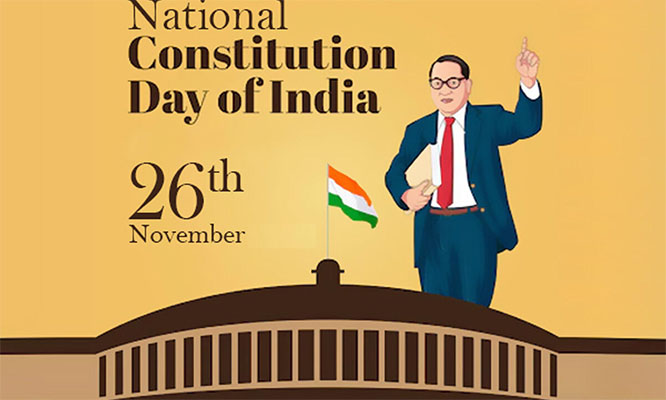
Constitution Day, also known as Samvidhan Divas, is observed every year on November 26 to honor the adoption of the Constitution of India and to recognize the visionary effort that shaped the world’s largest democracy.

Historical Background

It’s on November 26, 1949, the Constituent Assembly of India formally adopted the Constitution.This date is commemorated to acknowledge the completion of nearly three years of drafting, debate, and refinement.

On January 26, 1950, the Constitution came into force, marking India’s transition from a dominion to a sovereign republic.

The date 26 January was chosen to honor the “Purna Swaraj” declaration made in 1930 that marked the relentless efforts & sacrifices of the many. 

Why Constitution Day is Celebrated

* To honor & remember the framers of the Constitution, especially Dr. B. R. Ambedkar, the Chairman of the Drafting Committee, & many others. 

* To remind the citizens of the values, responsibilities, and rights enshrined in the Constitution.

* To promote constitutional values & literacy among students, institutions, and the general public.

* To reaffirm the nation’s commitment to justice, equality, liberty, fraternity and secular values. 

Vision and Significance of the Constitution

It establishes the fundamental political and legal framework for the nation.

Defines the structure, powers and functions of:
    •    The Executive
    •    The Legislature
    •    The Judiciary
    •    Guarantees a comprehensive set of Fundamental Rights, including:

-Equality before law
-Freedom of speech & expression
-Protection of life and personal liberty
-Freedom of religion
-Embeds Directive Principles of State Policy, guiding governance toward social justice and welfare.
-Introduces Fundamental Duties to ensure civic responsibility among citizens.

Key Features Celebrated on Constitution Day

-The Indian constitution is considered one of the longest written constitutions of the world. It’s systematically drafted considering almost all aspects that properly fits to the country. 

-Blend of multiple global constitutional principles while staying rooted in Indian values and realities.

-Framework that balances Federalism, Secularism, Democracy and Rule of Law. This makes everyone-from President to common man-below the law & are equal in the sight of law. 

-Another feature is that it’s based on built-in mechanisms for amendments, ensuring the Constitution grows with changing needs.

Message of the Day

The core ethos of this  Constitution Day is not merely about looking back at history-it’s a reminder of the continuous duty to protect democratic values, respect diversity and uphold the principles that define India as a sovereign, socialist, secular and democratic republic.

Happy Constitution Day to all my compatriots

Comments

Add new comment

  • Coastaldigest.com reserves the right to delete or block any comments.
  • Coastaldigset.com is not responsible for its readers’ comments.
  • Comments that are abusive, incendiary or irrelevant are strictly prohibited.
  • Please use a genuine email ID and provide your name to avoid reject.
News Network
December 3,2025

indigo.jpg

IndiGo, India’s largest airline, is battling one of its worst operational disruptions in recent years, with hundreds of delays and cancellations throwing domestic travel into chaos.

Government data on Tuesday showed its on-time performance plunging to 35%, an unusual dip for a carrier long associated with punctuality.

By Wednesday afternoon, airports in Delhi, Mumbai, Bengaluru and Hyderabad had collectively reported close to 200 cancellations, stranding travellers across the country.

Crew Shortage After New Duty Norms

A major trigger behind the meltdown is a severe crew shortage, especially among pilots, following the rollout of revised Flight Duty Time Limitation (FDTL) norms last month.

The rules mandate longer rest hours and more humane rosters — a shift IndiGo has struggled to incorporate across its vast network.

Sources said several flights were grounded due to lack of cabin crew, while some delays stretched upwards of eight hours.

With IndiGo controlling over 60% of India’s domestic aviation market, the ripple effect has impacted airports nationwide.

IndiGo Issues Apology, Lists “Compounding Factors”

In a statement, IndiGo acknowledged the large-scale disruption:

“We sincerely apologise to customers. A series of unforeseen operational challenges — technology glitches, winter schedule changes, adverse weather, system congestion and updated FDTL norms — created a compounding impact that could not have been anticipated.”

To stabilise operations, the airline has begun calibrated schedule adjustments for the next 48 hours, aiming to restore punctuality. Affected passengers are being offered refunds or alternate travel arrangements, IndiGo said.

What the FDTL Rules Require

The FDTL norms, designed to reduce pilot fatigue, cap duty and flying hours as follows:
•    Maximum 8 hours of flying per day
•    35 hours per week
•    125 hours per month
•    1,000 hours per year

Crew must also receive rest equalling twice the flight duration, with a minimum 10-hour rest period in any 24-hour window.

The DGCA introduced these limits to enhance flight safety.

Hyderabad: 33 Flights Cancelled, Long Queues Reported

Hyderabad’s Rajiv Gandhi International Airport saw heavy early-morning crowds as 33 IndiGo flights (arrivals and departures) were cancelled.

The airport clarified on X that operations were normal, advising passengers to contact IndiGo directly for latest flight status.

Cancellations included flights to and from Visakhapatnam, Goa, Ahmedabad, Delhi, Bengaluru, Chennai, Madurai, Hubli, Bhopal and Bhubaneswar.

Bengaluru: 42 Flights Disrupted

Bengaluru’s Kempegowda International Airport recorded 42 cancellations — 22 arrivals and 20 departures — affecting routes to Delhi, Mumbai, Chennai, Hyderabad, Goa, Kolkata and Lucknow.

Passengers Vent on Social Media

Irate travellers took to X to share their experiences. One passenger stranded in Hyderabad wrote: “I have been here since 3 a.m. and missed an important meeting.”

Another said: “My flight was pushed from 1:55 PM to 2:55 PM and now 4:35 PM. I was informed only three minutes before entering the airport.”

Delhi Airport Hit by Tech Glitch

At Delhi Airport, the disruption deepened due to a slowdown in the Amadeus system — used for reservations, check-ins and departure control.

The technical issue led to longer queues and sluggish processing, adding to delays already worsened by staff shortages.

Comments

Add new comment

  • Coastaldigest.com reserves the right to delete or block any comments.
  • Coastaldigset.com is not responsible for its readers’ comments.
  • Comments that are abusive, incendiary or irrelevant are strictly prohibited.
  • Please use a genuine email ID and provide your name to avoid reject.
News Network
November 30,2025

girlnomore.jpg

Mangaluru, Nov 30: A 22-year-old college student succumbed to her injuries at a private hospital in Mangaluru today, days after she was hit by a goods tempo while crossing a road in Padubidri.

The deceased has been identified as Preksha, a resident of Nadsalu Billitota in Padubidri. The fatal incident occurred as Preksha, who was returning home after completing her examination, attempted to cross the service road towards Mangaluru. She was struck by a goods tempo approaching from the Udupi side, causing her to fall and sustain a severe head injury.

Prompt action from local residents ensured she received immediate first aid before being rushed to a hospital in Mangaluru for specialised treatment. Despite medical efforts, she passed away while undergoing care.

Preksha was a student at Karavali College, Vamanjoor on the outskirts of Mangaluru city. The tragedy is compounded by the fact that she belonged to a financially vulnerable family, having previously lost her father. She is survived by her mother and brother.

A case related to the accident has been registered at the Padubidri police station, and an investigation is underway to determine the exact circumstances that led to the collision. The incident highlights the growing concerns over road safety, particularly on busy service roads, and serves as a tragic reminder of the human cost of traffic accidents.

Comments

Add new comment

  • Coastaldigest.com reserves the right to delete or block any comments.
  • Coastaldigset.com is not responsible for its readers’ comments.
  • Comments that are abusive, incendiary or irrelevant are strictly prohibited.
  • Please use a genuine email ID and provide your name to avoid reject.