Afghan searches for survivors as death from quake tops 1,400; India sends humanitarian aid

coastaldigest.com news network
September 2, 2025


afghanquake.jpg

The Taliban have called for international aid as Afghanistan reels from an earthquake that killed more than 1,400 people and left thousands more injured.

Rescuers searched into the night on Monday for survivors after the 6.0-magnitude quake struck on Sunday destroying entire villages across the country’s eastern Kunar province, which borders Pakistan.

Many remained trapped under the debris of mud and stone homes built into steep valleys, but rescuers struggled to reach remote areas because of rough mountainous terrain and inclement weather. It was a shallow earthquake, taking place just six miles beneath the Earth’s surface, which is known to have a particularly destructive impact. 

The death toll had passed 1,411, and more than 3,000 people were injured, Zabihullah Mujahid, a Taliban government spokesperson, said on Tuesday.

Authorities said they expected casualties to rise further once rescue teams reached more isolated locations, many of which remained inaccessible more than 24 hours after the earthquake struck.

Sharafat Zaman, a spokesperson for the health ministry in Kabul, called for international aid to tackle the devastation wreaked by the quake that struck at around midnight local time. “We need it because here lots of people lost their lives and houses,” he said.

Afghanistan had already been suffering from a severe economic crisis and a crippling withdrawal of international aid after the takeover of the country by the Taliban in 2021. Hardline Taliban policies such as a ban on female education and employment have spurred on a sharp drop in international aid funding and humanitarian assistance to the country.

The disaster will further stretch the resources of the war-torn nation’s Taliban administration, which is also grappling with the return of hundreds of thousands of Afghans deported by Iran and Pakistan in recent weeks.

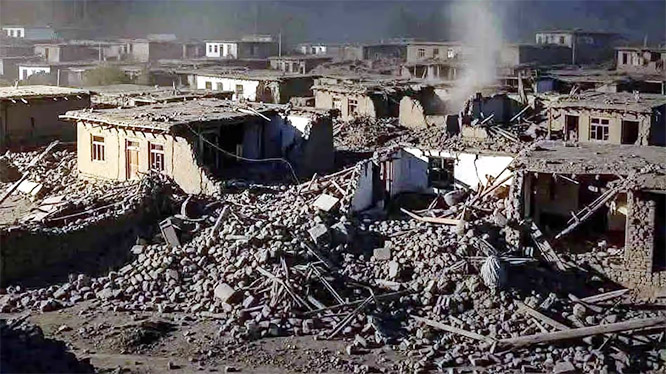
The quake razed three villages in Kunar and caused substantial damage in many others, authorities said. At least 610 people were killed in Kunar and there were 12 dead in Nangarhar, they added.

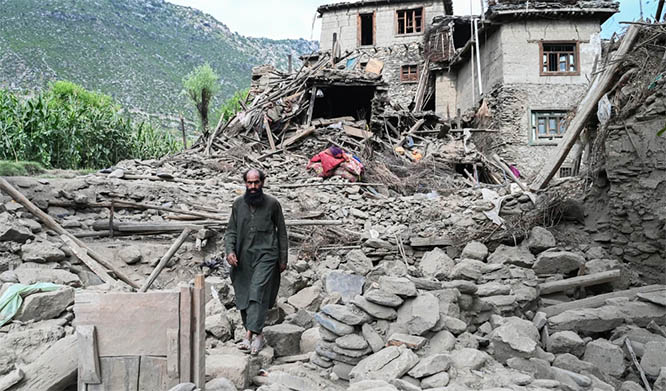
Ghazi Abad village, in the Nurgal district of Kunar, was a scene of devastation, the entire village destroyed. Homes had been reduced to rubble and many residents remained trapped under the debris.

Some villagers sat weeping amid the piled ruins of their homes. Others began laboriously clearing the debris by hand, or carried out the injured on makeshift stretchers.

“There is not a single standing room visible in this village,” said one resident, Abdullah. “The aftermath of the disaster suggests that life here was ended in mere seconds.”

Abdullah said adjoining villages had also suffered similar fates, completely levelled as the earthquake reduced every home to ruins. “The full extent of the earthquake’s impact will become clearer in the coming days as recovery efforts continue and many are still trapped,” he said.

“The losses are huge, people have no food and safe drinking water. While rescue operations are lacking, people are banding together to search for survivors and recover bodies all day and night. In one household there is no one left, everyone died here and their cattle are left alone.”

Another survivor said: “We need ambulances, we need doctors, we need everything to rescue the injured and recover the dead.”

In Kunar, the dead, some of them children, were wrapped in white shrouds by villagers who prayed over their bodies before burying them, while helicopters ferried the wounded to hospitals.

Rescuers were battling to reach remote mountainous areas cut off from mobile networks along the Pakistani border but their efforts were impeded by heavy rain, which heightened the risk of landslides and left many roads impassable. Military rescue teams fanned out across the region, the defence ministry said, with 40 flights carrying away 420 wounded and dead.

Experts urged the international community to step in and provide support, emphasising that the country’s own rescue and relief organisations were barely functional.

“The funds of the Afghan government that have been frozen by the US and other countries should be disbursed to international organisations that are carrying out relief work in Afghanistan,” said Osama Malik, an expert in international law. “The Pakistani government should also halt Afghan deportations at such a critical time when Afghanistan will be unable to manage an influx.”

On Monday, Britain set out emergency funding support for those affected by the recent earthquakes, saying it would ensure that the aid did not go to the Taliban administration by channelling it through its partners.

The US state department posted its condolences on X on Monday for the loss of life in the earthquake but did not immediately respond when asked if the US would provide any assistance.

India sends humanitarian aid

India has extended humanitarian assistance to Afghanistan following a series of powerful earthquakes. The Ministry of External Affairs (MEA) confirmed the aid in a post on X on Monday, stating, "India extends humanitarian assistance to Afghanistan in the wake of the earthquake."

The relief efforts include trucks loaded with sacks of rice and other essential food items. Early on Monday, a strong earthquake measuring 6.3 on the Richter scale struck eastern Afghanistan, with tremors felt as far away as Pakistan and India. The National Centre for Seismology (NCS) reported that several aftershocks followed, ranging between magnitudes 4 and 5.

Afghan.jpg

Comments

Add new comment

  • Coastaldigest.com reserves the right to delete or block any comments.
  • Coastaldigset.com is not responsible for its readers’ comments.
  • Comments that are abusive, incendiary or irrelevant are strictly prohibited.
  • Please use a genuine email ID and provide your name to avoid reject.
News Network
November 24,2025

israelsyra.jpg

Israeli forces have pushed over the Syrian frontier, erecting a checkpoint and stopping vehicles in the southwestern city of Quneitra, in yet another breach of the Arab country’s sovereignty.

The violation took place on Sunday, when the troops made their way across the border, setting up the outpost near the Ain al-Bayda junction in northern Quneitra, Syrian outlets reported.

According to the al-Ikhbariya paper, an Israeli detachment positioned itself at the junction, halting cars and conducting searches.

The Syrian Arab News Agency (SANA) reported that three Israeli military vehicles then moved further into the northern countryside, deploying between the town of Jubata al-Khashab and the villages of Ofaniya and Ain al-Bayda. The agency added that a separate Israeli unit mounted a new incursion in the central region, approaching the villages of Umm Batina and al-Ajraf.

Residents said such activities have surged in recent months, pointing to Israeli advances onto farmland, leveling of extensive forested areas, arrests, and spread of mobile checkpoints.

The Israeli regime began markedly increasing its military aggression against Syria last year.

The escalation coincided with increasingly ferocious onslaughts throughout the country by the so-called Hay'at Tahrir al-Sham (HTS) Takfiri terrorist group, which the government of President Bashar al-Assad had confined to northwestern Syria. The HTS, however, managed to overthrow the government as the Israeli attacks would pummel the country’s civilian and defensive infrastructure.

Various reports have shown that, during the escalation, the regime conducted more than 1,000 airstrikes on the Syrian territory and over 400 ground raids into the south.

Following the collapse of the Assad government, Tel Aviv also widened its grip over the occupied Golan Heights by taking control of a demilitarized buffer zone, in defiance of a 1974 Disengagement Agreement. Earlier this month, senior Israeli officials, including Prime Minister Benjamin Netanyahu, visited the buffer zone, prompting expressions of alarm on the part of the United Nations.

The United States, the regime’s biggest ally, has, meanwhile, been fraternizing the HTS head Abu Mohammed al-Jolani amid the widely reported prospect of rapprochement with Tel Aviv.

Comments

Add new comment

  • Coastaldigest.com reserves the right to delete or block any comments.
  • Coastaldigset.com is not responsible for its readers’ comments.
  • Comments that are abusive, incendiary or irrelevant are strictly prohibited.
  • Please use a genuine email ID and provide your name to avoid reject.
News Network
November 22,2025

gaza.jpg

The Israeli regime’s forces have killed two Palestinian children in the Gaza Strip every day since the ceasefire began in early October, UNICEF has warned.

The UN children’s agency said on Friday that Israeli forces continue to attack Palestinians in Gaza even though the agreement was meant to stop the killing.

“Since 11 October, while the ceasefire has been in effect, at least 67 children have been killed in conflict-related incidents in the Gaza Strip. Dozens more have been injured. That is an average of almost two children killed every day since the ceasefire took effect,” UNICEF spokesperson Ricardo Pires said in Geneva, reminding that each number in the statistics represents a child whose life had ended violently.

“These are not statistics,” he said. “Each child had a story, a family, and a future that was stolen from them.”

Data from Palestinian factions, human rights groups, and government bodies recorded since the US-brokered ceasefire deal went into effect on October 10 show that Israeli forces have carried out numerous attacks, each constituting a separate ceasefire violation.

UNICEF teams say they repeatedly continue to witness heart-wrenching scenes of fearful Palestinian children sleeping outdoors with amputated limbs, while others live as orphans in flooded, makeshift shelters.

“I saw this myself in August. There is no safe place for them. The world cannot normalize their suffering,” Pires said, lamenting that the UN could “do a lot more if the aid that is really needed was entering faster.”

The UNICEF spokesperson warned that with the advent of winter, the risks for hundreds of thousands of displaced children will increase.

He warned, “The stakes are incredibly high” for children as winter acts as a threat multiplier, where children have no heating, no insulation, and few blankets. He said respiratory infections rise.

“Too many children have already paid the highest price,” Pires said. “Too many are still paying it, even under a ceasefire. The world promised them it would stop and that we would protect them.”

“Now we must act like it,” the UNICEF spokesperson added.

Since the Israeli regime launched its genocidal war against Palestinians in Gaza in October 2023, it has killed nearly 70,000 people in the territory, most of them women and children, and injured over 170,000 more, while reducing most of the structures in the enclave to rubble.

Comments

Add new comment

  • Coastaldigest.com reserves the right to delete or block any comments.
  • Coastaldigset.com is not responsible for its readers’ comments.
  • Comments that are abusive, incendiary or irrelevant are strictly prohibited.
  • Please use a genuine email ID and provide your name to avoid reject.
News Network
December 3,2025

indigo.jpg

IndiGo, India’s largest airline, is battling one of its worst operational disruptions in recent years, with hundreds of delays and cancellations throwing domestic travel into chaos.

Government data on Tuesday showed its on-time performance plunging to 35%, an unusual dip for a carrier long associated with punctuality.

By Wednesday afternoon, airports in Delhi, Mumbai, Bengaluru and Hyderabad had collectively reported close to 200 cancellations, stranding travellers across the country.

Crew Shortage After New Duty Norms

A major trigger behind the meltdown is a severe crew shortage, especially among pilots, following the rollout of revised Flight Duty Time Limitation (FDTL) norms last month.

The rules mandate longer rest hours and more humane rosters — a shift IndiGo has struggled to incorporate across its vast network.

Sources said several flights were grounded due to lack of cabin crew, while some delays stretched upwards of eight hours.

With IndiGo controlling over 60% of India’s domestic aviation market, the ripple effect has impacted airports nationwide.

IndiGo Issues Apology, Lists “Compounding Factors”

In a statement, IndiGo acknowledged the large-scale disruption:

“We sincerely apologise to customers. A series of unforeseen operational challenges — technology glitches, winter schedule changes, adverse weather, system congestion and updated FDTL norms — created a compounding impact that could not have been anticipated.”

To stabilise operations, the airline has begun calibrated schedule adjustments for the next 48 hours, aiming to restore punctuality. Affected passengers are being offered refunds or alternate travel arrangements, IndiGo said.

What the FDTL Rules Require

The FDTL norms, designed to reduce pilot fatigue, cap duty and flying hours as follows:
•    Maximum 8 hours of flying per day
•    35 hours per week
•    125 hours per month
•    1,000 hours per year

Crew must also receive rest equalling twice the flight duration, with a minimum 10-hour rest period in any 24-hour window.

The DGCA introduced these limits to enhance flight safety.

Hyderabad: 33 Flights Cancelled, Long Queues Reported

Hyderabad’s Rajiv Gandhi International Airport saw heavy early-morning crowds as 33 IndiGo flights (arrivals and departures) were cancelled.

The airport clarified on X that operations were normal, advising passengers to contact IndiGo directly for latest flight status.

Cancellations included flights to and from Visakhapatnam, Goa, Ahmedabad, Delhi, Bengaluru, Chennai, Madurai, Hubli, Bhopal and Bhubaneswar.

Bengaluru: 42 Flights Disrupted

Bengaluru’s Kempegowda International Airport recorded 42 cancellations — 22 arrivals and 20 departures — affecting routes to Delhi, Mumbai, Chennai, Hyderabad, Goa, Kolkata and Lucknow.

Passengers Vent on Social Media

Irate travellers took to X to share their experiences. One passenger stranded in Hyderabad wrote: “I have been here since 3 a.m. and missed an important meeting.”

Another said: “My flight was pushed from 1:55 PM to 2:55 PM and now 4:35 PM. I was informed only three minutes before entering the airport.”

Delhi Airport Hit by Tech Glitch

At Delhi Airport, the disruption deepened due to a slowdown in the Amadeus system — used for reservations, check-ins and departure control.

The technical issue led to longer queues and sluggish processing, adding to delays already worsened by staff shortages.

Comments

Add new comment

  • Coastaldigest.com reserves the right to delete or block any comments.
  • Coastaldigset.com is not responsible for its readers’ comments.
  • Comments that are abusive, incendiary or irrelevant are strictly prohibited.
  • Please use a genuine email ID and provide your name to avoid reject.