Covid crisis brings regime change for the world’s central banks

News Network
November 12, 2020

corona.jpg

Just eight months after they swung into action to avert a crippling depression and credit crunch, central banks are in the uncomfortable position of relying on governments to power fragile economic rebounds.

The decisions their counterparts make will affect not just the growth outlook for the next few quarters but could shape central banks’ policy options, and even their credibility, for years to come.

Monetary authorities entered the Covid-19 crisis with the least conventional policy space -- namely, interest-rate cuts -- of any postwar downturn. After pulling down borrowing costs near or even below zero and deploying massive asset-purchase programs, they are now practically begging governments to step up.

Without aggressive fiscal stimulus now, the danger is that economies develop deep scars that hobble growth over the longer term. That could then leave central banks unable to reset and prepare for the next shock or recession. Monetary policy and fiscal policy are now interdependent.

 “This is definitely a new regime -- there simply isn’t enough demand in the global economy, and monetary policy can’t generate demand,” said Torsten Slok, chief economist at Apollo Global Management Inc. in New York.

Federal Reserve Chair Jerome Powell, who along with European Central Bank President Christine Lagarde and Bank of England Governor Andrew Bailey will be addressing the ECB’s annual forum on Thursday, is among those calling attention to the risk of long-term damage.

“There is a real threat here of those things,” Powell said at a press conference last week, referring to the risk of more business bankruptcies and long, skill-eroding periods of unemployment. “We’ll have a stronger recovery if we can just get at least some more fiscal support when it’s appropriate.”

British policymakers emphasised the power of dual action on March 11, when a BOE emergency rate cut was explicitly timed hours before the government outlined its own spending plans, and stress their ongoing coordination.

Even while they encourage fiscal cooperation, central bankers have kept up their guard to preserve their independence. After all, from Europe to Japan they were granted autonomy decades ago out of recognition of the need to wall off money creation from political impulses.

Bailey was explicit in addressing the risk last week.

“It’s perfectly possible to have coordinated policy and obviously be very cognizant of the importance of the independence of the Bank of England,” the BOE chief told reporters Nov. 5.

Even so, escalating government debt burdens will make future monetary tightening all the more costly, potentially limiting central banks’ room to maneuver.

Already, an uptick in US government bond yields this week, spurred in part by investor optimism over prospects for an effective coronavirus vaccine, has strengthened expectations for further Fed asset purchases as soon as by year-end.

Lagarde, speaking to the ECB’s virtual conference Wednesday, highlighted that asset purchases along with long-term bank funding are the tools to focus on in the next wave of monetary stimulus. Fed watchers see the potential for adjustments in the quantitative easing program next month.

The Catch-22 for central banks is that the longer they keep their balance sheets bloated and interest rates near zero, the greater the risk of their being seen as having limited power.

‘Second Fiddle’

“Right now, fiscal policy is doing what it has to do and monetary policy is playing second fiddle,” said Erik Nielsen, group chief economist at UniCredit SpA. “Most central bankers now are saying, this is the right policy at this time, but boy am I uncomfortable about it.”

Every central banker knows what lies at the end of a policy response that fails to restore the economy’s longer-term growth track: Japanification.

Since it adopted a zero-rate policy two decades ago, Japan’s central bank has gone on to snap up over 40% of the country’s government bond market, blowing its balance sheet out to more than 138% of gross domestic product.

A Bloomberg survey showed last month that a majority of forecasters doesn’t expect the Bank of Japan to tighten policy even over the longer term. The cost of that widespread assumption: Japan’s central bank has effectively lost the tool of forward guidance. Its tweaks in recent years, including the adoption of a commitment to overshoot its 2% inflation target, haven’t produced notable market reactions.

Bright Lines

The BOJ’s counterparts are determined to prevent any perception that they become little more than financing agencies for fiscal authorities.

Powell drew a bright line on money-financed fiscal policy last week, even as the Fed scoops up $80 billion a month of Treasuries.

“That’s not something we do -- we have different jobs,” Powell said in response to a question at his Nov. 5 press conference. “The job of taxation and spending goes to people who have stood for election and been elected and that’s the way it should be.”

The Fed chair also underscored that the unprecedented emergency lending programs unveiled this year, which provided a backstop for everything from municipalities to mid-size businesses, is a temporary arrangement.

“That shouldn’t be a permanent thing where we’re just another federal financing agency,” Powell said.

Bundesbank President Jens Weidmann put it another way in a speech on Nov. 5. “In the current environment, monetary and fiscal policy are working in harmony,” he said. “Their respective goals are aligned. But we should not pretend that such harmony will be a permanent condition.”


Comments

Add new comment

  • Coastaldigest.com reserves the right to delete or block any comments.
  • Coastaldigset.com is not responsible for its readers’ comments.
  • Comments that are abusive, incendiary or irrelevant are strictly prohibited.
  • Please use a genuine email ID and provide your name to avoid reject.
News Network
December 3,2025

arrival.jpg

Mangaluru, Dec 3: A group of Congress workers gathered at the Mangaluru International Airport on Wednesday to welcome AICC general secretary K C Venugopal, but the reception quickly turned into a display of support for Deputy Chief Minister D K Shivakumar.

Venugopal arrived in the city to participate in the centenary commemoration of the historic dialogue between Mahatma Gandhi and Narayana Guru. The event, organised by the Sivagiri Mutt, Varkala, in association with the Mangalore University Sri Narayana Guru Study Chair, is being held on the university’s Konaje campus.

KPCC general secretary Mithun Rai and several party workers had assembled at the airport to receive Venugopal. However, the moment he stepped out, workers began raising slogans backing Shivakumar.

The university programme will be inaugurated by Chief Minister Siddaramaiah.

This show of support comes just a day after Siddaramaiah remarked that Shivakumar would lead the government “when the high command decides.” The chief minister made the comment after a breakfast meeting at Shivakumar’s residence—another public display of camaraderie between the two leaders amid ongoing attempts by the party high command to downplay their leadership rivalry.

Comments

Add new comment

  • Coastaldigest.com reserves the right to delete or block any comments.
  • Coastaldigset.com is not responsible for its readers’ comments.
  • Comments that are abusive, incendiary or irrelevant are strictly prohibited.
  • Please use a genuine email ID and provide your name to avoid reject.
News Network
December 5,2025

indigoCEO.jpg

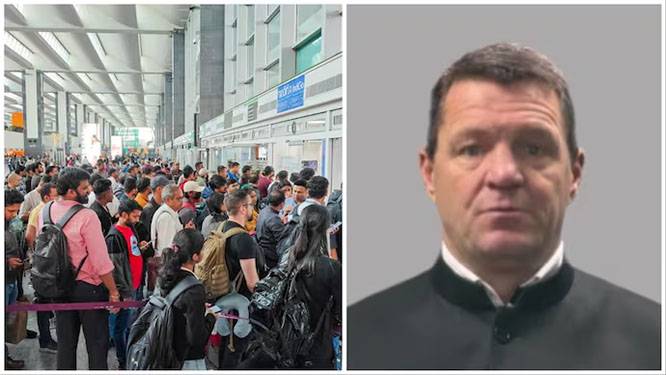
New Delhi, Dec 5: IndiGo CEO Pieter Elbers issued a public apology this evening after more than a thousand flights were cancelled today, making it the "most severely impacted day" in terms of cancellations. The biggest airline of the country cancelled "more than half" of its daily number of flights on Friday, said Elbers. He also said that even though the crisis will persist on Saturday, the airline anticipates fewer than 1,000 flight cancellations.

"Full normalisation is expected between December 10 and 15, though IndiGo cautions that recovery will take time due to the scale of operations," the IndiGo CEO said. 

IndiGo operates around 2,300 domestic and international flights daily.

Pieter Elbers, while apologising for the major inconvenience due to delays and cancellations, said the situation is a result of various causes.

The crisis at IndiGo stems from new regulations that boost pilots' weekly rest requirements by 12 hours to 48 and allow only two night-time landings per week, down from six. IndiGo has attributed the mass cancellations to "misjudgment and planning gaps".

Elbers also listed three lines of action that the airline will adopt to address the issue.

"Firstly, customer communication and addressing your needs, for this, messages have been sent on social media. And just now, a more detailed communication with information, refunds, cancellations and other customer support measures was sent," he said.

The airline has also stepped up its call centre capacity.

"Secondly, due to yesterday's situation, we had customers stranded mostly at the nation's largest airports. Our focus was for all of them to be able to travel today itself, which will be achieved. For this, we also ask customers whose flights are cancelled not to come to the airports as notifications are sent," the CEO said.

"Thirdly, cancellations were made for today to align our crew and planes to be where they need to start tomorrow morning afresh. Earlier measures of the last few days, regrettable, have proven not to be enough, but we have decided today to reboot all our systems and schedules, resulting in the highest numbers of cancellations so far, but imperative for progressive improvements starting from tomorrow," he added.

As airports witnessed chaotic scenes, the Directorate General of Civil Aviation (DGCA) stepped in to grant IndiGo a temporary exemption from stricter night duty rules for pilots. It also allowed substitution of leaves with a weekly rest period. 

Civil Aviation Minister Ram Mohan Naidu has said a high-level inquiry will be ordered and accountability will be fixed.

Comments

Add new comment

  • Coastaldigest.com reserves the right to delete or block any comments.
  • Coastaldigset.com is not responsible for its readers’ comments.
  • Comments that are abusive, incendiary or irrelevant are strictly prohibited.
  • Please use a genuine email ID and provide your name to avoid reject.
News Network
December 2,2025

Mangaluru, Dec 2: Mangaluru International Airport responded to a medical emergency late on Monday night. Air India Express flight IX 522, travelling from Riyadh to Thiruvananthapuram, was diverted to Mangaluru Airport after a passenger in his late 30s experienced a medical emergency on board.

The Airport’s Operations Control Centre received an alert regarding the passenger’s health condition. The airport activated its emergency response protocol, mobilising the airport medical team and coordinating with stakeholders including CISF, immigration, and customs. 

Upon landing, airport medical personnel attended to the passenger, assessed his condition, and arranged to shift him to a local tertiary-care hospital for further treatment. The passenger’s relatives accompanied the passenger, who incidentally received necessary medical care on board, which helped stabilise the situation.

Following the handling of the emergency, the flight departed for Thiruvananthapuram at 2:05 am on Tuesday.

"We appreciate the cooperation of all parties involved, and this incident reaffirms our ongoing commitment to prioritising passenger safety and readiness to respond to unforeseen emergencies with professionalism and care," the Airport spokesperson said. 

Comments

Add new comment

  • Coastaldigest.com reserves the right to delete or block any comments.
  • Coastaldigset.com is not responsible for its readers’ comments.
  • Comments that are abusive, incendiary or irrelevant are strictly prohibited.
  • Please use a genuine email ID and provide your name to avoid reject.