



‘Dark money’ helped Joe Biden reach the White House?

Agencies
January 24, 2021

President Joe Biden benefited from a record-breaking amount of donations from anonymous donors to outside groups backing him, meaning the public will never have a full accounting of who helped him win the White House.

Biden’s winning campaign was backed by $145 million in so-called dark money donations, a type of fundraising Democrats have decried for years. Those fundraising streams augmented Biden’s $1.5 billion haul, in itself a record for a challenger to an incumbent president.

That amount of dark money dwarfs the $28.4 million spent on behalf of his rival, former President Donald Trump. And it tops the previous record of $113 million in anonymous donations backing Republican presidential nominee Mitt Romney in 2012.

Democrats have said they want to ban dark money as uniquely corrupting, since it allows supporters to quietly back a candidate without scrutiny. Yet in their effort to defeat Trump in 2020, they embraced it.

For example, Priorities USA Action Fund, the super political action committee that Biden designated as his preferred vehicle for outside spending, used $26 million in funds originally donated to its nonprofit arm, called Priorities USA, to back Biden. The donors of that money do not have to be disclosed.

Guy Cecil, the chairman of Priorities USA, was unapologetic. “We weren’t going to unilaterally disarm against Trump and the right- wing forces that enabled him,” he said in a statement.

Campaign finance laws, in theory, are supposed to limit the influence big money has over politicians. But the system has gaping loopholes, which groups backing Biden and other candidates, have exploited.

“He benefited from it,” said Larry Noble, a former general counsel at the Federal Election Commission.

A Biden spokesman didn’t respond to attempts to seek comment.

His campaign called for banning some types of nonprofits from spending money to influence elections and requiring that any organization spending more than $10,000 to influence elections to register with the FEC and disclose its donors.

Deep Pockets

Biden raised more than $1 billion for his campaign, which can accept donations of up to $2,800 per election from individuals. That included $318.6 million from donors who gave less than $200 each. The rest of the money Biden raised came from donors with pockets deep enough to give as much as $825,000, with that money being divided among the Democratic National Committee and 47 state parties.

Dark money is not the biggest source of cash to campaigns. Wealthy donors can write eight-figure checks to super-PACs, Noble pointed out. Joint fundraising committees that raise money for campaigns and parties can bring in chunks of $830,500.

In September, Michael Bloomberg said he would spend $100 million to help Biden in Florida, allowing Democrats to divert money to other must-win states. Biden lost Florida but flipped five states that Trump won in 2016.

Bloomberg is the founder and majority owner of Bloomberg LP, the parent company of Bloomberg News.

Donors who want to avoid disclosure can give to political nonprofits, like Defending Democracy Together, which spent $15.6 million backing Biden, and aren’t required to disclose their contributors to the FEC. Donors can also give money to a nonprofit that in turn gives the money to a super-PAC, like Priorities USA did. Candidates and their campaigns can’t coordinate spending with such groups under federal law.

And that lack of disclosure worries reform groups.

Big donors -- individuals or corporations -- who contributed anonymously will have the same access to decision makers as those whose names were disclosed, but without public awareness of who they are or what influence they might wield.

“The whole point of dark money is to avoid public disclosure while getting private credit,” said Meredith McGehee, executive director of Issue One, which advocates for reducing the influence of money on politics. “It’s only dark money to the public.”

Battleground Attack Ads

Overall, Democrats in this election cycle benefited from $326 million in dark money, according to the Center for Responsive Politics. That was more than twice the $148 million that supported Republican groups. Some of the Democratic groups that relied on dark money in whole or in part spent heavily on early ads attacking Trump in critical battleground states like Michigan, Pennsylvania and Wisconsin. The groups started spending while Biden’s relatively cash-poor campaign was struggling to raise money for the primaries.

Future Forward PAC, a super-PAC that spent $104 million backing Biden, got $46.9 million from Facebook Inc. co-founder Dustin Moskovitz, $3 million from Twilio Inc. Chief Executive Officer Jeff Lawson and $2.6 million from Eric Schmidt of Alphabet Inc, the parent company of Google. But its biggest source of funds was its sister nonprofit, Future Forward USA Action, which contributed $61 million. The names of those who put up the $61 million don’t have to be disclosed.

The Sixteen Thirty Fund, a nonprofit that sponsors progressive advocacy, donated a total of $55 million in the 2020 election cycle to Democratic super-PACs, including Priorities USA Action Fund and Future Forward PAC, FEC records show. That total was much more than the $3 million it gave in 2018.

Amy Kurtz, executive director of the Sixteen Thirty Fund, said the surge of money to the group, which doesn’t disclose the names of its donors, included people who previously gave to Republicans or had not been engaged in politics.

The flood of dark money to Democrats and progressive groups has complicated their effort to reform the system.

Senator Sheldon Whitehouse, a Rhode Island Democrat, has blamed dark money for persuading Republicans to block legislation to address climate change and assuring judges who share their views are appointed to the courts.

“Dark money is toxic to democracy -- period,” Whitehouse said in a statement. “The fact that progressive groups have learned to fight back using similar tactics is no excuse for continuing the plague of dark money in America.”

Kurtz says her group would prefer rules that eliminated dark money.

“We have lobbied in favor of reform to the current campaign finance system,” she said, referring to H.R. 1, an election reform measure Democrats have proposed that includes more rigorous disclosure of donors to political nonprofits, “but we remain equally committed to following the current laws to level the playing field for progressives.”

Even Cecil, who runs the super-PAC supporting Biden, said the group supports reform.

“We still look forward to the day when unlimited money and super-PACs are a thing of the past,” he said.

Comments

Add new comment

  • Coastaldigest.com reserves the right to delete or block any comments.
  • Coastaldigset.com is not responsible for its readers’ comments.
  • Comments that are abusive, incendiary or irrelevant are strictly prohibited.
  • Please use a genuine email ID and provide your name to avoid reject.
News Network
February 4,2026

gaming.jpg

Ghaziabad: In a tragic incident, three sisters aged 12, 14 and 16 died after jumping from the ninth floor of their apartment in Uttar Pradesh’s Ghaziabad in the early hours of Wednesday. The girls allegedly took the extreme step after becoming deeply obsessed with an online Korean task-based game.

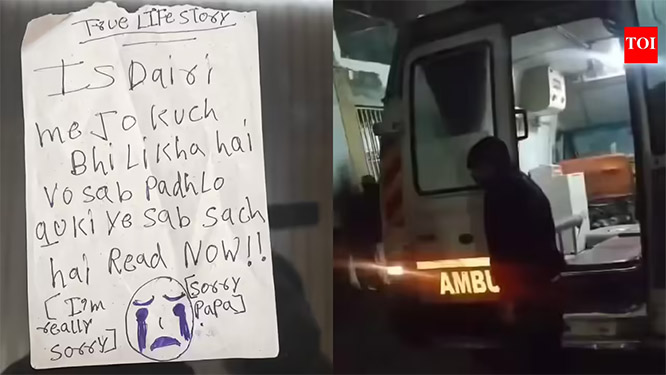
The incident occurred around 2.15 am at a high-rise apartment complex in Bharat City. Before jumping, the sisters — Pakhi (12), Prachi (14) and Vishika (16) — left behind a handwritten note that read, “Sorry, Papa.”

According to police, the girls went to the balcony, bolted the door from inside and jumped one after another. Their screams and the sound alerted their parents, neighbours and security guards. By the time the parents broke open the balcony door, all three had died.

“When we reached the spot, we confirmed that three minor girls, daughters of Chetan Kumar, had died after jumping from the building,” said Assistant Commissioner of Police Atul Kumar Singh.

Visuals from the scene on Wednesday morning showed the bodies lying on the ground, their mother wailing in grief, and stunned neighbours gathering at the complex.

Police said the sisters were heavily influenced by Korean culture and were addicted to an online “Korean love game”, though no specific game has been identified so far. Investigators are examining an eight-page suicide note written in a pocket diary, detailing the girls’ mobile and gaming activities.

“Read everything written in this diary because all of it is true. I’m really sorry. Sorry, Papa,” the note said, accompanied by a hand-drawn crying emoji.

Their father, Chetan Kumar, told police that the girls had even adopted Korean names and had gradually withdrawn from school and daily activities. “They used to say, ‘Korea is our life, Korea is our biggest love. We cannot give it up,’” he said, breaking down.

Police said the parents had recently restricted the girls’ mobile phone usage, which may have triggered distress. “The investigation has not revealed the name of any particular game, but it is evident that the girls were deeply influenced by Korean culture, as mentioned in the suicide note,” said senior police officer Nimish Patel.

The sisters reportedly did everything together, including eating and bathing. Their gaming addiction is believed to have begun during the COVID-19 pandemic, after which they became irregular at school and eventually stopped attending altogether.

Police also revealed that Chetan Kumar is married to two sisters and lives with both wives and their children, all daughters. Two of the deceased girls were daughters of one wife, while the third was their half-sister.

Further investigation is underway.

Comments

Add new comment

  • Coastaldigest.com reserves the right to delete or block any comments.
  • Coastaldigset.com is not responsible for its readers’ comments.
  • Comments that are abusive, incendiary or irrelevant are strictly prohibited.
  • Please use a genuine email ID and provide your name to avoid reject.
News Network
January 31,2026

trumpkill.jpg

The US Department of Justice has released millions of new documents linked to the case of convicted child sex offender Jeffrey Epstein, before removing some pages that contained complaints mentioning President Donald Trump.

Deputy Attorney General Todd Blanche said on Friday that approximately 3.5 million files were published to comply with the Epstein Transparency Act, following criticism that the administration had missed a December 19 deadline set by Congress.

The documents include FBI communications and complaints submitted as tips, some of which list comments mentioning Trump and others who had social or professional ties to Epstein.

Trump has repeatedly denied any wrongdoing in relation to his past association with Epstein.

Pages removed from DOJ website

After their publication, pages containing complaints that mentioned Trump were removed from the DOJ website and now return a “page not found” message. Copies of the documents, however, have circulated widely on social media. CNN anchor Jake Tapper was among those who publicly noted that the pages had been taken down.

One complaint, filed by a friend of a victim, says Trump forced a girl aged 13–14 to perform “oral sex” approximately 35 years ago in New Jersey. The document states that an investigator was sent to Washington to conduct an interview.

Another complaint says Trump regularly paid an individual to perform sexual acts and adds that he was present when her newborn child was murdered by a relative. The paperwork notes that there was “no contact made” with the complainant.

A separate complaint, which provided no contact information, said “calendar girls” parties at Trump’s Mar-a-Lago involved children and sexual abuse. The document also names several public figures as present at such events.

In another account, a complainant said they witnessed a “sex trafficking ring” at Trump National Golf Club in Rancho Palos Verdes, California, in the mid-1990s. The person noted “threats” from Trump’s head of security if she spoke publicly about what she had seen.

Other figures mentioned in the files

The latest release also includes a draft email Epstein wrote to himself in 2013, referring to Microsoft co-founder Bill Gates. In the message, Epstein said Gates asked him to delete emails and referenced “personal matters.”

The DOJ has not provided a detailed explanation for why certain pages were removed after publication. The department said the document release was ongoing.

Comments

Add new comment

  • Coastaldigest.com reserves the right to delete or block any comments.
  • Coastaldigset.com is not responsible for its readers’ comments.
  • Comments that are abusive, incendiary or irrelevant are strictly prohibited.
  • Please use a genuine email ID and provide your name to avoid reject.
News Network
February 1,2026

Bengaluru, Feb 1: For travelers landing at Kempegowda International Airport (KIA), the sleek, wood-paneled curves of Terminal 2 promise a world-class welcome. But the famed “Garden City” charm quickly withers at the curb. As India’s aviation sector swells to record numbers—handling over 43 million passengers in Bengaluru alone this past year—the “last mile” has turned into a marathon of frustration.

The Bengaluru Logjam: Rules vs Reality

While the city awaits the 2027 completion of the Namma Metro Blue Line, the interim has been chaotic. Recent “decongestion” rules at Terminal 1 have pushed app-based cab pickups to distant parking zones, forcing weary passengers into a 20-minute walk with luggage.

“I landed after ten months away and felt like a stranger in my own city,” says Ruchitha Jain, a Koramangala resident. “My driver couldn’t find me, staff couldn’t guide me, and the so-called ‘Premium’ lane is just a fancy tax on convenience.”

•    The Cost of Distance: A 40-km cab ride can now easily cross ₹1,500, driven by demand pricing and airport surcharges.

•    The Bus Gap: While Vayu Vajra remains a lifeline, its ₹300–₹400 fare is often cited as the most expensive airport bus service in the country.

A National Pattern of Disconnect

The struggle is not unique to Karnataka. From Chennai’s coast to Hyderabad’s plateau, India’s airports tell a familiar story: brilliant runways, broken exits.

City:    Primary Issue   |    Recent Development

Bengaluru:    Cab pickup restrictions & distance  |    App-based taxis shifted to far parking zones; long walks and fare spikes reported

Chennai:    Multi-Level Parking (MLCP) hike  |    Passengers report 40-minute walks to reach cab pickup points

Hyderabad:    “Taxi mafia” & touting  |    Over 440 touting cases reported; security presence intensified

Mumbai:    Fare scams  |     Tourists charged ₹18,000 for just 400 metres, triggering police action

In Hyderabad, travelers continue to battle entrenched local groups that intimidate Uber and Ola drivers, pushing passengers toward overpriced private taxis. Chennai flyers, meanwhile, complain that reaching the designated pickup zones now takes longer than short-haul flights from cities like Coimbatore.

The ‘Budget Day’ Hope

As Finance Minister Nirmala Sitharaman presents the Union Budget 2026 today, the aviation sector is watching closely. With the government’s renewed emphasis on multimodal integration, there is cautious hope for funding toward seamless airport-metro-bus hubs.

The vision is clear: a future where planes, trains, and metros speak the same language. Until then, passengers at KIA—and airports across India—will continue to discover that the hardest part of flying isn’t the thousands of kilometres in the air, but the last few on the ground.

Comments

Chandramohan
 - 
Friday, 6 Feb 2026

Sir, I request the airport authorities to introduce a free transport services from terminal 1 to terminal 2 as is very difficult for the passengers to reach terminal 2 along with their luggage. Also a trolley should be provided to reach the counter. Hope the authorities would help the passengers as soon as possible.

Add new comment

  • Coastaldigest.com reserves the right to delete or block any comments.
  • Coastaldigset.com is not responsible for its readers’ comments.
  • Comments that are abusive, incendiary or irrelevant are strictly prohibited.
  • Please use a genuine email ID and provide your name to avoid reject.