Omicron threat | Travel bans may do more harm than good, warns WHO

News Network
December 1, 2021

The World Health Organization has warned blanket travel bans will not prevent the spread of Omicron, as more countries rushed to impose curbs and the first cases of the new Covid strain were detected in Latin America.

In the week since the new virus strain was reported by South Africa, dozens of countries around the world have responded with travel restrictions -- most targeting southern African nations.

But the World Health Organization warned Tuesday that "blanket" travel bans risked doing more harm than good, just as Canada expanded its restrictions.

In a travel advisory, the WHO warned the bans could ultimately dissuade countries from sharing data about the evolving virus.

But it did advise that unvaccinated people vulnerable to Covid-19, including over-60s, should avoid travel to areas with community transmission of the virus.

WHO chief Tedros Adhanom Ghebreyesus said it was understandable for countries to seek to protect their citizens "against a variant we don't yet fully understand".

But he called for the global response to be "calm, coordinated and coherent", urging nations to "take rational, proportional risk-reduction measures".

The likely futility of broad travel restrictions was underscored as Dutch authorities reported that Omicron was present in the country before South Africa officially reported its first cases on November 25.

The new variant -- whose high number of mutations the WHO believes may make it more transmissible or resistant to vaccines -- was found in two Dutch test samples from November 19 and 23, with one having no travel history.

So far, well over a dozen countries and territories have detected cases, including Australia, Britain, Canada, Hong Kong, Israel, Italy and Portugal.

Latin America reported its first two cases Tuesday -- in people who travelled from South Africa to Brazil -- and a first case was confirmed in Japan, one day after it barred all foreign arrivals.

However, US President Joe Biden said the travel bans on just the southern African nations would stay in place, without referencing the other places where Omicron has been detected.

Asked how long travel restrictions that took effect Monday on South Africa and seven other southern African countries would remain, Biden said it "kind of depends".

"We're going to learn a lot more in the next couple weeks about the lethality of this virus, about how much it spreads, what we have to control it, etcetera," he told reporters.

Asked if any expansion of the travel restrictions to other countries could be made suddenly, as happened under former president Donald Trump, Biden said: "Unlike Trump I don't shock our allies."

In Asia, governments continued Wednesday to expand restrictions, including with Indonesia adding Hong Kong to its travel ban list alongside various African nations.

Hong Kong also added three more countries - Japan, Portugal and Sweden -- to its highest travel restriction category after Omicron cases were discovered in those nations.

While much is still unknown about the Omicron variant -- it could take weeks to determine whether and to what extent it is vaccine-resistant -- it has highlighted that the global fight against Covid-19 is far from over.

Omicron has emerged as much of the northern hemisphere was already bracing for a new winter wave of the pandemic -- leaving even nations with high vaccination rates struggling to contain rising infection numbers and prevent health services from being overwhelmed.

Governments, particularly in Western Europe, have already reintroduced mandatory mask-wearing, social-distancing measures, curfews or lockdowns -- leaving businesses fearing another grim Christmas.

Greece went ahead Tuesday in making vaccines compulsory for over-60s, while Norway will offer booster shots to all adults before Easter, as preferable to a lockdown.

Britain has set a target of delivering third jabs to all adults within two months.

While the European summer of fleeting Covid freedoms may be over, in the southern hemisphere, the Pacific island of Fiji ended 615 days of international isolation on Wednesday and reopened to tourists.

Traditional dancers in grass skirts welcomed waving holidaymakers from Sydney, the first of an expected flood of desperately needed tourists in the coming weeks.

Fiji Airways chief executive Andre Viljoen said it was a "momentous" occasion, where tourism accounts for about 40 percent of the economy.

"The international border reopening will reignite Fiji's economy," he told reporters.

Comments

Add new comment

  • Coastaldigest.com reserves the right to delete or block any comments.
  • Coastaldigset.com is not responsible for its readers’ comments.
  • Comments that are abusive, incendiary or irrelevant are strictly prohibited.
  • Please use a genuine email ID and provide your name to avoid reject.
News Network
December 3,2025

indigo.jpg

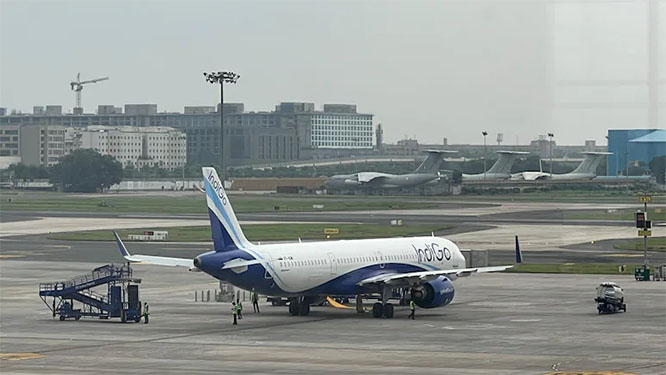
IndiGo, India’s largest airline, is battling one of its worst operational disruptions in recent years, with hundreds of delays and cancellations throwing domestic travel into chaos.

Government data on Tuesday showed its on-time performance plunging to 35%, an unusual dip for a carrier long associated with punctuality.

By Wednesday afternoon, airports in Delhi, Mumbai, Bengaluru and Hyderabad had collectively reported close to 200 cancellations, stranding travellers across the country.

Crew Shortage After New Duty Norms

A major trigger behind the meltdown is a severe crew shortage, especially among pilots, following the rollout of revised Flight Duty Time Limitation (FDTL) norms last month.

The rules mandate longer rest hours and more humane rosters — a shift IndiGo has struggled to incorporate across its vast network.

Sources said several flights were grounded due to lack of cabin crew, while some delays stretched upwards of eight hours.

With IndiGo controlling over 60% of India’s domestic aviation market, the ripple effect has impacted airports nationwide.

IndiGo Issues Apology, Lists “Compounding Factors”

In a statement, IndiGo acknowledged the large-scale disruption:

“We sincerely apologise to customers. A series of unforeseen operational challenges — technology glitches, winter schedule changes, adverse weather, system congestion and updated FDTL norms — created a compounding impact that could not have been anticipated.”

To stabilise operations, the airline has begun calibrated schedule adjustments for the next 48 hours, aiming to restore punctuality. Affected passengers are being offered refunds or alternate travel arrangements, IndiGo said.

What the FDTL Rules Require

The FDTL norms, designed to reduce pilot fatigue, cap duty and flying hours as follows:
•    Maximum 8 hours of flying per day
•    35 hours per week
•    125 hours per month
•    1,000 hours per year

Crew must also receive rest equalling twice the flight duration, with a minimum 10-hour rest period in any 24-hour window.

The DGCA introduced these limits to enhance flight safety.

Hyderabad: 33 Flights Cancelled, Long Queues Reported

Hyderabad’s Rajiv Gandhi International Airport saw heavy early-morning crowds as 33 IndiGo flights (arrivals and departures) were cancelled.

The airport clarified on X that operations were normal, advising passengers to contact IndiGo directly for latest flight status.

Cancellations included flights to and from Visakhapatnam, Goa, Ahmedabad, Delhi, Bengaluru, Chennai, Madurai, Hubli, Bhopal and Bhubaneswar.

Bengaluru: 42 Flights Disrupted

Bengaluru’s Kempegowda International Airport recorded 42 cancellations — 22 arrivals and 20 departures — affecting routes to Delhi, Mumbai, Chennai, Hyderabad, Goa, Kolkata and Lucknow.

Passengers Vent on Social Media

Irate travellers took to X to share their experiences. One passenger stranded in Hyderabad wrote: “I have been here since 3 a.m. and missed an important meeting.”

Another said: “My flight was pushed from 1:55 PM to 2:55 PM and now 4:35 PM. I was informed only three minutes before entering the airport.”

Delhi Airport Hit by Tech Glitch

At Delhi Airport, the disruption deepened due to a slowdown in the Amadeus system — used for reservations, check-ins and departure control.

The technical issue led to longer queues and sluggish processing, adding to delays already worsened by staff shortages.

Comments

Add new comment

  • Coastaldigest.com reserves the right to delete or block any comments.
  • Coastaldigset.com is not responsible for its readers’ comments.
  • Comments that are abusive, incendiary or irrelevant are strictly prohibited.
  • Please use a genuine email ID and provide your name to avoid reject.
News Network
November 21,2025

Bantwal: A domestic dispute appears to have led to a violent confrontation in BC Road area, where the owner of a textile shop was allegedly attacked with a knife by his wife on Wednesday evening.

Krishna Kumar Somayaji, the owner of Somayaji Textiles, sustained serious injuries in the incident and was immediately taken to a hospital for treatment. He is currently receiving care in the intensive care unit and is reported to have survived the assault, according to police.

The Bantwal Town police have registered a case against Somayaji's wife, Jyothi KT, who has since been taken into custody.

Police stated that the complainant, Namita, an employee at the shop, reported the sequence of events. She stated that around 7 p.m. on Wednesday, the suspect entered the shop, wearing a burqa and disguised as a customer, before attacking Somayaji with a knife. The employee then transported the injured owner to a local hospital via an autorickshaw.

Superintendent of Police Arun K confirmed that an ongoing domestic dispute between Somayaji and his wife reportedly preceded the attack. Police noted that Jyothi KT had previously visited the shop and issued threats.

Based on the complaint, Bantwal Town police have registered a case under relevant sections of the Bharatiya Nyaya Sanhita (BNS) and the Indian Arms Act-1959. An investigation into the incident is currently underway.

Comments

Add new comment

  • Coastaldigest.com reserves the right to delete or block any comments.
  • Coastaldigset.com is not responsible for its readers’ comments.
  • Comments that are abusive, incendiary or irrelevant are strictly prohibited.
  • Please use a genuine email ID and provide your name to avoid reject.
News Network
November 26,2025

Mangaluru, Nov 26: Assembly Speaker and local MLA U.T. Khader has initiated a high-level push to resolve one of Mangaluru’s longest-standing traffic headaches: the narrow, high-density stretch of National Highway-66 between Nanthoor and Talapady.

He announced on Tuesday that a formal proposal has been submitted to the Union Ministry of Road Transport and Highways (MoRTH) seeking approval to prepare a Detailed Project Report (DPR) for the widening of this crucial corridor.

The plan specifically aims to expand the existing 45-meter road width to a full 60 meters, coupled with the construction of dedicated service roads. Khader highlighted that land for a 60-meter highway was originally acquired during the initial four-laning project, but only 45 meters were developed, leading to a perpetual bottleneck.

"With vehicle density rising sharply, the expansion has become unavoidable," Khader stated, stressing that the upgrade is essential for ensuring smoother traffic flow and improving safety at the city's main entry and exit points.

The stretch between Nanthoor and Talapady is a vital link on the busy Kochi-Panvel coastal highway and connects to major city junctions. The move to utilize the previously acquired land for the full 60-meter width is seen as a necessary measure to catch up with the region's rapid vehicular growth and prevent further traffic gridlocks.

Comments

Add new comment

  • Coastaldigest.com reserves the right to delete or block any comments.
  • Coastaldigset.com is not responsible for its readers’ comments.
  • Comments that are abusive, incendiary or irrelevant are strictly prohibited.
  • Please use a genuine email ID and provide your name to avoid reject.