



Modi's space diplomacy puts India into new orbit

April 30, 2017

New Delhi, Apr 30: India embarks on space diplomacy like never before. For the first time, New Delhi is flexing its prowess of space technology by embarking on an unprecedented and un- chartered 'stratospheric diplomacy' through a special Rs 450 crore gift for south Asians. India is carving a very unique place in the universe, this week New Delhi will 'gift' a heavyweight bird in the sky to its neighbours through the 'South Asia Satellite'.
space

India is opening its heart out to its neighbours, explains External Affairs Ministry spokesperson Gopal Baglay, adding "neighbourhood first is now being extended beyond the stratosphere". It seems this 'gift' of a communications satellite for use by neighbours at no cost has no parallels in the space- faring world, all other current regional consortia are commercial for-profit enterprises.

So it seems Prime Minister Narendra Modi, who is a known visionary space buff, is placing the Indian Space Research Organisation (ISRO) in a new orbit by providing this space- based platform that would cost the participating nations almost USD 1,500 million over the 12-year life of the satellite.

Prashant Agarwal, an IIT Kanpur-trained engineer and the point-person in the Ministry of External Affairs piloting the project, says, "Prime Minister Modi has actually extended his slogan 'Sab Ka Saath Sab Ka Vikas' to India's neighbourhood essentially to service the needs of the poor in South Asia."

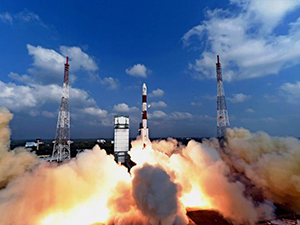
On May 5, the skies above the island of Sriharikota on the coast of the Bay of Bengal will be lit up as the Geo- synchronous Satellite Launch Vehicle (GSLV) also called the 'naughty boy of ISRO' on its 11th mission will carry a message of peace like never before.

The nearly 50-m-tall rocket that weighs about 412 tons will carry what is now dubbed as the 'South Asia Satellite' or what the Indian Space Research Organisation (ISRO) still prefers to call GSAT-9. The 2230-kg satellite has been fabricated in three years and is purely a communications satellite costing Rs 235 crore.

The uniqueness of this satellite is that it will have a footprint that extends all over South Asia and India is gifting this heavenly messenger to its neighbours who according to India's assessment could be helped in better utilising these space based technologies. The South Asia Satellite has 12 Ku band transponders which India's neighbours can utilise to increase communications. Each country will get access to at least one transponder through which they could beam their own programming and there could be common 'south Asian programing' as well.

Each country has to develop its own ground infrastructure though India is willing to extend assistance and know-how. According to the government. the satellite will "enable a full range of applications and services to our neighbours in the areas of telecommunication and broadcasting applications viz. television, direct-to-home (DTH), very small aperture terminals (VSATs), tele-education, telemedicine and disaster management support".

The satellite also has the capability to provide secure hot lines among the participating nations in addition since the region is highly prone to earthquakes, cyclones, floods, tsunamis, it may help in providing critical communication links in times of disasters. In this unusual message of peace, India's most hostile neighbour Pakistan has fully opted out. Rest of the seven nations part of the South Asian Association for Regional Co- operation (SAARC) are already on-board with Afghanistan still to ink the deal with some minor technical details still to be fixed in Kabul.

Nepal, Bhutan, Maldives, Bangladesh and Sri Lanka have agreed to be part of this mission, confirms Baglay. When Prime Minister Modi was just a fresher and just four weeks into his new position on June 30, 2014, he surprised the world while speaking to the scientists at ISRO in Sriharikota as he asked "the space community to take up the challenge of developing a SAARC satellite that we can dedicate to our neighbourhood as a gift from India".

The proposal emerged directly from Modi and the leadership at ISRO was stunned into silence not knowing what this space animal will look like. A highly-impassioned Modi, who had just witnessed a successful launch, said "I believe that the fight against the poverty of the countries of SAARC is the fight against illiteracy, the fight against superstitions, the challenge of moving forward in the scientific field is the possibility of providing opportunities to young people of SAARC countries.

"Our dream of this SAARC Satellite will work in the welfare of all our neighbouring countries. And that's why I have proposed in front of you today that we offer a valuable gift to our SAARC countries through a SAARC Satellite launch so that we also become partners in their welfare." Modi reinforced this idea five months later when speaking in Kathmandu at the SAARC Summit on November 26, 2014. He said, "India's gift of a satellite for the SAARC region will benefit us all in areas like education, telemedicine, disaster response, resource management, weather forecasting and communication.

"We will also host a conference in India for all South Asian partners next year, to strengthen our collective ability to apply space technology in economic development and governance. And, we plan to launch our satellite by the SAARC Day in 2016." Modi's sincere efforts got a jolt when even after participating in the planning meeting on June 22, 2015, Pakistan decided to 'opt out' from the proposed SAARC satellite suggesting that 'Pakistan has its own space program'.

So the project was renamed to 'South Asia Satellite' but sources say Pakistan was not allowed to veto the development project. Meanwhile frequency co-ordination activities took longer than expected and the launch got postponed by almost six months. Among India's neighbours, three nations already possess full-fledged communication satellites with Pakistan and Sri Lanka having been helped by China; Afghanistan also has a communication satellite actually an old India-made satellite acquired from Europe.

Bangladesh is likely to have its first bird in the sky later this year made with help from Thales. Essentially, it is the tiny nations of Bhutan and Maldives that may benefit in the long run. Incidentally, Nepal has already floated a tender to acquire two communications satellites. Experts say "Pakistan has missed an opportunity" since its own space program is currently in a primitive stage as compared to India's. This is despite the fact that Pakistan actually launched its first rocket five years ahead of India and its space agency Pakistan Space and Upper Atmosphere Research Commission (SUPARCO) is older than ISRO.

Pakistan has had five satellites in space but today lacks heavy duty launchers and satellite fabrication facilities. But will India's strident regional space diplomacy yield results? There is no doubt that through the South Asia Satellite India is actively trying to counter China's growing influence on its neighbours. But in the 21st-century Asian space race, China already has the first mover advantage.

Better late than never is prevailing mood and for this unique space diplomacy it is almost certain that India is likely to get applauded by the world's powers for this one of a kind friendly confidence building measure. Hopefully friendly skies can result in reduced hostilities on Earth.

Comments

Add new comment

  • Coastaldigest.com reserves the right to delete or block any comments.
  • Coastaldigset.com is not responsible for its readers’ comments.
  • Comments that are abusive, incendiary or irrelevant are strictly prohibited.
  • Please use a genuine email ID and provide your name to avoid reject.
News Network
December 13,2025

New Delhi: School-going children are picking up drug and smoking habits and engaging in consumption of alcohol, with the average age of introduction to such harmful substances found to be around 13 years, suggesting a need for earlier interventions as early as primary school, a multi-city survey by AIIMS-Delhi said.

The findings also showed substance use increased in higher grades, with grade XI/XII students two times more likely to report use of substances when compared with grade VIII students. This emphasised the importance of continued prevention and intervention through middle and high school.

The study led by Dr Anju Dhawan of AIIMS's National Drug Dependence Treatment Centre, published in the National Medical Journal of India this month, looks at adolescent substance use across diverse regions.

The survey included 5,920 students from classes 8, 9, 11 and 12 in urban government, private and rural schools across 10 cities -- Bengaluru, Chandigarh, Delhi, Dibrugarh, Hyderabad, Imphal, Jammu, Lucknow, Mumbai, and Ranchi. The data were collected between May 2018 and June 2019.

The average age of initiation for any substance was 12.9 (2.8) years. It was lowest for inhalants (11.3 years) followed by heroin (12.3 years) and opioid pharmaceuticals (without prescription; 12.5 years).

Overall, 15.1 per cent of participants reported lifetime use, 10.3 per cent reported past year use, and 7.2 per cent reported use in the past month of any substance, the study found.

The most common substances used in the past year, after tobacco (4 per cent) and alcohol (3.8 per cent), were opioids (2.8 per cent), followed by cannabis (2 per cent) and inhalants (1.9 per cent). Use of non-prescribed pharmaceutical opioids was most common among opioid users (90.2 per cent).

On being asked, 'Do you think this substance is easily available for a person of your age' separately for each substance category, nearly half the students (46.3 per cent) endorsed that tobacco products and more than one-third of the students (36.5 per cent) agreed that a person of their age can easily procure alcohol products.

Similarly, for Bhang (21.9 per cent), ganja/charas (16.1 per cent), inhalants (15.2 per cent), sedatives (13.7 per cent), opium and heroin (10 per cent each), the students endorsed that these can be easily procured.

About 95 per cent of the children, irrespective of their grade, agreed with the statement that 'drug use is harmful'.

The rates of substance use (any) among boys were significantly higher than those of girls for substance use (ever), use in the past year and use in the past 30 days. Compared to grade VIII students, grade IX students were more likely, and grade XI/XII students were twice as likely to have used any substance (ever).

The likelihood of past-year use of any substance was also higher for grade IX students and for grade XI/XII students as compared to grade VIII students.

About 40 per cent of students mentioned that they had a family member who used tobacco or alcohol each. The use of cannabis (any product) and opioid (any product) by a family member was reported by 8.2 per cent and 3.9 per cent of students, respectively, while the use of other substances, such as inhalants/sedatives by family was 2-3 per cent, the study found.

A relatively smaller percentage of students reported use of tobacco or alcohol among peers as compared to among family members, while a higher percentage reported inhalants, sedatives, cannabis or opioid use among peers.

Children using substances (past year) compared to non-users reported significantly higher any substance use by their family members and peers.

There were 25.7 per cent students who replied 'yes' to the question 'conflicts/fights often occur in your family'. Most students also replied affirmatively to 'family members are aware of how their time is being spent' and 'damily members are aware of with whom they spend their time'.

Comments

Add new comment

  • Coastaldigest.com reserves the right to delete or block any comments.
  • Coastaldigset.com is not responsible for its readers’ comments.
  • Comments that are abusive, incendiary or irrelevant are strictly prohibited.
  • Please use a genuine email ID and provide your name to avoid reject.
News Network
December 4,2025

indigoflight.jpg

Domestic carrier IndiGo has cancelled over 180 flights from three major airports — Mumbai, Delhi and Bengaluru — on Thursday, December 4, as the airline struggles to secure the required crew to operate its flights in the wake of new flight-duty and rest-period norms for pilots.

While the number of cancellations at Mumbai airport stands at 86 (41 arrivals and 45 departures) for the day, at Bengaluru, 73 flights have been cancelled, including 41 arrivals, according to a PTI report that quoted sources.

"IndiGo cancelled over 180 flights on Thursday at three airports-Mumbai, Delhi and Bengaluru," the source told the news agency.

Besides, it had cancelled as many as 33 flights at Delhi airport for Thursday, the source said, adding, "The number of cancellations is expected to be higher by the end of the day."

The Gurugram-based airline's On-Time Performance (OTP) nosedived to 19.7 per cent at six key airports — Delhi, Mumbai, Chennai, Kolkata, Bengaluru and Hyderabad — on December 3, as it struggled to get the required crew to operate its services, down from almost half of December 2, when it was 35 per cent.

"IndiGo has been facing acute crew shortage since the implementation of the second phase of the FDTL (Flight Duty Time Limitations) norms, leading to cancellations and huge delays in its operations across the airports," a source had told PTI on Wednesday.

Chaos continued at several major airports for the third day on Thursday because of the cancellations.

A spokesperson for the Kempegowda International Airport (KIA) in Bengaluru said that 73 IndiGo flights had been cancelled on Thursday.

At least 150 flights were cancelled and dozens of others delayed on Wednesday, airport sources said, leaving thousands of travellers stranded, according to news agency Reuters.

The Directorate General of Civil Aviation (DGCA) has said it is investigating IndiGo flight disruptions and has asked the airline to submit the reasons for the current situation, as well as its plans to reduce flight cancellations and delays.

It may be mentioned here that the pilots' body, Federation of Indian Pilots (FIP), has alleged that IndiGo, despite getting a two-year preparatory window before the full implementation of new flight duty and rest period norms for cockpit crew, "inexplicably" adopted a "hiring freeze".

The FIP said it has urged the safety regulator, the DGCA, not to approve airlines' seasonal flight schedules unless they have adequate staff to operate their services "safely and reliably" in accordance with the New Flight Duty Time Limitations (FDTL) norms.

In a letter to the DGCA late on Wednesday, the FIP urged the DGCA to consider re-evaluating and reallocating slots to other airlines, which have the capacity to operate them without disruption during the peak holiday and fog season if IndiGo continues to "fail in delivering on its commitments to passengers due to its own avoidable staffing shortages."

Comments

Add new comment

  • Coastaldigest.com reserves the right to delete or block any comments.
  • Coastaldigset.com is not responsible for its readers’ comments.
  • Comments that are abusive, incendiary or irrelevant are strictly prohibited.
  • Please use a genuine email ID and provide your name to avoid reject.
News Network
December 2,2025

A major upgrade in safety and monitoring is planned for Haj 2026, with every Indian pilgrim set to receive a Haj Suvidha smart wristband linked to the official Haj Suvidha mobile app. The initiative aims to support pilgrims—especially senior citizens—who may struggle with smartphones during the 45-day journey.

What the Smart Wristband Will Do

Officials said the device will come with:
•    Location tracking
•    Pedometer
•    SOS emergency button
•    Qibla compass
•    Prayer timings
•    Basic health monitoring

SP Tiwari, secretary of the UP State Haj Committee, said the goal is to make the pilgrimage safer and more comfortable.

“Most Hajis are elderly and not comfortable with mobile apps,” he said. “The smartwatch will help locate pilgrims who forget their way or cannot communicate their location.”

The wristbands will be monitored by the Consulate General of India in Saudi Arabia, similar to mobile tracking via the Haj Suvidha App.

Free Distribution and Training

•    Smart wristbands will be given free of cost.
•    Training for pilgrims will be conducted between January and February 2026.
•    Sample units will reach state Haj committees soon.
•    Final devices will be distributed as pilgrims begin their journey.

New Rules for Accommodation

Two major decisions have also been finalised for Haj 2026:
1.    Separate rooms for men and women – including married couples. They may stay on the same floor but must occupy different rooms, following stricter Saudi guidelines.
2.    Cooking banned – gas cylinders will not be allowed; all meals will be provided through official catering services arranged by the Haj Committee of India.

These decisions were finalised during a meeting of the Haj Committee of India and state representatives in Mumbai.

Haj Suvidha App Launched Earlier

The government launched the Haj Suvidha App in 2024, offering:

•    Training modules
•    Accommodation and flight details
•    Baggage information
•    SOS and translation tools
•    Grievance redressal

Haj 2026 Quota and Key States

•    India’s total Haj quota for 2026: 1,75,025 pilgrims
•    70% (1,25,000) allotted to the Haj Committee of India
•    30% (around 50,000) reserved for Haj Group Organisers

Uttar Pradesh has the largest allocation (around 30,000 seats), though approximately 18,000 pilgrims are expected to go this year. States with high pilgrim numbers include Kerala, Maharashtra and Gujarat.

Dates of Haj 2026

The pilgrimage is scheduled to take place from 24 May to 29 May, 2026 (tentative).
Haj is one of the five pillars of Islam and is mandatory for Muslims who meet the required conditions.

Comments

Add new comment

  • Coastaldigest.com reserves the right to delete or block any comments.
  • Coastaldigset.com is not responsible for its readers’ comments.
  • Comments that are abusive, incendiary or irrelevant are strictly prohibited.
  • Please use a genuine email ID and provide your name to avoid reject.