



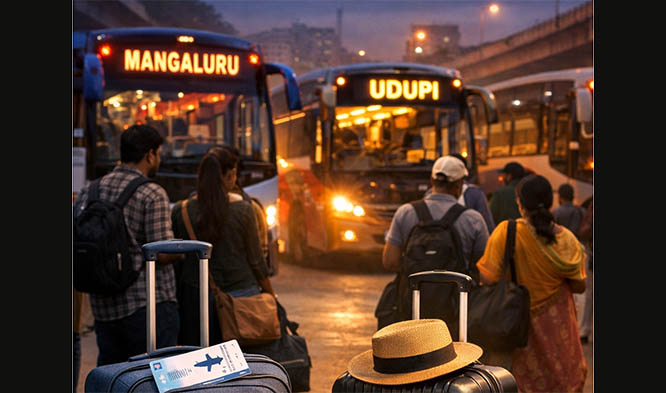
Festive travel shock: Bus fares from Bengaluru to Mangaluru, Udupi soar beyond flight ticket costs

News Network
December 24, 2025

flight.jpg

Mangaluru, Dec 24: As the coastal districts of Mangaluru and Udupi gear up for the year-end festivities—ranging from Christmas Eve midnight masses to the influx of tourists for the upcoming temple festivals—the joy of "coming home" has been met with a harsh financial reality. Private bus operators are facing intense backlash for "predatory pricing," with ticket costs from Bengaluru to the coast skyrocketing by over 300% overnight.

A Seasonal Extortion?

For the thousands of students and professionals working in Karnataka’s capital, the 350km journey to the coast is a seasonal ritual. However, this year, the "homecoming" has turned into a luxury few can afford.

Standard sleeper coach tickets, which usually retail between ₹800 and ₹1,000, are currently being sold on major aggregators for anywhere between ₹2,800 and ₹3,600.

"It’s not just a surge; it’s extortion," says Rohan Saldanha, a Mangaluru native who works in Whitefield. "I waited to book my tickets thinking prices would stabilize, but now I’m paying nearly the price of a flight ticket just to sit on a bus for nine hours."

The Operator’s Defense

Private transport unions have been quick to defend the move, citing the "Empty Return" factor. They argue that while every seat to Mangaluru and Udupi is occupied this week, the buses return to Bengaluru almost entirely empty, leading to a massive operational deficit.

"We are not the villains here," one operator claimed. "Between rising toll charges on the Shiradi Ghat and the high cost of diesel, we have to make the most of these four days to keep our business viable for the rest of the year."

Government Intervention: Too Little, Too Late?

The Karnataka State Road Transport Corporation (KSRTC) has attempted to bridge the gap by deploying 500 extra 'Special' buses to the coastal region. While these government-run services are priced more reasonably, they were fully booked within hours of the announcement, leaving late-comers at the mercy of private players.

The Transport Department has reportedly dispatched "Sleeper Squads" to major boarding points like Madiwala and Majestic to check for overcharging, but commuters claim the checks are superficial and do little to bring down the digital prices listed on apps.
The Regional Impact

The price hike doesn't just affect families; it hits the local economy. Udupi, currently bustling with pilgrims and tourists visiting the Sri Krishna Matha for year-end darshans, and Mangaluru, vibrant with Christmas celebrations, both rely on this seasonal influx. High travel costs threaten to dampen the tourism footfall that local businesses depend on.

Comments

Add new comment

  • Coastaldigest.com reserves the right to delete or block any comments.
  • Coastaldigset.com is not responsible for its readers’ comments.
  • Comments that are abusive, incendiary or irrelevant are strictly prohibited.
  • Please use a genuine email ID and provide your name to avoid reject.
News Network
December 13,2025

New Delhi: School-going children are picking up drug and smoking habits and engaging in consumption of alcohol, with the average age of introduction to such harmful substances found to be around 13 years, suggesting a need for earlier interventions as early as primary school, a multi-city survey by AIIMS-Delhi said.

The findings also showed substance use increased in higher grades, with grade XI/XII students two times more likely to report use of substances when compared with grade VIII students. This emphasised the importance of continued prevention and intervention through middle and high school.

The study led by Dr Anju Dhawan of AIIMS's National Drug Dependence Treatment Centre, published in the National Medical Journal of India this month, looks at adolescent substance use across diverse regions.

The survey included 5,920 students from classes 8, 9, 11 and 12 in urban government, private and rural schools across 10 cities -- Bengaluru, Chandigarh, Delhi, Dibrugarh, Hyderabad, Imphal, Jammu, Lucknow, Mumbai, and Ranchi. The data were collected between May 2018 and June 2019.

The average age of initiation for any substance was 12.9 (2.8) years. It was lowest for inhalants (11.3 years) followed by heroin (12.3 years) and opioid pharmaceuticals (without prescription; 12.5 years).

Overall, 15.1 per cent of participants reported lifetime use, 10.3 per cent reported past year use, and 7.2 per cent reported use in the past month of any substance, the study found.

The most common substances used in the past year, after tobacco (4 per cent) and alcohol (3.8 per cent), were opioids (2.8 per cent), followed by cannabis (2 per cent) and inhalants (1.9 per cent). Use of non-prescribed pharmaceutical opioids was most common among opioid users (90.2 per cent).

On being asked, 'Do you think this substance is easily available for a person of your age' separately for each substance category, nearly half the students (46.3 per cent) endorsed that tobacco products and more than one-third of the students (36.5 per cent) agreed that a person of their age can easily procure alcohol products.

Similarly, for Bhang (21.9 per cent), ganja/charas (16.1 per cent), inhalants (15.2 per cent), sedatives (13.7 per cent), opium and heroin (10 per cent each), the students endorsed that these can be easily procured.

About 95 per cent of the children, irrespective of their grade, agreed with the statement that 'drug use is harmful'.

The rates of substance use (any) among boys were significantly higher than those of girls for substance use (ever), use in the past year and use in the past 30 days. Compared to grade VIII students, grade IX students were more likely, and grade XI/XII students were twice as likely to have used any substance (ever).

The likelihood of past-year use of any substance was also higher for grade IX students and for grade XI/XII students as compared to grade VIII students.

About 40 per cent of students mentioned that they had a family member who used tobacco or alcohol each. The use of cannabis (any product) and opioid (any product) by a family member was reported by 8.2 per cent and 3.9 per cent of students, respectively, while the use of other substances, such as inhalants/sedatives by family was 2-3 per cent, the study found.

A relatively smaller percentage of students reported use of tobacco or alcohol among peers as compared to among family members, while a higher percentage reported inhalants, sedatives, cannabis or opioid use among peers.

Children using substances (past year) compared to non-users reported significantly higher any substance use by their family members and peers.

There were 25.7 per cent students who replied 'yes' to the question 'conflicts/fights often occur in your family'. Most students also replied affirmatively to 'family members are aware of how their time is being spent' and 'damily members are aware of with whom they spend their time'.

Comments

Add new comment

  • Coastaldigest.com reserves the right to delete or block any comments.
  • Coastaldigset.com is not responsible for its readers’ comments.
  • Comments that are abusive, incendiary or irrelevant are strictly prohibited.
  • Please use a genuine email ID and provide your name to avoid reject.
News Network
December 24,2025

bajpe.jpg

Mangaluru: The Bharatiya Janata Party (BJP) secured a clear majority in the Bajpe and Kinnigoli town panchayat elections in Dakshina Kannada district. Vote counting was held on Wednesday.

The town panchayat elections were conducted for the first time on December 21, four years after the upgradation of the Bajpe and Kinnigoli gram panchayats.

In Bajpe, elections were held for 19 seats. The BJP won 11 seats, while the Congress secured four seats. The Social Democratic Party of India (SDPI) won three seats, and one seat was won by an independent candidate. A total of 59 candidates were in the fray. The counting of votes took place at the Mangaluru Mini Vidhana Soudha.

Bajpe Town Panchayat was formed in 2021 by merging the Bajpe and Malavoor gram panchayats.

In Kinnigoli, the BJP won 10 seats, while the Congress secured eight seats. A total of 42 candidates contested the election. The vote counting was held at the Kinnigoli Town Panchayat office. The Kinnigoli Town Panchayat was formed by merging the Kinnigoli, Mennabettu and Kateel gram panchayats.

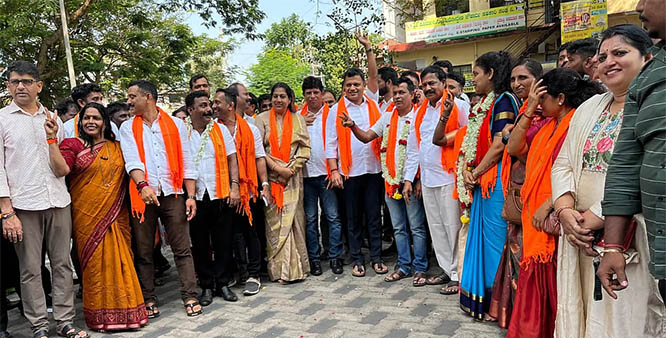
BJP workers celebrated the party’s victory in both Bajpe and Kinnigoli. Dakshina Kannada MP Capt. Brijesh Chowta, district BJP president Sathish Kumpala and other party leaders were present.

Comments

Add new comment

  • Coastaldigest.com reserves the right to delete or block any comments.
  • Coastaldigset.com is not responsible for its readers’ comments.
  • Comments that are abusive, incendiary or irrelevant are strictly prohibited.
  • Please use a genuine email ID and provide your name to avoid reject.
News Network
December 22,2025

The Bharatiya Janata Party (BJP) received ₹6,654.93 crore in donations during the 2024-25 financial year — a Lok Sabha election year — registering a 68 per cent increase over the previous fiscal.

In its annual contribution report submitted to the Election Commission on December 8, two days ahead of the deadline, the BJP disclosed all donations exceeding ₹20,000. The report, now available on the Commission’s website, covers contributions received between April 1, 2024 and March 30, 2025 — a period marked by the general election and Assembly polls in Arunachal Pradesh, Sikkim, Andhra Pradesh, Odisha, Jammu and Kashmir, Haryana, Jharkhand, Maharashtra and Delhi.

The BJP, the world’s largest political party by membership, had reported donations of ₹3,967 crore in 2023-24. The latest figures represent the party’s highest donation receipts in the last five years.

Electoral trusts accounted for around 40 per cent of the BJP’s total donations. The Prudent Electoral Trust contributed ₹2,180 crore, followed by the Progressive Electoral Trust with ₹757 crore and the New Democratic Electoral Trust with ₹150 crore. Contributions from other electoral trusts together amounted to ₹3,112.5 crore. The remaining funds came from corporate donors and individuals. Electoral trusts are entities set up by companies to channel donations to political parties.

Among major corporate contributors, Serum Institute of India donated ₹100 crore, Rungta Sons Private Limited ₹95 crore, Vedanta ₹67 crore, and Macrotech Developers (formerly Lodha Developers) ₹65 crore. Three Bajaj Group companies together contributed ₹65 crore, while Derive Investments donated ₹50 crore.

Other notable donors included Malabar Gold (₹10 crore), Kalyan Jewellers (₹15.1 crore), Hero Group (₹23.65 crore), Dilip Buildcon Group (₹29 crore), ITC Limited (₹35 crore), Wave Industries (₹5.25 crore) and Zerodha’s investment firm, promoted by Nikhil Kamath, which contributed ₹1.5 crore.

Several BJP leaders also made individual donations. Assam Chief Minister Himanta Biswa Sarma donated ₹3 lakh, Assam minister Pijush Hazarika ₹2.75 lakh, Union Education Minister Dharmendra Pradhan ₹1 lakh, Odisha Chief Minister Mohan Charan Majhi ₹5 lakh, Indore Mayor Pushyamitra Bhargava ₹1 lakh, and Akash Vijayvargiya, son of senior BJP leader Kailash Vijayvargiya, also donated ₹1 lakh, among others.

In contrast, most opposition parties reported a sharp decline in donations. The Congress received ₹522.13 crore in 2024-25, a fall of about 43 per cent from ₹1,129 crore in the previous year. The Trinamool Congress saw donations drop to ₹184.08 crore from ₹618.8 crore, while the Bharat Rashtra Samithi reported just ₹15.09 crore, down from ₹580 crore.

The Aam Aadmi Party, however, recorded an increase, collecting ₹39.2 crore compared to ₹22.1 crore last year. The Telugu Desam Party received ₹85.2 crore in donations, down from ₹274 crore, but also earned ₹102 crore through fees and subscriptions. The Biju Janata Dal reported ₹60 crore in donations, compared to ₹246 crore in the previous fiscal.

The 2024-25 financial year is also the first without electoral bonds, after the Supreme Court struck down the scheme as unconstitutional in February 2024. Since its introduction in 2018, the electoral bond scheme had enabled political parties to receive over ₹16,000 crore in anonymous donations, with the BJP receiving the largest share. 

Comments

Add new comment

  • Coastaldigest.com reserves the right to delete or block any comments.
  • Coastaldigset.com is not responsible for its readers’ comments.
  • Comments that are abusive, incendiary or irrelevant are strictly prohibited.
  • Please use a genuine email ID and provide your name to avoid reject.