Petrol, diesel prices on the rise again

Agencies
October 7, 2018

New Delhi, Oct 7: Within a day of the one-off excise duty cut and PSUs subsidising fuel, petrol and diesel prices are on the rise again and have hit a three week high.
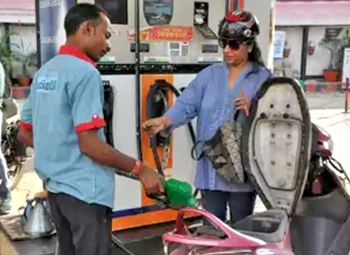
Petrol and diesel prices were cut by a minimum Rs 2.50 on October 5 when the government's only second cut in excise duty of Rs 1.50 per litre and state-owned fuel retailers providing a Re 1 per litre subsidy came into effect. In BJP-ruled states, the reduction was higher as they matched the cut with a similar reduction in local sales tax or VAT.

But the prices were on the rise from the very next day. Petrol price was hiked by 18 paise a litre on October 6 and 14 paise on Sunday, according to daily price notification issued by state-owned oil firms.

Petrol, which in Delhi was cut to Rs 81.50 on October 5, on Sunday costs Rs 81.82.

Similarly, diesel rates are hiked by 29 paise a litre each on October 6 and Sunday. It costs Rs 73.53 per litre in Delhi, up from Rs 72.95 on October 5, according to the oil firms.

Delhi, which did not cut VAT on fuel, still has the cheapest fuel in all metros and bulk of state capital as it levies lower taxes. Mumbai despite reducing VAT on petrol still has the highest priced fuel.

Petrol in Mumbai sells for Rs 87.29 a litre on Sunday and diesel is priced at Rs 77.06.

Petrol prices had hit an all-time high of Rs 84 per litre in Delhi and Rs 91.34 in Mumbai on October 4. Diesel rates too had peaked to Rs 75.45 a litre in Delhi and Rs 80.10 in Mumbai. Following the twin decision, they fell to Rs 81.50 per litre of petrol in Delhi and Rs 86.97 in Mumbai.

Diesel rates fell to Rs 72.95 in Delhi and Rs 77.45 in Mumbai on October 5.

On Sunday, the rates hit a three-week high.

Private retailers like Nayara Energy, formerly known as Essar Oil, too are matching PSU rates by subsidising fuel by Re 1 a litre.

After the Centre cut excise duty by Rs 1.50 per litre and asked PSU oil firms to subsidise fuel by Re 1, Maharashtra and Gujarat governments were among the first to announce a matching Rs 2.50 cut.

They were later joined by Chhattisgarh, Jharkhand, Tripura, Uttar Pradesh, Madhya Pradesh, Himachal Pradesh, Haryana Assam, Uttarakhand, Goa and Arunachal Pradesh with similar moves. Jammu and Kashmir, which is under governor's rule, too reduced tax on the two fuel.

Maharashtra, however, reduced VAT only on petrol and not on diesel.

Even before the excise duty cut, Rajasthan, West Bengal, Karnataka, Kerala and Andhra Pradesh had last month reduced VAT to cushion consumers for a spate of price increases.

The reduction in excise duty, only the second in four years of BJP-led NDA rule, will dent central government revenues by Rs 10,500 crore and was aimed at cooling retail prices that had shot up to an all-time high.

The BJP-government at the Centre had raised excise duty on petrol by Rs 11.77 a litre and that on diesel by Rs 13.47 a litre in nine installments between November 2014 and January 2016 to shore up finances as global oil prices fell, but then cut the tax just once in October last year by Rs 2 a litre.

Prior to Friday's cut, petrol price had risen by Rs 6.86 a litre and diesel by Rs 6.73 since mid-August - the most in any six-week duration after the daily price revision was introduced in mid-June last year.

Industry sources said for state-owned fuel retailers absorbing Re 1 per litre price would mean a Rs 9,000 crore hit on profits on an annualised basis. For the remainder of current fiscal, it would be Rs 4,500 crore, with IOC's share being roughly half and the rest is split equally between HPCL and BPCL.

Almost half of the fuel price is made up of taxes. The Centre, prior to the excise duty cur, levied a total of Rs 19.48 per litre of excise duty on petrol and Rs 15.33 per litre on diesel. On top of this, states levy value-added tax (VAT).

The hike in duties in 2014-16 had led to excise collections from petro goods rising from Rs 99,184 crore in 2014-15 to Rs 2,29,019 crore in 2017-18. States saw their VAT revenue rise from Rs 1,37,157 crore in 2014-15 to Rs 1,84,091 crore in 2017-18.


Comments

Add new comment

  • Coastaldigest.com reserves the right to delete or block any comments.
  • Coastaldigset.com is not responsible for its readers’ comments.
  • Comments that are abusive, incendiary or irrelevant are strictly prohibited.
  • Please use a genuine email ID and provide your name to avoid reject.
News Network
December 19,2025

Saudi Arabia has abolished fees on expatriate workers employed in licensed industrial establishments, signaling a strong push to empower national factories and enhance the Kingdom’s global industrial competitiveness. The move reflects the leadership’s commitment to building a sustainable and resilient industrial economy under Saudi Vision 2030.

The decision was approved by the Council of Ministers, chaired by Crown Prince and Prime Minister Mohammed bin Salman, following a recommendation from the Council of Economic and Development Affairs (CEDA). It forms part of a broader strategy to support, modernize, and strengthen the industrial sector.

By removing fees on foreign workers, industrial establishments gain greater operational flexibility and relief from financial pressures. This is expected to help factories expand production, improve efficiency, and compete more effectively in international markets, while reinforcing long-term sustainability.

The initiative aligns closely with Saudi Vision 2030, which identifies industry as a key pillar of economic diversification. A competitive and resilient industrial base is viewed as essential for driving innovation, attracting investment, and sustaining long-term economic growth.

Overall, the fee exemption underscores the Kingdom’s commitment to creating a supportive environment for industrial development and ensuring that Saudi factories remain globally competitive and capable of leading the nation’s economic transformation.

Comments

Add new comment

  • Coastaldigest.com reserves the right to delete or block any comments.
  • Coastaldigset.com is not responsible for its readers’ comments.
  • Comments that are abusive, incendiary or irrelevant are strictly prohibited.
  • Please use a genuine email ID and provide your name to avoid reject.
News Network
December 16,2025

bengal.jpg

The deletion of over 58 lakh names from West Bengal’s draft electoral rolls following a Special Intensive Revision (SIR) has sparked widespread concern and is likely to deepen political tensions in the poll-bound state.

According to the Election Commission, the revision exercise has identified 24 lakh voters as deceased, 19 lakh as relocated, 12 lakh as missing, and 1.3 lakh as duplicate entries. The draft list, published after the completion of the first phase of SIR, aims to remove errors and duplication from the electoral rolls.

However, the scale of deletions has raised fears that a large number of eligible voters may have been wrongly excluded. The Election Commission has said that individuals whose names are missing can file objections and seek corrections. The final voter list is scheduled to be published in February next year, after which the Assembly election announcement is expected. Notably, the last Special Intensive Revision in Bengal was conducted in 2002.

The development has intensified the political row over the SIR process. Chief Minister Mamata Banerjee and her Trinamool Congress have strongly opposed the exercise, accusing the Centre and the Election Commission of attempting to disenfranchise lakhs of voters ahead of the elections.

Addressing a rally in Krishnanagar earlier this month, Banerjee urged people to protest if their names were removed from the voter list, alleging intimidation during elections and warning of serious consequences if voting rights were taken away.

The BJP, meanwhile, has defended the revision and accused the Trinamool Congress of politicising the issue to protect what it claims is an illegal voter base. Leader of the Opposition Suvendu Adhikari alleged that the ruling party fears losing power due to the removal of deceased, fake, and illegal voters.

The controversy comes amid earlier allegations by the Trinamool Congress that excessive work pressure during the SIR led to the deaths by suicide of some Booth Level Officers (BLOs), for which the party blamed the Election Commission. With the draft list now out, another round of political confrontation appears imminent.

As objections begin to be filed, the focus will be on whether the correction mechanism is accessible, transparent, and timely—critical factors in ensuring that no eligible voter is denied their democratic right ahead of a crucial election.

Comments

Add new comment

  • Coastaldigest.com reserves the right to delete or block any comments.
  • Coastaldigset.com is not responsible for its readers’ comments.
  • Comments that are abusive, incendiary or irrelevant are strictly prohibited.
  • Please use a genuine email ID and provide your name to avoid reject.
News Network
December 5,2025

indigoCEO.jpg

New Delhi, Dec 5: IndiGo CEO Pieter Elbers issued a public apology this evening after more than a thousand flights were cancelled today, making it the "most severely impacted day" in terms of cancellations. The biggest airline of the country cancelled "more than half" of its daily number of flights on Friday, said Elbers. He also said that even though the crisis will persist on Saturday, the airline anticipates fewer than 1,000 flight cancellations.

"Full normalisation is expected between December 10 and 15, though IndiGo cautions that recovery will take time due to the scale of operations," the IndiGo CEO said. 

IndiGo operates around 2,300 domestic and international flights daily.

Pieter Elbers, while apologising for the major inconvenience due to delays and cancellations, said the situation is a result of various causes.

The crisis at IndiGo stems from new regulations that boost pilots' weekly rest requirements by 12 hours to 48 and allow only two night-time landings per week, down from six. IndiGo has attributed the mass cancellations to "misjudgment and planning gaps".

Elbers also listed three lines of action that the airline will adopt to address the issue.

"Firstly, customer communication and addressing your needs, for this, messages have been sent on social media. And just now, a more detailed communication with information, refunds, cancellations and other customer support measures was sent," he said.

The airline has also stepped up its call centre capacity.

"Secondly, due to yesterday's situation, we had customers stranded mostly at the nation's largest airports. Our focus was for all of them to be able to travel today itself, which will be achieved. For this, we also ask customers whose flights are cancelled not to come to the airports as notifications are sent," the CEO said.

"Thirdly, cancellations were made for today to align our crew and planes to be where they need to start tomorrow morning afresh. Earlier measures of the last few days, regrettable, have proven not to be enough, but we have decided today to reboot all our systems and schedules, resulting in the highest numbers of cancellations so far, but imperative for progressive improvements starting from tomorrow," he added.

As airports witnessed chaotic scenes, the Directorate General of Civil Aviation (DGCA) stepped in to grant IndiGo a temporary exemption from stricter night duty rules for pilots. It also allowed substitution of leaves with a weekly rest period. 

Civil Aviation Minister Ram Mohan Naidu has said a high-level inquiry will be ordered and accountability will be fixed.

Comments

Add new comment

  • Coastaldigest.com reserves the right to delete or block any comments.
  • Coastaldigset.com is not responsible for its readers’ comments.
  • Comments that are abusive, incendiary or irrelevant are strictly prohibited.
  • Please use a genuine email ID and provide your name to avoid reject.