



21 killed in Bangladesh violence after Jamaat leader’s hanging

December 15, 2013

Bangladesh_violence
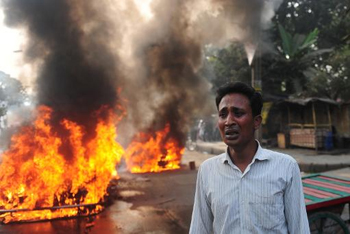
Dhaka, Dec 15: The death toll in violence across Bangladesh triggered by the execution of a top Jamaat-e-Islami leader on Saturday rose to 21, prompting Prime Minister Sheikh Hasina to issue a stern warning saying, “We know how to control you.”

Abdul Quader Mollah, known as the “Butcher of Mirpur” for atrocities committed during Bangladesh’s 1971 Liberation War, was hanged on Thursday night after the Supreme Court rejected his review petition. He was the first politician to be put to death for war crimes.

Speaking at a rally on Saturday commemorating the martyrs of 1971 war, Ms. Hasina accused her arch-rival main opposition Bangladesh Nationalist Party (BNP) chief Khaleda Zia of backing Jamaat to protect the perpetrators of crimes against humanity.

“We have shown enough patience. We will not tolerate anymore. People of the country know how to reply these atrocities, we (government) also know how to respond to, control you,” she said.

Her comments came as Jamaat called a nationwide strike today to protest the hanging of Mollah.

Violence erupted at several places soon after his execution, which the Jamaat described as a “political murder” even as it vowed to take revenge.

Jamaat activists set ablaze the house of State Home Minister Shamsul Haque Tuku in Pabna, which was rented out to the local passport office. One room of the two-storey building was damaged when the activists hurled a petrol bomb, police said.

Three deaths were reported on Saturday from southeastern Laxmipur, where clashes between Jamaat workers and police broke out after a local leader of the party was allegedly found dead hours after he was picked up by security personnel.

Seven persons died when Jamaat cadres clashed with police at several places, including Noakhali, Satkhira, Khulna and Jessore on Friday.

The dead included six leaders and activists of the Jamaat, two Awami League workers, a BNP activist and a street vendor.

Two Awami League activists were killed in clashes with Jamaat activists in northwestern Nilphamari where they tried to attack the motorcade of Awami League lawmaker and leading actor Asaduzzaman Noor.

Noor escaped unhurt as paramilitary Border Guard Bangladesh (BGB) and police intervened as escorted him to safety.

The Jamaat activists tried to torch a police camp at Narayanganj, a suburb of Dhaka.

Unidentified persons damaged two Hindu idols at a temple in northwestern Sirajganj.

Comments

Add new comment

  • Coastaldigest.com reserves the right to delete or block any comments.
  • Coastaldigset.com is not responsible for its readers’ comments.
  • Comments that are abusive, incendiary or irrelevant are strictly prohibited.
  • Please use a genuine email ID and provide your name to avoid reject.
News Network
December 6,2025

pilot.jpg

New Delhi: IndiGo, India’s largest airline, faced major operational turbulence this week after failing to prepare for new pilot-fatigue regulations issued by the Directorate General of Civil Aviation (DGCA). The stricter rules—designed to improve flight safety—took effect in phases through 2024, with the latest implementation on November 1. IndiGo has acknowledged that inadequate roster planning led to widespread cancellations and delays.

Below are the key DGCA rules that affected IndiGo’s operations:

1. Longer Mandatory Weekly Rest

Weekly rest for pilots has been increased from 36 hours to 48 hours.

The government says the extended break is essential to curb cumulative fatigue. This rule remains in force despite the current crisis.

2. Cap on Night Landings

Pilots can now perform only two night landings per week—a steep reduction from the earlier limit of six.

Night hours, defined as midnight to early morning, are considered the least alert period for pilots.

Given the disruptions, this rule has been temporarily relaxed for IndiGo until February 10.

3. Reduced Maximum Night Flight Duty

Flight duty that stretches into the night is now capped at 10 hours.

This measure has also been kept on hold for IndiGo until February 10 to stabilize operations.

4. Weekly Rest Cannot Be Replaced With Personal Leave

Airlines can no longer count a pilot’s personal leave as part of the mandatory 48-hour rest.

Pilots say this closes a loophole that previously reduced actual rest time.

Currently, all airlines are exempt from this rule to normalise travel.

5. Mandatory Fatigue Monitoring

Airlines must submit quarterly fatigue reports along with corrective actions to DGCA.

This system aims to create a transparent fatigue-tracking framework across the industry.

The DGCA has stressed that these rules were crafted to strengthen flight safety and align India with global fatigue-management standards. The temporary relaxations are expected to remain until February 2025, giving IndiGo time to stabilise its schedules and restore normal air travel.

Comments

Add new comment

  • Coastaldigest.com reserves the right to delete or block any comments.
  • Coastaldigset.com is not responsible for its readers’ comments.
  • Comments that are abusive, incendiary or irrelevant are strictly prohibited.
  • Please use a genuine email ID and provide your name to avoid reject.
