4 killed as violence erupts in parts of India over SC/ST Act ruling

Agencies
April 2, 2018

New Delhi, Apr 2: Four people were killed today in Madhya Pradesh as violence broke out in several parts of the country due to anger over a Supreme Court ruling on atrocities against Dalit.

A 'Bharat Bandh' called by several organisations today, and supported by some political parties, saw security forces clashing with protesters with reports of vandalism, stone-pelting and firing by police in not just Madhya Pradesh but also in the states of Rajasthan, Punjab, Haryana, Uttarakhand, Jharkhand, Bihar, Odisha and Uttar Pradesh.

Even as protests began to spiral out of control in some states, the BJP-led Centre filed a review petition in the Supreme Court against its order last month, which barred automatic arrests on complaints filed under the SC/ST (Prevention of Atrocities) Act.

However, the Chief Justice of India declined to hear the urgent plea on the ruling. In its petition, the Centre sought the restoration of the earlier status by which any offence under the SC/ST Act was made a cognizable non-bailable offence.

The Centre, Dalit activists as well as several opposition parties - including the Congress and the RJD - came out against the SC's ruling, which they said dilutes the SC/ST Act and might lead to an increase in violence against Dalits.

Amid all this, Congress president Rahul Gandhi and the BJP criticised each other over today over how their respective governments treat the issue of the welfare of the Dalits.

"We have filed a review petition in the Supreme Court. I appeal to all political parties and groups to maintain peace and not incite violence," said Union home minister Rajnath Singh, even as Union law minister Ravi Shankar Prasad said, "humbly that we don't agree with the SC's reasoning behind the order."

In clashes in Madhya Pradesh's Morena, four persons were killed as protesters blocked a railway crossing and set fire to some public property. Some nine people injured in Gwalior of whom two were in critical condition. Elsewhere in the state, protesters threw stones in Bhind, and tangled with law enforcement in Sagar. In three of those four places the local administrations imposed a curfew and/or Section 144, which prohibits an assembly or more than four people. In Gwalior, Internet service was blocked until 6:00 am tomorrow.

In Uttarakhand's Dehradun, shops were forcibly shut by protesters. In Rajasthan's Jaipur shops were vandalised by unknown perpetrators, and protesters blocked railway tracks and stopped trains; in Barmar, cars and other vehicles and some public property was damaged. A ban was imposed on Internet services, bulk SMSes and MMSes in Barmer until 8 pm tomorrow. Internet services were also ordered banned in Alwar from 2.30 pm onward today.

In the NCR region, protesters squatted on tracks in several places outside Delhi, stopping trains, including the Dehradun Express and the Ranchi Rajdhani, to enforce an all India shutdown. Services were disrupted by a mob at the Ghaziabad railyard. Many trains, including the Saptakranti Express, Utkal Express, the Bhubaneswar and Ranchi Rajdhanis and the Kanpur Shatabdi were stopped ahead of Ghaziabad in Meerut and Modinagar, officials said. A mob of about 2,000 people stopped trains at the Hapur station as well, disrupting the movement of many goods trains, they added.

In Punjab, protests were witnessed in Ambala, and in Haryana in Rohtak; protests also rocked the states' common capital Chandigarh. The CBSE postponed the class 12 and the class 10 examinations scheduled to be held today in Punjab at the request of the state government in view of the 'Bharat Bandh'. The state government decided to keep all schools shut for the day, the CBSE said.

In Patna, MLAs from opposition parties, as well as some from the ruling side, demanded a resolution be passed by the House urging the Centre to take adequate measures to undo the recent Supreme Court order on arrests under the SC/ST Act. Protesters stormed the Patna Junction where they forced closure of the ticket booking counters and squatted on railway tracks disrupting movement of a number of trains.

Normal life was partially affected in several parts of Odisha as well after activists of 'Adivasi Dalit Sena' staged a rail roko at Khetrajpur station in Sambalpur which caused delay in the running of some trains, officials said. In the state capital of Bhubaneswar, activists of different Dalit organisations put up road blockade near Vani Vihar, Jayadev Vihar and Acharya Vihar areas

In Meerut in Uttar Pradesh, protesters were beaten by police personnel. And in Jharkhand's Ranchi, a clash between police and protesters led to several people being injured.

Earlier today, Congress president Rahul Gandhi and the BJP's Ravi Shankar Prasad slugged it out on the issue of the welfare of Dalits.

Rahul said that the "oppression of Dalits is in the RSS's and BJP's DNA".

"Keeping Dalits at the lowest rung of Indian society is in the DNA of the RSS/BJP. Whoever dares challenge this position is suppressed with violence," tweeted Rahul, even as a 'Bharat Bandh' is under way in the country to protest a ruling by the Supreme Court, which some say dilutes a law to protect Dalits.

The BJP's Prasad then hit back, accusing the Congress of "playing politics with BR Ambedkar", a Dalit icon and the father of the Indian Constitution.

"The Modi government and the BJP want to make one thing clear, that Dalit and Adivasi welfare is what we want, but some people are playing politics with Ambedkar," said the BJP's Prasad, targeting the Congress for staking claim to the Dalit icon's memory.

"I want to ask the Congress - which is making all this noise - one question. 'When did Ambedkar get the Bharat Ratna?' I'll tell you when he did. He got it during VP Singh's time when BJP supported that government. Ambedkar died in 1956 and Congress was ruling for decades after that (with no Bharat Ratna for Ambedkar) and the Congress asks us questions?" said Prasad.


Comments

Add new comment

  • Coastaldigest.com reserves the right to delete or block any comments.
  • Coastaldigset.com is not responsible for its readers’ comments.
  • Comments that are abusive, incendiary or irrelevant are strictly prohibited.
  • Please use a genuine email ID and provide your name to avoid reject.
News Network
December 6,2025

pilot.jpg

New Delhi: IndiGo, India’s largest airline, faced major operational turbulence this week after failing to prepare for new pilot-fatigue regulations issued by the Directorate General of Civil Aviation (DGCA). The stricter rules—designed to improve flight safety—took effect in phases through 2024, with the latest implementation on November 1. IndiGo has acknowledged that inadequate roster planning led to widespread cancellations and delays.

Below are the key DGCA rules that affected IndiGo’s operations:

1. Longer Mandatory Weekly Rest

Weekly rest for pilots has been increased from 36 hours to 48 hours.

The government says the extended break is essential to curb cumulative fatigue. This rule remains in force despite the current crisis.

2. Cap on Night Landings

Pilots can now perform only two night landings per week—a steep reduction from the earlier limit of six.

Night hours, defined as midnight to early morning, are considered the least alert period for pilots.

Given the disruptions, this rule has been temporarily relaxed for IndiGo until February 10.

3. Reduced Maximum Night Flight Duty

Flight duty that stretches into the night is now capped at 10 hours.

This measure has also been kept on hold for IndiGo until February 10 to stabilize operations.

4. Weekly Rest Cannot Be Replaced With Personal Leave

Airlines can no longer count a pilot’s personal leave as part of the mandatory 48-hour rest.

Pilots say this closes a loophole that previously reduced actual rest time.

Currently, all airlines are exempt from this rule to normalise travel.

5. Mandatory Fatigue Monitoring

Airlines must submit quarterly fatigue reports along with corrective actions to DGCA.

This system aims to create a transparent fatigue-tracking framework across the industry.

The DGCA has stressed that these rules were crafted to strengthen flight safety and align India with global fatigue-management standards. The temporary relaxations are expected to remain until February 2025, giving IndiGo time to stabilise its schedules and restore normal air travel.

Comments

Add new comment

  • Coastaldigest.com reserves the right to delete or block any comments.
  • Coastaldigset.com is not responsible for its readers’ comments.
  • Comments that are abusive, incendiary or irrelevant are strictly prohibited.
  • Please use a genuine email ID and provide your name to avoid reject.
News Network
November 30,2025

The United Nations Committee against Torture (CAT) has condemned the Israeli regime for enforcing a policy of “organized torture” against Palestinians.

In a report published on Friday, CAT stated that the occupying regime enforces a deliberate policy of “organized and widespread torture and ill-treatment” against Palestinian abductees, particularly since October 7, 2023, when Israel launched its genocidal war on Gaza.

The committee expressed “deep concern over repeated severe beatings, dog attacks, electrocution, water-boarding, use of prolonged stress positions [and] sexual violence” inflicted on Palestinians.

Palestinian prisoners were degraded by “being made to act like animals or being urinated on,” systematically denied medical care, and subjected to excessive restraints, “in some cases resulting in amputation,” the report added.

CAT also condemned the routine application of “unlawful combatants law” to justify the prolonged detention without trial of thousands of Palestinian men, women, and children.

More than 10,000 Palestinians, including women and children, are currently held in Israeli prisons, according to Palestinian and international human rights groups, with 3,474 Palestinians in “administrative detention,” meaning they are imprisoned without trial for indefinite periods.

The report highlighted the “high proportion of children who are currently detained without charge or on remand,” noting that while Israel sets the age of criminal responsibility at 12, even younger children have been abducted.

Children designated as security prisoners face severe restrictions on family contact, may be subjected to solitary confinement, and are denied access to education, in clear violation of international law.

The committee further suggested that Israel’s policies across the Occupied Territories constitute collective torture against the Palestinian population.

“A range of policies adopted by Israel in the course of its continued unlawful presence in the Occupied Palestinian Territory amounts to cruel, inhuman or degrading living conditions for the Palestinian population,” the report said.

On Thursday, the Palestinian resistance movement Hamas condemned the systematic killing and torture of Palestinian abductees in Israeli prisons, urging international action to halt these abuses.

Citing human rights data, Hamas stated that 94 Palestinians have been killed in Israeli prisons since the start of Tel Aviv’s genocidal war on Gaza.

“This reflects an organized criminal approach that has turned these prisons into direct killing grounds to eliminate our people,” the resistance movement said.

Hamas called on the international community, the UN, and human rights organizations to immediately pressure Israel to end crimes against prisoners and uphold their rights as guaranteed by all international conventions and norms.

Comments

Add new comment

  • Coastaldigest.com reserves the right to delete or block any comments.
  • Coastaldigset.com is not responsible for its readers’ comments.
  • Comments that are abusive, incendiary or irrelevant are strictly prohibited.
  • Please use a genuine email ID and provide your name to avoid reject.
News Network
December 7,2025

envoy.jpg

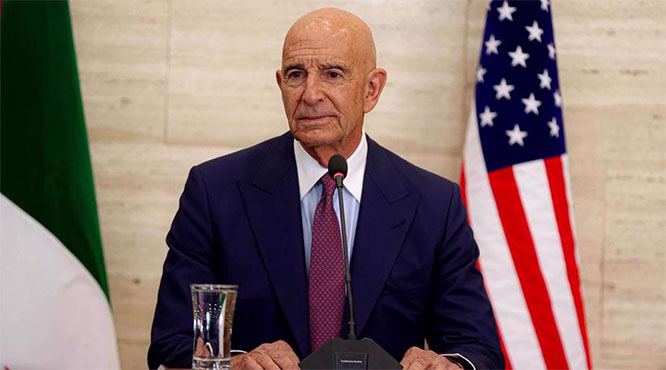
Since 1946, the United States has attempted 93 coups or “regime change” operations across the world — including two in Iran, US Special Envoy for Syria Tom Barrack has admitted.

Speaking to the UAE-based IMI Media Group, in remarks published by The National, Barrack said Washington tried twice to overthrow the Iranian government but failed both times. 

“For (Trump) then to be imputed with regime change — we had two regime changes in Iran already. Neither one worked. So I think wisely leave it to the region to solve,” said Barrack, who also serves as the US ambassador to Turkey.

His comments come six months after the US joined Israel in airstrikes against Iran during ongoing indirect nuclear negotiations between Tehran and Washington.

On June 13, Israel launched an attack on Iran that killed at least 1,064 people and hit civilian infrastructure. Days later, the United States targeted three nuclear facilities — Fordow, Natanz and Isfahan — in what Iran called a clear violation of international law. Iranian retaliation eventually forced a halt to the assault on June 24.

Barrack further claimed that US President Donald Trump and Foreign Secretary Marco Rubio are “not into regime change” and prefer a regional approach driven by Middle Eastern countries themselves. According to him, regional dialogue and non-interference by outside powers offer a more durable path forward.

He added that Washington is still open to an agreement with Tehran if Iranian authorities show “seriousness” and willingness to engage constructively.

However, Iran maintains the US has not shown readiness for meaningful talks. In an interview with Japan’s Kyodo News, Iranian Foreign Minister Abbas Araghchi said negotiations could advance only if Washington acknowledges Iran’s right to peaceful nuclear energy and lifts unilateral sanctions.

Comments

Add new comment

  • Coastaldigest.com reserves the right to delete or block any comments.
  • Coastaldigset.com is not responsible for its readers’ comments.
  • Comments that are abusive, incendiary or irrelevant are strictly prohibited.
  • Please use a genuine email ID and provide your name to avoid reject.