7 billion barrels of oil found in new Abu Dhabi reserves; UAE in 6th position in global oil reserves

News Network
November 5, 2019

Abu Dhabi, Nov 5: The UAE’s Supreme Petroleum Council on Monday announced a new pricing mechanism for ADNOC Murban crude, which will be listed on “an exchange,” and also announced a major increases in Abu Dhabi’s oil and gas reserves.

During the meeting held at ADNOC headquarters, the Council revealed the discovery of new hydrocarbon reserves estimated at 7 billion barrels of crude oil and 58 trillion standard cubic feet of conventional gas, putting the UAE in the sixth place in terms of global oil and gas reserves, with a total reserves of 105 billion barrels and 273 trillion cubic feet of conventional gas.

Dr. Sultan Ahmed Al Jaber, UAE Minister of State and ADNOC Group CEO, has said that support of the UAE’s leadership is enabling ADNOC to accelerate the pace of its ongoing transformation into a more commercially-driven and customer-focused integrated energy company with global reach.

Speaking following the Supreme Petroleum Council, SPC, meeting, Dr. Al Jaber, said, "Following the leadership’s wise directives, ADNOC is adopting more creative strategies and more flexible business models, while shaping value-add partnership opportunities to remain resilient and meet operational and financial targets in today’s unpredictable energy markets, as we deliver our 2030 strategy."

The SPC meeting was presided over by His Highness Sheikh Mohamed Bin Zayed Al Nahyan, Crown Prince of Abu Dhabi, Deputy Supreme Commander of the UAE Armed Forces, and Vice-Chairman of the SPC.

Sheikh Mohamed highlighted ADNOC’s ongoing transformation into a more performance-led and commercially-driven organisation and emphasised the central role ADNOC plays in enabling the UAE’s economic ambitions. He expressed the SPC’s recognition of ADNOC’s efforts to drive foreign investment into the UAE through its approach to strategic partnerships and investments.

He noted ADNOC has recruited over 3,200 Emirati nationals with advanced qualifications since 2016 and is set to employ an additional 1,258 by the end of 2019, including over 600 ADNOC scholars. He also acknowledged ADNOC’s plans to recruit more than 3,000 additional Emirati nationals over the next few years.

Murban crude to be traded on an exchange

Commenting on the SPC’s decision to list ADNOC’s Murban crude on an exchange, Dr. Al Jaber said, "The forward-looking decision and market-orientated foresight of His Highness Sheikh Mohamed bin Zayed and the SPC, to list Murban on an internationally recognised exchange and improve the terms of sale of ADNOC’s Murban Crude, is another significant step in our transformation.

The initiative will enable our customers and other market participants to better price, manage and trade their purchases of Murban. This historic and strategic move cements the UAE, Abu Dhabi and ADNOC’s role in the international oil and gas sector.

He noted, "Murban is recognised the world over for its intrinsic chemical qualities, consistent and stable production volumes, large number of international buyers, and numerous long-term concession and production partners. These landmark changes, the SPC has approved, will make Murban an even more attractive crude to the global market."

MURBAN

Murban is the main onshore crude grade of Abu Dhabi and is produced by ADNOC Onshore – a subsidiary of ADNOC – via the ADNOC Onshore Murban Concession. The Murban concession produces approximately 1.7 mmbpd of Murban crude oil. ADNOC is a 60 percent equity shareholder in the Murban concession, with the remaining 40 percent shareholding held by the other concession partners, BP, Total, INPEX of Japan, GS Caltex of Korea, CNPC and ZhenHua of China.

Increase in reserves

Speaking about the increase in hydrocarbon reserves, Dr. Al Jaber said, "We are very pleased and honoured to have enabled the UAE to move from the seventh to the sixth-largest oil and gas reserves in both global rankings. These achievements underscore ADNOC’s drive to ensure we remain a trusted, reliable and responsible supplier of energy to the world for decades to come.

Crucially, the discovery of substantial unconventional recoverable gas resources, for the first time, marks an important milestone in the development of the UAE’s unconventional resources as we execute our integrated gas strategy."

He added, "The significant discoveries and increase in reserves increase are testament to the hard work, innovation, and dedication of the ADNOC family who are ensuring that we continue to thrive and stay ahead of the world’s growing demand for energy. Building on this success, we are expanding our strategic partnerships and leveraging state-of-the-art technologies and world-class expertise to efficiently expedite further exploration of Abu Dhabi’s huge untapped resources while also driving new commercial opportunities, for the benefit of the UAE."

The council’s announcement was made yesterday during its meeting chaired by His Highness Shaikh Mohammad Bin Zayed Al Nahyan, Abu Dhabi Crown Prince and Deputy Supreme Commander of the UAE Armed Forces.

The council also announced the discovery of 160 trillion standard cubic feet of unconventional gas resources. These discoveries are the first of its kind in the region, marking the beginning of a new phase in the development of unconventional hydrocarbon resources.

The SPC is the highest governing body of the oil and gas industry in Abu Dhabi. The Council formulates, approves, and oversees the implementation of Abu Dhabi's petroleum policy and follows up its implementation across all areas of the petroleum industry to ensure that the set goals are achieved.

After the meeting, Sheikh Mohamed reviewed the progress of ADNOC’s development and expansion projects at its headquarters, as well as its other works, such as a water fountain.

He was then briefed about the new facilities of ADNOC’s headquarters and toured a tunnel linking the building’s staff parking area and the main entrance to its northern and southern lobbies.

During the tour, he also viewed the modern lighting on the green areas surrounding the building, as well as its new plaza area and the drilling heads and valves used in several oil fields, which all combine the modernity and originality of ADNOC.

Comments

Add new comment

  • Coastaldigest.com reserves the right to delete or block any comments.
  • Coastaldigset.com is not responsible for its readers’ comments.
  • Comments that are abusive, incendiary or irrelevant are strictly prohibited.
  • Please use a genuine email ID and provide your name to avoid reject.
News Network
November 28,2025

fire.jpg

Several Syrians were killed and more than two dozen others injured in Israeli strikes on the outskirts of Damascus, amid intensified incursions by the occupying regime since the fall of former president Bashar al-Assad and the rise of Hayat Tahrir al-Sham (HTS) rule.

Syrian state TV reported that the casualties occurred during an overnight Israeli assault involving helicopters and drones on the town of Beit Jinn in the Damascus countryside. The attack followed an Israeli military unit’s entry into the town, where they were surrounded by local residents, leading to gunfire and direct confrontations.

According to the report, “The occupation army’s helicopters and artillery shelled Beit Jinn, located at the foothills of Mount Hermon, resulting in 13 martyrs and 25 injured civilians.” The broadcaster did not specify the full extent of damage.

Al-Ikhbariyah Syria confirmed that the shelling coincided with Israeli soldiers entering Beit Jinn, while artillery pounded surrounding areas. The broadcaster stated that the escalation began after local residents clashed with an Israeli patrol that had infiltrated the southern town and “kidnapped” three young men.

Following a two-hour exchange of heavy fire, Israeli forces withdrew and repositioned on the hill of Butt al-Warda at the town’s outskirts.

Israeli media acknowledged that six soldiers were wounded in the clashes—three of them seriously—describing the confrontation as a “sudden ambush” that forced the deployment of reserve units and air support to secure an exit route. No further details were provided.

The aggression has fueled renewed displacement from Beit Jinn, with residents fleeing to nearby villages amid increasingly frequent Israeli attacks.

The raid came just a day after Israeli troops carried out another ground incursion into Umm al-Luqas village in Quneitra province. According to SANA, an Israeli unit in four vehicles entered the village, raided several homes, and later withdrew.

Syria condemned the repeated incursions as violations of the 1974 Disengagement Agreement and UN resolutions, urging the international community to enforce compliance and pressure Israel to halt its operations and withdraw fully.

Israel has expanded its attacks across Syrian territory following the collapse of the Assad government last year. Prime Minister Benjamin Netanyahu has reportedly instructed his forces to push deeper into Syrian territory and seize strategic positions.

Meanwhile, critics say the HTS-led interim government’s inaction and growing normalization gestures toward Israel have emboldened Tel Aviv to intensify its military operations. HTS, formerly linked to al-Qaeda, seized control of Damascus last December, formally ending Assad’s rule.

Comments

Add new comment

  • Coastaldigest.com reserves the right to delete or block any comments.
  • Coastaldigset.com is not responsible for its readers’ comments.
  • Comments that are abusive, incendiary or irrelevant are strictly prohibited.
  • Please use a genuine email ID and provide your name to avoid reject.
News Network
November 21,2025

israel.jpg

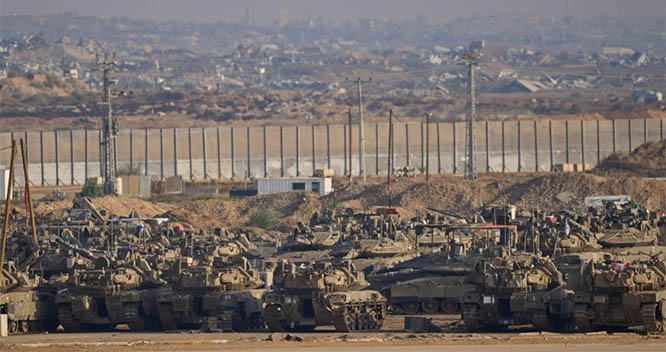
Local authorities say the Israeli military has expanded the so-called “yellow line” truce demarcation in Gaza City and repositioned its forces deeper into the territory in violation of a ceasefire agreement that came into force on October 10, besieging dozens of Palestinian families.

Gaza’s Government Media Office announced in a statement on Thursday that Israeli forces widened the boundary by shifting the markers, and advanced roughly 300 meters (984 feet) into the neighborhoods of Ash-Shaaf, An-Nazzaz and Baghdad Street.

The move pushed further into civilian areas, trapping families who were unable to flee as tanks rolled forward, it added.

“The fate of many of these families remains unknown amidst the shelling that targeted the area,” the office said, adding that the expansion of the yellow line shows a “blatant disregard” for the ceasefire deal.

On Friday, sources said the Israeli military carried out continued air and artillery strikes inside the so-called “yellow line” east of Khan Younis in the southern Gaza Strip.

According to the reports, Israeli warplanes and tanks targeted areas within the zone. One Palestinian was reported killed and several others wounded in the strikes, the sources said.

The fresh aggression came only a day after 25 Palestinians were killed in Israeli airstrikes on Gaza City and Khan Younis on Wednesday.

The media office reported that Israel has consistently violated the truce deal since its implementation last month, with near-daily attacks by air, artillery and direct shootings.

The office said over 400 violations have been documented. These breaches have resulted in the deaths of more than 300 Palestinians and left hundreds injured.

The Government Media Office in Gaza urged the guarantors of the ceasefire — the US, Egypt, Qatar and Turkey — to take swift action to halt the ongoing violations and facilitate the delivery of food, shelter materials, medical aid, and infrastructure equipment.

The so-called “yellow line,” set out in the agreement between Israel and Hamas resistance movement, refers to a non-physical partition where the Israeli military repositioned itself when the truce deal took effect.

It has allowed Israel, which routinely fires at Palestinians who approach the line, to retain control over more than half of the Gaza Strip.

International bodies, including the UN Independent International Commission of Inquiry, the International Association of Genocide Scholars, Amnesty International, Human Rights Watch, B’Tselem, and other rights groups, have concluded that the Israeli war on Gaza amounts to genocide.

In the attacks in Gaza since October 2023, Israel has killed at least 69,546 people and injured 170,833 others, leveling large swaths of the territory and displacing almost all of the population. 

Comments

Add new comment

  • Coastaldigest.com reserves the right to delete or block any comments.
  • Coastaldigset.com is not responsible for its readers’ comments.
  • Comments that are abusive, incendiary or irrelevant are strictly prohibited.
  • Please use a genuine email ID and provide your name to avoid reject.