



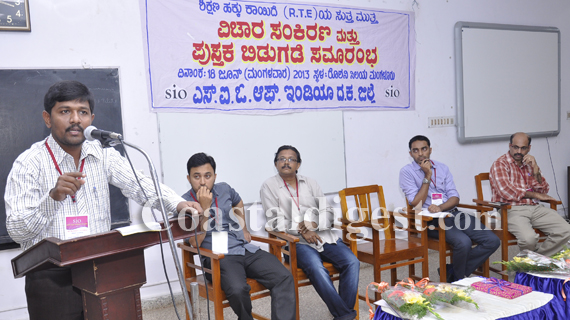
Speaking at a seminar on RTE organized by Students Islamic Organisation (SIO) in Mangalore on Tuesday, Mr. Umashankar said that although on the face of it, the RTE appears to be a platform for students from backward communities to study in prestigious private schools, the Act has become a tool for the government to encourage privatization. The basic intention of introducing RTE is to ensure quality education for all children which is not being addressed, he said.
“Of the 46,288 schools in Karnataka, 13,000 do not possess toilets, 8,000 schools lack water facility and 20,000 schools are without playgrounds. The basic promise of providing basic facilities to our children studying in schools is not being fulfilled.
The 25% quota is a tool being used by the government to financially strengthen private schools further while government schools are being closed down. The government says it needs about 3 lakh crore rupees to ensure free and compulsory education for all but claims it has no money. When the government can waive off taxes amounting to Rs.4.5 lakh crore to 20 corporate houses and announce financial aid worth Rs. 56000 crore for EU nations, why cannot it spend Rs. 3 lakh crore for education?”, Mr. Umashankar reasoned.
The concept of neighbourhood schools needs to be strictly implemented in India as has been the case in countries like Germany and England, Mr. Umashankar said. “Here, we see private players dumping children in their schools from places 25 kms away even. These are all tactics to encourage privatization by the government. Minority schools must also not be exempted from the quota rule. There are economically backward children in minority communities as well and a 50% quota for them must also be created in minority run schools”, he said.
The RTE activist further shed light on the complications in the Act with regard to the 30:1 student-teacher ratio and said that the focus must instead be on having a teacher for each subject in a school.
Renni D'Souza, Director, PADI Valorade, Mangalore, said that government, education activists and people alike must not confine their fight to achieveing free and compulsory education for children until primary school but demand free education for children upto 18 years of age as per the UN declaration.
Tousif Ahmed M Y, State President, SIO, said that the government is indirectly encouraging caste based education and inequality in the country through the variant schooling system. “A survey in companies of people holding top posts will reveal that they all hail from upper castes and from a private schooling background while those in low profile jobs like peons and clerks will be from government schooling background and from lower castes”, he said.
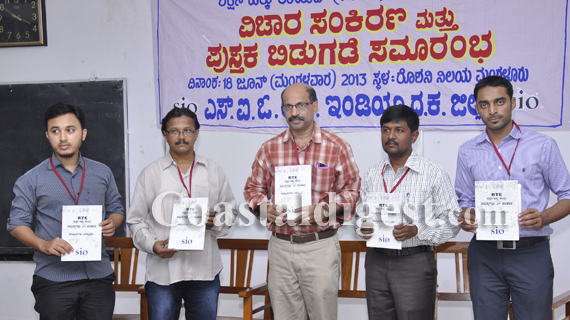
A book 'RTE: Samasye Mattu Parihara; Maadhyamagalu Yenennuttave…' was released by Joseline Lobo, Assistant Professor, Roshni Nilaya School of Social Work, Mangalore, on the occasion.
Shoukath Ali K, Sub-editor, Sanmarga weekly, also spoke.

Comments
Add new comment