



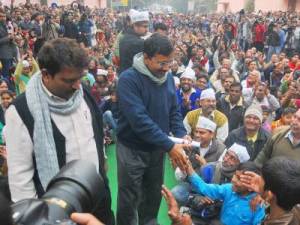
Arvind Kejriwal to ride metro to swearing-in ceremony ; tight security at venue

December 28, 2013

Arvind_Kejriwal
New Delhi, Dec 28: Around 1,600 Delhi Police personnel will keep tight vigil at Ramlila Ground on Saturday where Aam Aadmi Party leader Arvind Kejriwal will be sworn in as seventh chief minister of the national capital.

The security wing will secure the stage where Delhi lieutenant governor Najeeb Jung will administer the oath of office and secrecy to Kejriwal and six other ministers, only the second time it is being done at a public function.

In 1996, BJP leader Sahib Singh Verma had taken oath at a ceremony in Chhatrasal Stadium.

In order to ensure foolproof security, different units of Delhi Police have been entrusted with separate jobs.

A central control room has been set up at the venue for real-time monitoring and to ensure proper coordination among security personnel. Senior Delhi police officials will be present in the control room to supervise the entire event.

Arrangements related to law and order and crowd management will be the responsibility of the staff of the Central Range while the Traffic Police will make arrangements to regulate vehicular movements.

CCTV cameras have been installed at more than 20 strategic locations and spotters will be deployed during the event at neighbouring high-rise buildings.

Delhi Police commandos and bomb squads will also be deployed along with anti-riot police and vehicles at the venue.

The venue will be sanitized once this evening and again on Saturday morning by metal detectors and sniffer dogs. Other then the armed policemen in uniform, those in plain cloths will also be present among the crowd and around the venue during the event.

"We are expecting a turnout of 30 to 35 thousand for the swearing-in ceremony tomorrow. Sufficient security arrangements have been put in place. Every visitor will be frisked properly manually and doorframe metal detectors have been put in place at the entry gates of the venue," said a senior Delhi Police official.

Out of the five entry gates, one of them will be reserved for VIPs while three will be open for public entry. The fourth gate has been kept for contingency, police said.

Kejriwal had on Monday, during his meeting with Delhi LG Najeeb Jung expressed his desire to take oath at Ramlila Maidan, as the venue was associated with the Jan Lokpal movement and he also wanted the people to be part of the event.

Delhi Police had swung into action on Monday itself, even before the date was decided for the ceremony.

Senior Police Officials including Special Commissioner (Law and Order) Deepak Mishra, Joint commissioner (Central range) Sandeep Goel, DCP (central) Alok Verma along with a team of officials had inspected the venue on Monday to determine the kind of security apparatus needed to be put in place for the oath taking ceremony.

The officials then returned and a meeting was held in the Delhi Police headquarters which was headed by Delhi Police Commissioner B S Bassi and other senior officials where security arrangements for the swearing in ceremony were chalked out.

According to sources, senior officials are constantly reviewing the security arrangements at the venue and the exercise will go on till the very last minute to streamline the entire apparatus.

Kejriwal to pay homage at Rajghat before starting work

Ghaziabad: Soon after taking oath as Delhi chief minister on Saturday, Arvind Kejriwal will visit Rajghat before leaving for his first Cabinet meeting.

The Cabinet meeting is scheduled to take place at 2pm.

"After taking oath as Delhi's CM, I will call a cabinet meeting at 2pm on Saturday," the chief minister designate told reporters here.

Before going to the Delhi secretariat for the meeting, Kejriwal said that he will go to Rajghat to pay homage to the father of the nation.

Kejriwal said that he will also meet the transport department officials tomorrow to discuss the problems being faced by auto rickshaw drivers in Delhi.

Today, leaders of auto union met Kejriwal and put forth their twelve problems to which Kejriwal said he will look into after a meeting with the transport department officials.

Giving details of his schedule for Saturday, Kejriwal said that he will travel by metro from his house in Kaushambi to reach Barakhamba and from there he will reach Ramlila ground in his car for the swearing in ceremony.

He also said that he has spoken to Anna Hazare on Friday.

"I have spoken to Anna and he has said that he will not be able to attend the oath taking ceremony due to his ill health," Kejriwal said.

When reporters asked about his security inside the metro, Kejriwal said that he does not think that if he takes metro, there would be a security problem, adding that he is a common man and would go to venue of swearing-in ceremony as an 'aam aadmi'.

Comments

Add new comment

  • Coastaldigest.com reserves the right to delete or block any comments.
  • Coastaldigset.com is not responsible for its readers’ comments.
  • Comments that are abusive, incendiary or irrelevant are strictly prohibited.
  • Please use a genuine email ID and provide your name to avoid reject.
News Network
December 16,2025

bengal.jpg

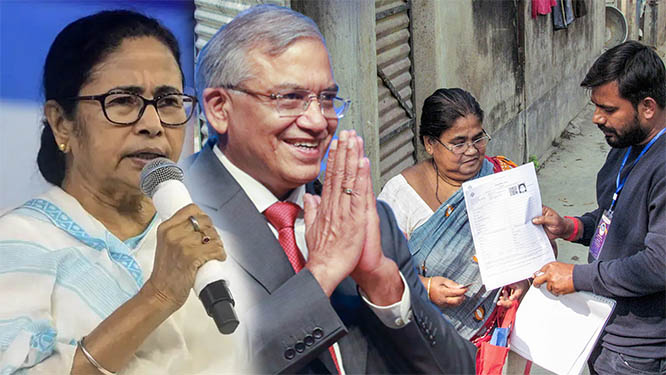
The deletion of over 58 lakh names from West Bengal’s draft electoral rolls following a Special Intensive Revision (SIR) has sparked widespread concern and is likely to deepen political tensions in the poll-bound state.

According to the Election Commission, the revision exercise has identified 24 lakh voters as deceased, 19 lakh as relocated, 12 lakh as missing, and 1.3 lakh as duplicate entries. The draft list, published after the completion of the first phase of SIR, aims to remove errors and duplication from the electoral rolls.

However, the scale of deletions has raised fears that a large number of eligible voters may have been wrongly excluded. The Election Commission has said that individuals whose names are missing can file objections and seek corrections. The final voter list is scheduled to be published in February next year, after which the Assembly election announcement is expected. Notably, the last Special Intensive Revision in Bengal was conducted in 2002.

The development has intensified the political row over the SIR process. Chief Minister Mamata Banerjee and her Trinamool Congress have strongly opposed the exercise, accusing the Centre and the Election Commission of attempting to disenfranchise lakhs of voters ahead of the elections.

Addressing a rally in Krishnanagar earlier this month, Banerjee urged people to protest if their names were removed from the voter list, alleging intimidation during elections and warning of serious consequences if voting rights were taken away.

The BJP, meanwhile, has defended the revision and accused the Trinamool Congress of politicising the issue to protect what it claims is an illegal voter base. Leader of the Opposition Suvendu Adhikari alleged that the ruling party fears losing power due to the removal of deceased, fake, and illegal voters.

The controversy comes amid earlier allegations by the Trinamool Congress that excessive work pressure during the SIR led to the deaths by suicide of some Booth Level Officers (BLOs), for which the party blamed the Election Commission. With the draft list now out, another round of political confrontation appears imminent.

As objections begin to be filed, the focus will be on whether the correction mechanism is accessible, transparent, and timely—critical factors in ensuring that no eligible voter is denied their democratic right ahead of a crucial election.

Comments

Add new comment

  • Coastaldigest.com reserves the right to delete or block any comments.
  • Coastaldigset.com is not responsible for its readers’ comments.
  • Comments that are abusive, incendiary or irrelevant are strictly prohibited.
  • Please use a genuine email ID and provide your name to avoid reject.
News Network
December 6,2025

pilot.jpg

New Delhi: IndiGo, India’s largest airline, faced major operational turbulence this week after failing to prepare for new pilot-fatigue regulations issued by the Directorate General of Civil Aviation (DGCA). The stricter rules—designed to improve flight safety—took effect in phases through 2024, with the latest implementation on November 1. IndiGo has acknowledged that inadequate roster planning led to widespread cancellations and delays.

Below are the key DGCA rules that affected IndiGo’s operations:

1. Longer Mandatory Weekly Rest

Weekly rest for pilots has been increased from 36 hours to 48 hours.

The government says the extended break is essential to curb cumulative fatigue. This rule remains in force despite the current crisis.

2. Cap on Night Landings

Pilots can now perform only two night landings per week—a steep reduction from the earlier limit of six.

Night hours, defined as midnight to early morning, are considered the least alert period for pilots.

Given the disruptions, this rule has been temporarily relaxed for IndiGo until February 10.

3. Reduced Maximum Night Flight Duty

Flight duty that stretches into the night is now capped at 10 hours.

This measure has also been kept on hold for IndiGo until February 10 to stabilize operations.

4. Weekly Rest Cannot Be Replaced With Personal Leave

Airlines can no longer count a pilot’s personal leave as part of the mandatory 48-hour rest.

Pilots say this closes a loophole that previously reduced actual rest time.

Currently, all airlines are exempt from this rule to normalise travel.

5. Mandatory Fatigue Monitoring

Airlines must submit quarterly fatigue reports along with corrective actions to DGCA.

This system aims to create a transparent fatigue-tracking framework across the industry.

The DGCA has stressed that these rules were crafted to strengthen flight safety and align India with global fatigue-management standards. The temporary relaxations are expected to remain until February 2025, giving IndiGo time to stabilise its schedules and restore normal air travel.

Comments

Add new comment

  • Coastaldigest.com reserves the right to delete or block any comments.
  • Coastaldigset.com is not responsible for its readers’ comments.
  • Comments that are abusive, incendiary or irrelevant are strictly prohibited.
  • Please use a genuine email ID and provide your name to avoid reject.
News Network
December 13,2025

New Delhi: School-going children are picking up drug and smoking habits and engaging in consumption of alcohol, with the average age of introduction to such harmful substances found to be around 13 years, suggesting a need for earlier interventions as early as primary school, a multi-city survey by AIIMS-Delhi said.

The findings also showed substance use increased in higher grades, with grade XI/XII students two times more likely to report use of substances when compared with grade VIII students. This emphasised the importance of continued prevention and intervention through middle and high school.

The study led by Dr Anju Dhawan of AIIMS's National Drug Dependence Treatment Centre, published in the National Medical Journal of India this month, looks at adolescent substance use across diverse regions.

The survey included 5,920 students from classes 8, 9, 11 and 12 in urban government, private and rural schools across 10 cities -- Bengaluru, Chandigarh, Delhi, Dibrugarh, Hyderabad, Imphal, Jammu, Lucknow, Mumbai, and Ranchi. The data were collected between May 2018 and June 2019.

The average age of initiation for any substance was 12.9 (2.8) years. It was lowest for inhalants (11.3 years) followed by heroin (12.3 years) and opioid pharmaceuticals (without prescription; 12.5 years).

Overall, 15.1 per cent of participants reported lifetime use, 10.3 per cent reported past year use, and 7.2 per cent reported use in the past month of any substance, the study found.

The most common substances used in the past year, after tobacco (4 per cent) and alcohol (3.8 per cent), were opioids (2.8 per cent), followed by cannabis (2 per cent) and inhalants (1.9 per cent). Use of non-prescribed pharmaceutical opioids was most common among opioid users (90.2 per cent).

On being asked, 'Do you think this substance is easily available for a person of your age' separately for each substance category, nearly half the students (46.3 per cent) endorsed that tobacco products and more than one-third of the students (36.5 per cent) agreed that a person of their age can easily procure alcohol products.

Similarly, for Bhang (21.9 per cent), ganja/charas (16.1 per cent), inhalants (15.2 per cent), sedatives (13.7 per cent), opium and heroin (10 per cent each), the students endorsed that these can be easily procured.

About 95 per cent of the children, irrespective of their grade, agreed with the statement that 'drug use is harmful'.

The rates of substance use (any) among boys were significantly higher than those of girls for substance use (ever), use in the past year and use in the past 30 days. Compared to grade VIII students, grade IX students were more likely, and grade XI/XII students were twice as likely to have used any substance (ever).

The likelihood of past-year use of any substance was also higher for grade IX students and for grade XI/XII students as compared to grade VIII students.

About 40 per cent of students mentioned that they had a family member who used tobacco or alcohol each. The use of cannabis (any product) and opioid (any product) by a family member was reported by 8.2 per cent and 3.9 per cent of students, respectively, while the use of other substances, such as inhalants/sedatives by family was 2-3 per cent, the study found.

A relatively smaller percentage of students reported use of tobacco or alcohol among peers as compared to among family members, while a higher percentage reported inhalants, sedatives, cannabis or opioid use among peers.

Children using substances (past year) compared to non-users reported significantly higher any substance use by their family members and peers.

There were 25.7 per cent students who replied 'yes' to the question 'conflicts/fights often occur in your family'. Most students also replied affirmatively to 'family members are aware of how their time is being spent' and 'damily members are aware of with whom they spend their time'.

Comments

Add new comment

  • Coastaldigest.com reserves the right to delete or block any comments.
  • Coastaldigset.com is not responsible for its readers’ comments.
  • Comments that are abusive, incendiary or irrelevant are strictly prohibited.
  • Please use a genuine email ID and provide your name to avoid reject.
