



New Delhi, Mar 2: In the midst of allegations, counter-allegations and leaked letters, the Aam Aadmi Party has decided to hold a meeting of its national executive on Wednesday to discuss the roles of senior leaders Yogendra Yadav and Prashant Bhushan in the party.
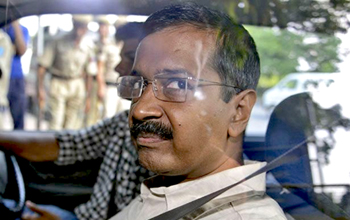
"The party will not be able to function smoothly when its senior members target Arvind ji and make efforts to defame the party," Singh told reporters.
He also said in its national executive meeting on March 4 the party will discuss the recent turn of events, including the leakage of letters, as well as the roles of Yadav and Bhushan in the party.
"Constant leaks of letters written by party members has made the party look like a joke," the party spokesperson said.
He also clarified that Kejriwal will remain the party's national convener.
According to sources, AAP founding members Yadav and Bhushan will be asked to step down from their posts in the Political Affairs Committee (PAC) or assume non-active roles amid difference on various issues. They will not be asked to leave the party but if they choose to do so, they will not be stopped, sources said.
With a series of letters leaked to the media - one by party lokpal Admiral L Ramdas, one by Yadav and Bhushan, one by Dilip Pandey and finally a rebuttal by Yadav – serious differences within the AAP, including Kejriwal's role in the party, have tumbled out in the public.
While Ramdas pointed to two camps emerging within the top leadership and asking the AAP to reconsider 'one-man, one-post' arrangement, others raised a number of problems including the treatment of volunteers, money management, donations, etc.
Pandey's letter and Singh's statements, however, show that these issues are being interpreted as a conspiracy against Kejriwal.
People close to Kejriwal such as Ashish Khetan have, meanwhile, been inducted in the Delhi government. Plans to expand to other states have also been put on hold by Kejriwal despite a keen interest shown by Yadav and several other party functionaries.
Efforts were made by leaders to contain the differences with AAP leader and former journalist Ashutosh tweeting that the developments were just a "clash of ideas" after the letter written by Bhushan became public.
Earlier on Monday, Yadav slammed the "fabricated" and "bizarre" reports about the crisis in the party involving him and colleague
Bhushan.
"Voters in Delhi have given us a huge mandate and this is the time to work more with a large heart," Yadav wrote on Twitter.
"The country has placed a lot of hope with us. And I can only appeal that we should not lower that expectation with our petty actions. I pray that better sense prevails on us," he added.
After media reports stated that the party was looking at reconstituting the Parliamentary Affairs Committee (PAC) and keeping Yadav out of it, both party members expressed a desire to leave. Kejriwal did not dissuade them, sources said.
Kejriwal did not attend the national executive meeting held on Thursday. According to party members, an argument between Yadav and other party members broke out. Another meeting was held on Friday which Yadav and Bhushan did not attend. It was in this meeting that the members asked Kejriwal to remain the national convener and reconstitute the PAC.
Bhushan in his letter had accused the party of running a "one person-centric" campaign that revolved around Kejriwal during the Delhi assembly elections saying it was contrary to the AAP's principles.
Bhushan said the campaign was making the party look like other conventional parties and called for more "swaraj" within the organisation.
"Running one person-centric campaign may be effective, but does that justify sacrificing our principles? We will need to make a conscious course correction if we have to get away from a supremo-controlled party," Bhushan said in a letter to members of the AAP's national executive, which met last Thursday.
Bhushan also sought transparency in the way funds were spent which, he claimed, was being done in an "arbitrary" manner.
"The party now receives considerable donations. There is, however, no systematic planning on how these funds are to be spend. We do not have any empowered committee or decision making system of deciding on how the funds are to be spent," he said.
"We said that we would put out all our accounts on a public website... But far from bringing party under RTI, we haven't even put our accounts on website, we've put donations but not expenses," he added.
"Our party has been built on idealism and sweat and tears of thousands of volunteers who sacrificed much to create a different party… We owe it to them and must ensure that we don't drift and become just another one man centric party," the letter went on to add.
Bhushan also accused Kejriwal of not giving more to the states to take their decision on contesting elections. Bhushan and Yadav wanted the party to contest the Haryana state elections, but another section led by Kejriwal was against it.
"Swaraj means decentralised decision making. On those principles it is the state unit who have to decide whether we should contest elections in the state. But we are deciding for them and ordering them not to contest elections.
"Even the national executive had decided when to allow the states and when to contest elections but that decision was frustrated by
Kejriwal by not allowing the states to contest elections. We made mockery of the principles of democracy and swaraj," Bhushan said.
"With the result that such decisions are being made in an arbitrary manner by a few people who are not authorised by the national executive to take such decisions. There are some volunteers who are paid by the party, but a vast majority of them are not... Even these decisions need to be taken in a systematic and democratic manner," Bhushan said.
In a public spat in June last year, Yadav had offered to quit but reconciliation was reached between him and Kejirwal.



Comments
Add new comment