



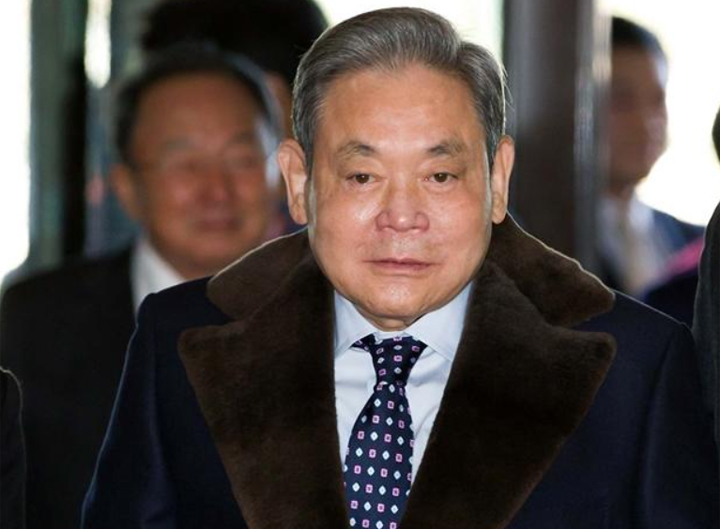
Lee Kun-hee, Korean icon who transformed Samsung, passes away at 78

News Network
October 25, 2020

samsung.JPG

Lee Kun-hee, who transformed Samsung Electronics Co. from a copycat South Korean appliance maker into the world’s biggest producer of smartphones, televisions and memory chips, has died. He was 78.

Lee passed away on Sunday with his family by his side, the company said in a statement, without mentioning the cause of death. His family will hold a private funeral. He had surgery in 2014 after a heart attack and was treated for lung cancer in the late 1990s.

Lee, who told employees to “change everything except your wife and children” during his drive to foster innovation and challenge rivals such as Sony Corp., was South Korea’s richest person. He had an estimated net worth of $20.7 billion, according to the Bloomberg Billionaires Index. Samsung, the biggest of South Korea’s family-run industrial groups, known as chaebol, has been led by his only son since the heart attack.

“Chairman Lee was a true visionary who transformed Samsung into the world-leading innovator and industrial powerhouse from a local business,” the company said. “His legacy will be everlasting.”

The reins are now set to pass to his only son Jay Y. Lee, who’s been the conglomerate’s de facto leader since his father’s hospitalization in 2014. Lee is expected to eventually inherit a $300 billion company that’s riding a Covid-era boom in online activity. Samsung, the maker of the Galaxy line of smartphones, also supplies semiconductors for Google’s data centers and Apple Inc.’s iPhone. It’s the world’s most advanced maker of displays for TVs, computers and mobile devices.

The younger Lee is currently grappling with two simultaneous legal disputes with South Korean prosecutors over allegations of bribery and corruption, which he’s repeatedly denied.

Lee Kun-hee’s heirs now face an estate tax of roughly $10 billion, and paying it may complicate the family’s control of the Samsung conglomerate -- his beneficiaries would likely have to sell some assets to cover the tax — diluting their stake in Samsung. South Korea’s levy of 50% on estates of more than 3 billion won ($2.6 million) is the second-highest among countries in the Organization for Economic Cooperation and Development, after Japan.

The Samsung empire includes 62 companies. Although the late Lee owned large chunks of some of the businesses — including 4.2% of Samsung Electronics — they’re not big enough to afford control of the conglomerate. The family depends on informal ties to executives who run related companies, and a lot of that soft power may dissipate with Lee’s death.

Global Powerhouse

It was Lee Kun-Hee who built the company into the electronics powerhouse of today, becoming synonymous with the rise of South Korea on a global economic stage.

Named one of the world’s 100 most influential people by Time magazine in 2005, Lee began overhauling Samsung Electronics after he saw the company’s products gathering dust in a Los Angeles electronics store, according to “The Lee Kun Hee Story,” a 2010 biography by Lee Kyung-sik. The Suwon, South Korea-based company had become known for cheap, low-quality electronics gear and was in the “second phase of cancer,” sending out 6,000 people to fix products made by 30,000 employees, Lee said in 1993, according to the biography.

Why Samsung’s Billionaire Scion Faces Two More Trials: QuickTake

The company’s makeover started in 1993 when Lee gathered top executives in Germany and laid out a plan, known as the Frankfurt Declaration, to transform Samsung from a second-tier television maker into an industry leader. The company’s new mission: create high-quality products, even if it meant lower sales.

Samsung Electronics became the world’s top maker of computer memory chips in 1992, the same year it became the first to develop 64-megabyte DRAM chips, according to the company.

Samsung’s Origins

Lee was born on Jan. 9, 1942, in Daegu about 240 kilometers (150 miles) south of Seoul, and was raised in the nearby rural district of Uiryeong, according to the company.

In 1938, his father Lee Byung-chull opened a four-story grocery store in Daegu that would later become Samsung Group.

As a teenager, Lee Kun-Hee liked movies and cars and kept to himself. He took up wrestling and played rugby in high school to fight loneliness. He graduated with a degree in economics from Waseda University in Tokyo and also studied business administration in the U.S. at George Washington University in Washington.

In 1971, Lee Byung-chull chose his youngest son to be his successor, and in 1974, the company moved into semiconductors when it acquired a 50% stake in unprofitable Hankook Semiconductor. The business turned profitable in 1988, helped by dynamic random-access memory chips it produced.

After the Frankfurt Declaration, Lee required employees to arrive at work at 7 a.m. instead of their usual 8:30 a.m. start, so they could “soak up reform in their slumber,” according to the biography.

In 1995, he assembled 2,000 workers to watch him make a bonfire out of 150,000 mobile phones, fax machines and other company products that didn’t meet his quality standards.

Lee’s cultural change eventually produced results. Samsung Electronics surpassed Tokyo-based Sony to become the top seller of flat-screen TVs in 2006, the same year its market value exceeded $100 billion.

In 2010, Samsung introduced the Galaxy-branded smartphone running Alphabet Inc.’s Android software, which helped it pass Apple as the world’s biggest smartphone maker in 2011 in terms of units sold. By introducing the Galaxy Note in 2011, Samsung created a new product niche known as the phablet, a smartphone-tablet hybrid.

Political Controversy

Samsung became the biggest seller of all mobile phones in 2012, unseating Nokia Oyj, which had been the industry leader for more than a decade. Its success in smartphones then boosted profits at its component businesses, including memory chips, display and processors.

Lee’s career was also notable for its setbacks and controversies. An expansion into the car business was unsuccessful. Samsung Motor Inc. rolled out its first automobiles in 1998 and failed to attract buyers. The unit was placed into receivership and Renault SA purchased a majority stake in 2000.

Lee was mired in political scandals in the late 1990s after being convicted of paying bribes to former president Roh Tae-woo in 1996. He was pardoned by President Kim Young-sam a year later.

In 2009, Lee was found guilty of tax evasion and breach of duty for causing losses at Samsung SDS Co., an information technology services provider, because he knew the company illegally sold bonds with warrants to his son at artificially low prices. He was fined 110 billion won and received a suspended three-year jail sentence.

Presidential Pardon

Four months after the 2009 ruling, South Korea’s then-President Lee Myung-bak pardoned Lee, a member of the International Olympic Committee, so he could help the country’s successful bid to host the 2018 Winter Olympics in Pyeongchang.

Lee, who resigned from the board of Samsung Electronics in 2008 amid the controversies, returned as chairman in March 2010, telling employees the business was “facing a real crisis.”

“In 10 years, the majority of products that represent Samsung may no longer exist,” he said in a statement announcing his return. “We must have a new start. There is no time to hesitate.”

Two months later, Samsung Group said it would invest 23 trillion won to expand in areas such as health care and solar batteries by 2020.

Lee’s son, Jay Y. Lee, became vice chairman of Samsung Electronics in December 2012 and his daughter, Lee Boo-jin, is president of Hotel Shilla Co., a Samsung affiliate, raising concerns that the founding family would maintain its grip on the conglomerate at the expense of minority shareholders. That issue lies at the heart of the two legal disputes the younger Lee is now embroiled in.

In August 2019, the Supreme Court ordered the retrial of Jay Y. Lee over bribery charges that voided an earlier decision to suspend Lee’s 2.5-year prison sentence. A special prosecutor had indicted the Samsung heir on charges of bribing a friend of former President Park Geun-hye in return for government backing for a merger that helped cement his control over Samsung while his father was hospitalized.

In 1967, Lee Kun-hee married Hong Ra-hee. In addition to children Jay Y. and Boo-jin, he had a daughter, Lee Seo-hyun. Another daughter, Lee Yoon-hyung, died in 2005 at age 26.

Comments

Add new comment

  • Coastaldigest.com reserves the right to delete or block any comments.
  • Coastaldigset.com is not responsible for its readers’ comments.
  • Comments that are abusive, incendiary or irrelevant are strictly prohibited.
  • Please use a genuine email ID and provide your name to avoid reject.
News Network
December 4,2025

Udupi: A 40-year-old NRI from Udupi has reportedly lost more than Rs 12.25 lakh in an online investment scam operated through Telegram.

According to a complaint filed at the CEN police station, Leo Jerome Mendonsa, who has been working in Dubai for the past 15 years in computer accessories sales, maintains NRI accounts in Karkala and Nitte.

On November 12, 2025, Mendonsa was added to a Telegram group called Instaflow Earnings by unknown individuals. Users identified as Priya and Dipannita persuaded him to invest in “Revenue Tasks.” Initially, Mendonsa transferred Rs 1,100 multiple times and received the promised returns, encouraging him to continue.

On November 14, another user, Nishmitha Shetty, directed him to register on a website, digitvisionuoce.cc, and invest Rs 4 lakh in various shares. Over the next few days, he made multiple transfers totaling Rs 12,25,000, including Rs 50,000 via Google Pay, believing the scheme was legitimate.

After receiving the money, the alleged handlers stopped responding, and neither the invested amount nor the promised profits were returned.

The CEN police have registered a case under Sections 66(C) and 66(D) of the IT Act and Section 318(4) of the Bharatiya Nyaya Sanhita (BNS), and investigations are ongoing.

Comments

Add new comment

  • Coastaldigest.com reserves the right to delete or block any comments.
  • Coastaldigset.com is not responsible for its readers’ comments.
  • Comments that are abusive, incendiary or irrelevant are strictly prohibited.
  • Please use a genuine email ID and provide your name to avoid reject.
News Network
November 21,2025

Bengaluru, Nov 21: The Karnataka government is facing pressure to overhaul its employment system after a high-level Cabinet sub-committee recommended the complete phase-out of job outsourcing in government offices, boards, and corporations by March 2028. The move is aimed at tackling a systemic issue that has led to the potential violation of constitutional reservation policies and the exploitation of workers.

The Call for Systemic Change

With over three lakh vacant posts currently being filled through private agencies on an outsource, insource, or daily wage basis, the sub-committee highlighted a significant lapse. "As a result, reservations are not being followed as per the Constitution and state laws. It’s an urgent need to take serious steps to change the system. It has been recommended to completely stop the system of outsourcing by March 2028," the panel stated in a document.

The practice of outsourcing involves private companies hiring workers to perform duties for a government agency. Critics argue this model results in lesser salaries, a lack of social security benefits (otherwise available to permanent government employees), and a failure to adhere to the provisions of Articles 14 and 15 of the Constitution, which guarantee equality before the law and prohibit discrimination.

The 'Bidar Model' as a Stop-Gap Solution

To regulate the current mode of employment and reduce worker exploitation until the 2028 deadline, the government plans to establish workers’ services multi-purpose cooperative societies across all districts, following the successful "Bidar Model."

The Bidar District Services of Labour Multi-purpose Cooperative Society Ltd., which operates under the District Commissioner, is cited as a successful example of providing a measure of social security to outsourced staff. Labour Department officials argue this society ensures workers receive their due wages and statutory facilities like ESI (Employees' State Insurance) and PF (Provident Fund), in exchange for a 1% service fee collected from the employees.

legislative push and Priority Insourcing

The recommendations, led by the sub-committee headed by Law and Parliamentary Affairs Minister H K Patil, are set to be discussed at the next Cabinet meeting. The committee has proposed the introduction of the Karnataka Outsourced Employees (Regulation, Placement and Welfare) Bill 2025.

In a move addressing immediate concerns, Labour Minister Santosh Lad, a member of the sub-committee, has reportedly assured that steps will be taken over the next 2-3 years to insource workers in "life-threatening services" on a priority basis. This includes essential personnel like pourakarmikas (sanitation workers), drivers, electrical staff in the Energy Department, and Health Department staff handling contagious diseases. The transition aims to grant these workers the long-term security and benefits they currently lack under the outsourcing system. 

Comments

Add new comment

  • Coastaldigest.com reserves the right to delete or block any comments.
  • Coastaldigset.com is not responsible for its readers’ comments.
  • Comments that are abusive, incendiary or irrelevant are strictly prohibited.
  • Please use a genuine email ID and provide your name to avoid reject.
P A Hameed Padubidri
November 26,2025

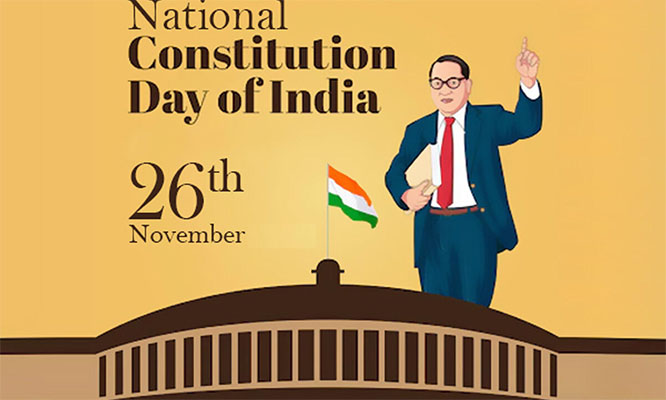
CD.jpg

Constitution Day, also known as Samvidhan Divas, is observed every year on November 26 to honor the adoption of the Constitution of India and to recognize the visionary effort that shaped the world’s largest democracy.

Historical Background

It’s on November 26, 1949, the Constituent Assembly of India formally adopted the Constitution.This date is commemorated to acknowledge the completion of nearly three years of drafting, debate, and refinement.

On January 26, 1950, the Constitution came into force, marking India’s transition from a dominion to a sovereign republic.

The date 26 January was chosen to honor the “Purna Swaraj” declaration made in 1930 that marked the relentless efforts & sacrifices of the many. 

Why Constitution Day is Celebrated

* To honor & remember the framers of the Constitution, especially Dr. B. R. Ambedkar, the Chairman of the Drafting Committee, & many others. 

* To remind the citizens of the values, responsibilities, and rights enshrined in the Constitution.

* To promote constitutional values & literacy among students, institutions, and the general public.

* To reaffirm the nation’s commitment to justice, equality, liberty, fraternity and secular values. 

Vision and Significance of the Constitution

It establishes the fundamental political and legal framework for the nation.

Defines the structure, powers and functions of:
    •    The Executive
    •    The Legislature
    •    The Judiciary
    •    Guarantees a comprehensive set of Fundamental Rights, including:

-Equality before law
-Freedom of speech & expression
-Protection of life and personal liberty
-Freedom of religion
-Embeds Directive Principles of State Policy, guiding governance toward social justice and welfare.
-Introduces Fundamental Duties to ensure civic responsibility among citizens.

Key Features Celebrated on Constitution Day

-The Indian constitution is considered one of the longest written constitutions of the world. It’s systematically drafted considering almost all aspects that properly fits to the country. 

-Blend of multiple global constitutional principles while staying rooted in Indian values and realities.

-Framework that balances Federalism, Secularism, Democracy and Rule of Law. This makes everyone-from President to common man-below the law & are equal in the sight of law. 

-Another feature is that it’s based on built-in mechanisms for amendments, ensuring the Constitution grows with changing needs.

Message of the Day

The core ethos of this  Constitution Day is not merely about looking back at history-it’s a reminder of the continuous duty to protect democratic values, respect diversity and uphold the principles that define India as a sovereign, socialist, secular and democratic republic.

Happy Constitution Day to all my compatriots

Comments

Add new comment

  • Coastaldigest.com reserves the right to delete or block any comments.
  • Coastaldigset.com is not responsible for its readers’ comments.
  • Comments that are abusive, incendiary or irrelevant are strictly prohibited.
  • Please use a genuine email ID and provide your name to avoid reject.