



Bhopal tragedy in UN list of major industrial accidents

April 20, 2019

United Nations, Apr 20: The 1984 Bhopal gas tragedy which killed thousands of people is among the world's "major industrial accidents" of the 20th century, a UN report has said, warning that 2.78 million workers die from occupational accidents and work-related diseases each year.

The report released by the UN labour agency International Labour Organization (ILO) said in 1984, at least 30 tons of methyl isocyanate gas, which was released from the Union Carbide pesticide plant in the Madhya Pradesh capital, affected more than 600,000 workers and nearby inhabitants.

"The Government figures estimate that there have been 15,000 deaths as a result of the disaster over the years. Toxic material remains and thousands of survivors and their descendants have suffered from respiratory diseases and from damage to internal organs and immune systems," it said.

The report titled 'The Safety and Health at the Heart of the Future of Work - Building on 100 years of experience' said the Bhopal disaster was among the world's "major industrial accidents after 1919".

Among the other nine major industrial disasters after 1919 listed in the report are the Chernobyl and Fukushima nuclear disasters as well as the Rana Plaza building collapse.

In the Chernobyl disaster in April 1986, one of four nuclear reactors at the Chernobyl power station in Ukraine exploded, releasing at least 100 times more radiation than the atom bombs dropped on Nagasaki and Hiroshima.

The explosion killed 31 people immediately and thousands of people in the aftermath.

"The number of casualties in the region increases every year due to long term effects including a sharp increase in thyroid cancer," the report said.

Following a major 9.0 magnitude earthquake and tsunami which struck north-eastern Japan in March 2011, the Fukushima nuclear power plants experienced equipment failures which caused a series of explosions, fires and radiation releases, causing injuries to plant workers and emergency responders, it said.

In one of the worst industrial disasters in Bangladesh, the Rana Plaza building in Dhaka collapsed in April 2013. The building, which housed five garment factories, killed at least 1,132 people and injured more than 2,500.

According to recent estimates released by the ILO, each year 2.78 million workers die from occupational accidents and work-related diseases (of which 2.4 million are disease-related).

An additional 374 million workers suffer from non-fatal occupational accidents. It is estimated that lost work days globally represent almost four per cent of the world's GDP, and in some countries, this rises to six per cent or more.

The report attributes stress, excessively-long working hours and disease to worker casualty every year, underlining ILO's message that no paid work should threaten a worker's wellbeing, safety or life.

The agency also identified several new or existing occupational risks of growing concern, that affect women more than men.

These include modern working practices overall, world population growth, increased digital connectivity and climate change, which are believed to account for losses of almost four per cent of the global economy.

"The world of work has changed, we're working differently, we're working longer hours, we're using more technology," ILO's Manal Azzi told UN News.

"The report says 36 per cent of workers are working excessive long hours, meaning more than 48 hours per week," she said.

Noting that "people are increasingly asked to produce more and more, they have no time to rest," Azzi highlighted that women are particularly at risk because they tend to be the primary carer for children or parents and lack the time to exercise.

"Not only do you work when you're at your office but then you're working at home as well," Azzi said, adding that "so it's a lot of sedentary work and that affects cardiovascular diseases as well".

The greatest proportion of work-related deaths – 86 per cent – come from disease, according to the ILO, with some 6,500 people a day dying from occupational diseases, compared to 1,000 from fatal occupational accidents.

The greatest causes of mortality are circulatory diseases (31 per cent), work-related cancers (26 per cent) and respiratory diseases (17 per cent).

"As well as the economic cost we must recognise the immeasurable human suffering such illnesses and accidents cause. These are all-the-more tragic because they are largely preventable," Azzi said.

Launched during the ILO's centenary year – and ahead of the World Day for Safety and Health at Work on April 28, the report underlines the life-saving value of promoting prevention, to save lives and encourage healthy working environments.

"Serious consideration should also be given to the recommendation of the ILO's Global Commission on the Future of Work, that occupational safety and health be recognised as a fundamental principle and right at work," Azzi said.

The report said that new risks may emerge whereas other risks may be on the rise.

"While the road ahead presents many new challenges to safety and health at work, it is important for governments, employers and workers, and other stakeholders to seize the opportunities to create a safe and healthy future of work for all," it said.

Since 1919, the ILO has adopted more than 40 international labour standards promoting occupational health and safety.

Comments

Add new comment

  • Coastaldigest.com reserves the right to delete or block any comments.
  • Coastaldigset.com is not responsible for its readers’ comments.
  • Comments that are abusive, incendiary or irrelevant are strictly prohibited.
  • Please use a genuine email ID and provide your name to avoid reject.
News Network
November 28,2025

ministerPM.jpg

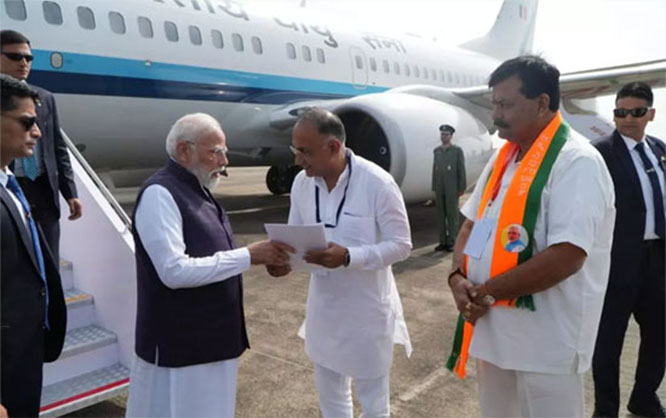
Mangaluru, Nov 28: Karnataka Health Minister and Dakshina Kannada district in-charge minister Dinesh Gundu Rao on Friday handed over Chief Minister Siddaramaiah’s letter to Prime Minister Narendra Modi, highlighting the severe distress faced by farmers due to crashing crop prices.

PM Modi arrived at the Mangaluru International Airport en route to Udupi, where Gundu Rao welcomed him and submitted the letter. The chief minister’s message stressed that farmers are suffering heavy losses because maize and green gram are being bought far below the Minimum Support Price (MSP). The state urged the Centre to immediately begin procurement at MSP.

According to the letter, Karnataka has a bumper harvest this year—over 54.74 lakh metric tons of maize and 1.98 lakh metric tons of green gram—yet farmers are unable to secure fair prices. Against the MSP of ₹2,400/MT for maize and ₹8,768/MT for green gram, market rates have plunged to ₹1,600–₹1,800 and ₹5,400 respectively.

The chief minister has requested the Centre to:

• Direct NAFED, FCI and NCCF to start MSP procurement immediately.
• Ensure ethanol units purchase maize directly from farmers or FPOs.
• Increase Karnataka’s ethanol allocation, citing high production capacity.
• Stop maize imports, which have depressed domestic prices.
• Relax quality norms for green gram, allowing up to 10% discoloration due to rains.

The letter stresses that MSP is crucial for farmer dignity and income stability and calls for swift central intervention to prevent a deepening crisis.

Comments

Add new comment

  • Coastaldigest.com reserves the right to delete or block any comments.
  • Coastaldigset.com is not responsible for its readers’ comments.
  • Comments that are abusive, incendiary or irrelevant are strictly prohibited.
  • Please use a genuine email ID and provide your name to avoid reject.
News Network
November 24,2025

Mangaluru, Nov 24: The original departure time of 11.10 pm was a distant memory for scores of Dammam-bound passengers at Mangaluru International Airport last Friday night, as their Air India Express flight was abruptly cancelled at the eleventh hour, sparking hours of frustration and chaos.

The flight, IX 885, initially scheduled to depart at 11.10 pm on November 22, was subject to two back-to-back reschedules—first pushed to 11.45 pm and then significantly postponed to 1.40 am—before the final, crushing announcement of cancellation was made. For the travellers, many of whom are likely expatriate workers with tight schedules, the last-minute change marked the beginning of a distressing ordeal.

"There was no drinking water, no food, and absolutely no proper guidance. We were left stranded like refugees," complained a stranded passenger.

According to multiple passenger accounts, the airline's ground staff failed to provide adequate support or essential amenities following the cancellation. Complaints poured in about the total absence of drinking water, food provisions, and any reliable guidance from the carrier's representatives. Travellers alleged they were left stranded for a considerable period, with no immediate arrangements or clear communication offered regarding accommodation or alternative travel to send them back home.

The incident has highlighted serious concerns over the carrier's contingency planning and customer service protocols during flight disruptions at one of India's key international gateways. The airline is yet to issue a comprehensive statement addressing the alleged lapse in passenger care.
 

Comments

Add new comment

  • Coastaldigest.com reserves the right to delete or block any comments.
  • Coastaldigset.com is not responsible for its readers’ comments.
  • Comments that are abusive, incendiary or irrelevant are strictly prohibited.
  • Please use a genuine email ID and provide your name to avoid reject.
News Network
December 2,2025

Mangaluru, Dec 2: Mangaluru International Airport responded to a medical emergency late on Monday night. Air India Express flight IX 522, travelling from Riyadh to Thiruvananthapuram, was diverted to Mangaluru Airport after a passenger in his late 30s experienced a medical emergency on board.

The Airport’s Operations Control Centre received an alert regarding the passenger’s health condition. The airport activated its emergency response protocol, mobilising the airport medical team and coordinating with stakeholders including CISF, immigration, and customs. 

Upon landing, airport medical personnel attended to the passenger, assessed his condition, and arranged to shift him to a local tertiary-care hospital for further treatment. The passenger’s relatives accompanied the passenger, who incidentally received necessary medical care on board, which helped stabilise the situation.

Following the handling of the emergency, the flight departed for Thiruvananthapuram at 2:05 am on Tuesday.

"We appreciate the cooperation of all parties involved, and this incident reaffirms our ongoing commitment to prioritising passenger safety and readiness to respond to unforeseen emergencies with professionalism and care," the Airport spokesperson said. 

Comments

Add new comment

  • Coastaldigest.com reserves the right to delete or block any comments.
  • Coastaldigset.com is not responsible for its readers’ comments.
  • Comments that are abusive, incendiary or irrelevant are strictly prohibited.
  • Please use a genuine email ID and provide your name to avoid reject.