BJP agrees to maintain status quo on Article 370

March 2, 2015

Jammu, Mar 2: PDP chief Mufti Mohammad Sayeed called for peace Sunday after taking oath as chief minister of Jammu and Kashmir, heading a coalition that brought the BJP to power for the first time in India's only Muslim-majority state.
Sayeed sworn

Prime Minister Narendra Modi and BJP leaders Amit Shah and L.K. Advani were among the 1,400 guests who witnessed the ceremony, over two months after the PDP and the BJP won 28 and 25 seats respectively in a hung verdict that exposed deep divisions between the Muslim and Hindu areas.

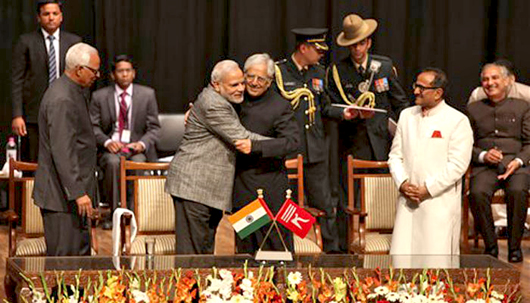
After taking oath in English, Sayeed, 79, warmly hugged Modi and sat close to him on a flower-decked stage at the Jammu University's General Zorawar Singh auditorium to witness the entire ceremony.

Later, addressing the media, Sayeed said he had told Modi that peace was a must if Jammu and Kashmir had to prosper.

He said the Modi government must address the need for a dialogue between India and Pakistan, two countries which dispute the ownership of Jammu and Kashmir. Kashmiris, he said, must be involved in the process.

In an indication as to what he desired, Sayeed lavished praise on former prime minister and now ailing BJP leader Atal Bihari Vajpayee for starting a peace process with Pakistan in 2003 - when Sayeed was chief minister the first time.

And in comments that would not have pleased many BJP supporters, he credited Pakistan, the separatist Hurriyat group and militants for what he said was a peaceful ballot in November-December last year.

"The PDP-BJP government is a historic opportunity to fulfil the aspirations of the people of Jammu and Kashmir and take the state to new heights of progress," Modi tweeted.

The National Conference and the Congress stayed away from the oath-taking ceremony.

National Conference leader Omar Abdullah took a dig at BJP ministers for taking oath to uphold the Jammu and Kashmir constitution - the only Indian state to have its own constitution and a flag.

Son of a religious preacher from the Kashmir Valley, Sayeed will head the government of his Peoples Democratic Party and the Bharatiya Janata Party, and will be the chief minister for all of six years.

BJP leader Nirmal Singh will be the deputy chief minister. He said the two parties would provide a stable government.

Former separatist leader Sajjad Gani Lone took oath as a BJP ally, and then warmly hugged Modi and Sayeed, triggering thunderous applause.

Inclusive of Sayeed, the PDP will have 11 cabinet berths and the BJP six, Lone included. The PDP and BJP have three and five junior ministers respectively. Two of the junior ministers are women: Priya Sethi (BJP) and Asiya Naqash (PDP).

The PDP cabinet ministers are Abdul Rehman Bhat Veeri, Javaid Mustafa Mir, Abdul Haq Khan, Syed Basharat Bukhari, Chowdhary Zulfiqar Ali, Haseeb Drabu, Ghulam Nabi Lone Hanjura, Altaf Bukhari, Imran Raza Ansari and Naeem Akhtar.

The BJP's cabinet members are Nirmal Singh, Chander Prakash, Choudhary Lal Singh, Bali Baghat, Sukhnandan Kumar and Lone (Peoples Conference).

The junior ministers are Chering Dorjay, Sunil Kumar Sharma, Abdul Ghani Kohli, Priya Sethi and Pawan Gupta (all BJP) and Abdul Majeed Paddar, Muhammad Ashraf Mir and Asiya Naqash (all PDP).

In the evening, the PDP and the BJP released a common minimum programme (CMP), promising to transform Jammu and Kashmir as "the most ethical state ... from the present day position of being the most corrupt state".

The CMP promised "genuine autonomy of institutions of probity", and "a sustained and meaningful dialogue" for peace with "all internal stakeholders ... irrespective of ideological views and predilections".

It revealed the continuing difference of opinion between the two parties on the controversial Armed Forces Special Powers Act, which gives sweeping powers to armed forces in the state. The PDP wants it to go.

This is the second time Sayeed heads a coalition government in Kashmir. He took power in 2002, heading a PDP-Congress alliance, for three years.

The Kashmir verdict brought about a clear divide between the Muslim-majority Kashmir Valley and the Hindu-dominated Jammu region, with the PDP winning almost all its seats in the valley and the BJP sweeping Jammu.

This is the first time the BJP is tasting power in Jammu and Kashmir, where a separatist campaign which has raged since 1989 has left thousands dead.


Comments

Add new comment

  • Coastaldigest.com reserves the right to delete or block any comments.
  • Coastaldigset.com is not responsible for its readers’ comments.
  • Comments that are abusive, incendiary or irrelevant are strictly prohibited.
  • Please use a genuine email ID and provide your name to avoid reject.
News Network
December 16,2025

jordan.jpg

Prime Minister Narendra Modi on Monday held talks with Jordan’s King Abdullah II in Amman, during which the two leaders discussed ways to further strengthen bilateral relations, with the Prime Minister outlining an eight-point vision covering key areas of cooperation.

Describing the meeting as “productive”, PM Modi said he shared a roadmap focused on trade and economy, fertilisers and agriculture, information technology, healthcare, infrastructure, critical and strategic minerals, civil nuclear cooperation, and people-to-people ties.

In a post on social media platform X, the Prime Minister praised King Abdullah II’s personal commitment to advancing India–Jordan relations, particularly as both countries mark the 75th anniversary of the establishment of diplomatic ties this year.

“Held productive discussions with His Majesty King Abdullah II in Amman. His personal commitment towards vibrant India-Jordan relations is noteworthy. This year, we are celebrating the 75th anniversary of our bilateral diplomatic relations,” PM Modi said.

The meeting took place at the Al Husseiniya Palace, where the two leaders also exchanged views on regional and global issues of mutual interest. According to the Ministry of External Affairs (MEA), both sides agreed to further deepen cooperation in areas including trade and investment, defence and security, counter-terrorism and de-radicalisation, fertilisers and agriculture, infrastructure, renewable energy, tourism, and heritage.

The MEA said both leaders reaffirmed their united stand against terrorism.

PM Modi arrived in Amman earlier on Monday and was received by Jordanian Prime Minister Jafar Hassan, who accorded him a formal welcome. Following the talks, King Abdullah II hosted a banquet dinner in honour of the Prime Minister, reflecting the warmth of bilateral ties.

Jordan is the first leg of PM Modi’s three-nation tour. From Amman, the Prime Minister will travel to Ethiopia at the invitation of Prime Minister Abiy Ahmed Ali, marking his first official visit to the African nation. The tour will conclude with a visit to Oman.

Comments

Add new comment

  • Coastaldigest.com reserves the right to delete or block any comments.
  • Coastaldigset.com is not responsible for its readers’ comments.
  • Comments that are abusive, incendiary or irrelevant are strictly prohibited.
  • Please use a genuine email ID and provide your name to avoid reject.
News Network
December 6,2025

pilot.jpg

New Delhi: IndiGo, India’s largest airline, faced major operational turbulence this week after failing to prepare for new pilot-fatigue regulations issued by the Directorate General of Civil Aviation (DGCA). The stricter rules—designed to improve flight safety—took effect in phases through 2024, with the latest implementation on November 1. IndiGo has acknowledged that inadequate roster planning led to widespread cancellations and delays.

Below are the key DGCA rules that affected IndiGo’s operations:

1. Longer Mandatory Weekly Rest

Weekly rest for pilots has been increased from 36 hours to 48 hours.

The government says the extended break is essential to curb cumulative fatigue. This rule remains in force despite the current crisis.

2. Cap on Night Landings

Pilots can now perform only two night landings per week—a steep reduction from the earlier limit of six.

Night hours, defined as midnight to early morning, are considered the least alert period for pilots.

Given the disruptions, this rule has been temporarily relaxed for IndiGo until February 10.

3. Reduced Maximum Night Flight Duty

Flight duty that stretches into the night is now capped at 10 hours.

This measure has also been kept on hold for IndiGo until February 10 to stabilize operations.

4. Weekly Rest Cannot Be Replaced With Personal Leave

Airlines can no longer count a pilot’s personal leave as part of the mandatory 48-hour rest.

Pilots say this closes a loophole that previously reduced actual rest time.

Currently, all airlines are exempt from this rule to normalise travel.

5. Mandatory Fatigue Monitoring

Airlines must submit quarterly fatigue reports along with corrective actions to DGCA.

This system aims to create a transparent fatigue-tracking framework across the industry.

The DGCA has stressed that these rules were crafted to strengthen flight safety and align India with global fatigue-management standards. The temporary relaxations are expected to remain until February 2025, giving IndiGo time to stabilise its schedules and restore normal air travel.

Comments

Add new comment

  • Coastaldigest.com reserves the right to delete or block any comments.
  • Coastaldigset.com is not responsible for its readers’ comments.
  • Comments that are abusive, incendiary or irrelevant are strictly prohibited.
  • Please use a genuine email ID and provide your name to avoid reject.
News Network
December 6,2025

indigoticket.jpg

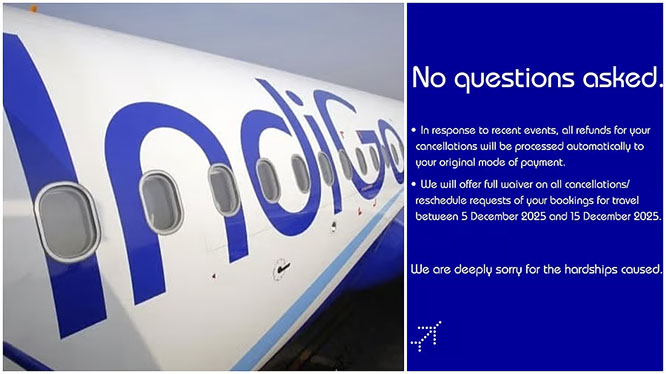
With IndiGo flight disruptions impacting thousands of passengers, the airline on Saturday said that it will offer full waiver on all cancellations/reschedule requests for travel bookings between December 5, 2025 and December 15, 2025.

Earlier in the day, the civil aviation ministry had directed the airline to complete the ticket refund process for the cancelled flights by Sunday evening, as well as ensure baggage separated from the travellers are delivered in the next two days.

In a post on X, titled 'No questions asked', IndiGo wrote, "In response to recent events, all refunds for your cancellations will be processed automatically to your original mode of payment."

"We are deeply sorry for the hardships caused," it further added.

Several passengers, however, complained of not getting full refund as promised by the airline.

Netizens have shared screenchots of getting charged for airline cancellation fee and convenience fee.

"Please tell me why u have did this airline cancellation charges when u say full amount will be refunded (sic)," a user wrote sharing a screenshot of the refund page.

"Well, but you have still debited the convenience charges," wrote another.

Passengers have also raised concerns about the "cancel" option being disabled on the IndiGo app. "First enable the 'Cancel' button on your App & offer full refund on tickets cancelled by customers between the said dates," wrote a user.

A day after the country's largest airline, IndiGo, cancelled more than 1,000 flights and caused disruptions for the fifth day on Saturday, the ministry said that any delay or non-compliance in refund processing will invite immediate regulatory action.

The refund process for all cancelled or disrupted flights must be completed by 8 pm on Sunday, the ministry said in a statement.

"Airlines have also been instructed not to levy any rescheduling charges for passengers whose travel plans were affected by cancellations," it said.

On Saturday, more than 400 flights were cancelled at various airports.

IndiGo has also been instructed to set up dedicated passenger support and refund facilitation cells.

Comments

Add new comment

  • Coastaldigest.com reserves the right to delete or block any comments.
  • Coastaldigset.com is not responsible for its readers’ comments.
  • Comments that are abusive, incendiary or irrelevant are strictly prohibited.
  • Please use a genuine email ID and provide your name to avoid reject.