



Budget session: All you need to know about the schedule, agenda, hurdles ahead

February 23, 2015

New Delhi, Delhi 23: The government, which is looking to pass key legislation, is set to face a stormy Budget session starting Monday despite its promise to walk the “extra mile” to accommodate the opposition’s concerns.
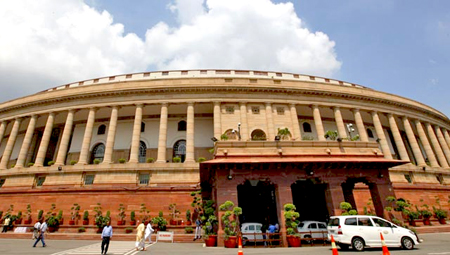
Budget session
On Sunday, Prime Minister Narendra Modi assured the Opposition of addressing all its concerns as his government sought support for the bills that will replace six ordinances, including the one that aims to overhaul the land law.

Parliament opens on Monday for what will be the first full budget session of the Modi government. The budget -- to be presented on February 28 -- will be closely watched for the economic path the government charts. The session will be a test of the NDA's floor management skills with a heavy legislative agenda lined up.

The session will begin with President Pranab Mukherjee's address to members of both Houses of Parliament that will indicate the government's agenda for the session.

"I can assure you that all the issues you have referred to will be discussed adequately and appropriately," the PM told an all-party meet Sunday evening.

Modi's reach-out mission started hours earlier when parliamentary affairs minister Venkaiah Naidu drove to the 10 Janpath residence of Congress chief Sonia Gandhi in the morning.

The Congress, however, remained non-committal, saying it couldn't back bills that were "anti-people".

"We have some concerns about the land law amendments," sources quoted Sonia as telling Naidu.

It was the first official engagement between the Modi government and the Congress president.

HT reported on February 20 that a senior Modi minister may meet Sonia to end the ordinance logjam, with the government planning to bring in the bills on Day 1 itself.

Farmers and social activists, led by Anna Hazare, are planning a sit-in against the land bill, which aims to make land acquisition easy for industry, to coincide with the opening day of the session.  

While another contentious legislation — the insurance bill — wasn't discussed, Sonia did tell Naidu that it would be "good" to have detailed discussion on other ordinances as well, sources said.

At the all-party meeting, Modi said it was the collective responsibility of leaders of all parties to ensure that the session ran smoothly.

"…Hope we can collectively work for the benefit of common man," he said.

Congress leader in Lok Sabha Mallikarjun Kharge, who was also present during the Sonia-Naidu meeting, and party colleague Ghulam Nabi Azad, leader of the Opposition in Rajya Sabha, did not promise anything. The Congress parliamentary party had not met for the session, they said.

Janata Dal (United) chief Sharad Yadav said the land proposals were worse than what existed during the British time.

During the session, the focus should be on financial matters and "we must discuss the special category status for different states," Biju Janata Dal leader Bhartruhari Mahtab said.

The opposition leaders also demanded that the PM repeat on the floor of the House the remarks about the government's commitment to religious tolerance and freedom.

Agenda in Parliament

The government enjoys a brute majority in Lok Sabha but in Rajya Sabha it is outnumbered by the Opposition, whose support is critical for law-making.

Naidu, interestingly, said there was a broad consensus on "five out of six" ordinances, indicating the government's willingness to negotiate a dilution of its land ordinance.

HT wrote on Sunday that the government may water down some clauses of the land bill, dubbed anti-farmer by opposition and various social groups.

The government aims to get Parliament's nod for 44 bills during the session. The coal block auction, insurance and motor vehicles law amendment (e-rickshaw) bills will be tabled in Rajya Sabha. The land bill will come up first in Lok Sabha.

The Rail Budget will be presented February 26, Economic Survey February 27 and General Budget February 28.

An official release said the financial business (11 items) includes presentation of and discussion on General and Railway Budget, voting on demands for grants, supplementary demands for grants for 2014-15 and excess demands, if any, for 2013-14.

The legislative agenda comprises introduction, consideration and passing of seven new bills by both the houses including the finance bill, 2015, and bills replacing the six ordinances.

While 10 new bills are slated to be introduced, the government's agenda includes passing of 3 bills pending in Lok Sabha and 7 in Rajya Sabha.

Those pending in the Lok Sabha are: The Constitution (122nd Amendment) Bill, 2014 relating to introduction of GST, The Lok Pal and Lok Ayuktas and other Related Law (Amendment) Bill, 2014 and The Repealing and Amending Bill, 2014. After being passed by Lok Sabha, these bills will be taken up by Rajya Sabha.

Bills pending in Rajya Sabha include 4 bills already passed by Lok Sabha - The Companies (Amendment) Bill, 2014, The Public Premises Eviction of Unauthorised Occupants) Amendment Bill, 2014, The Regional Rural Banks (Amendment) Bill, 2014, The Repealing and Amending (Second) Bill, 2014, and the Payments and Settlement Systems(Amendment) Bill, 2014.

Other pending bills are: The Prevention of Corruption (Amendment) Bill, 2013 and The Constitution (Scheduled Casts) Orders (Amendment) Bill, 2014.

The new bills pertain to on the National Cooperative Development Corporation, the Warehousing Corporation, Andhra Pradesh reorganisation, arbitration and conciliation, repeal of appropriation acts, registration of births and deaths, whistle blowers protection, Indian Institutes of Management, National Academic Depository and Identification of Scheduled Castes.

The non-legislative business for the session includes discussion on the motion of thanks to the President's address.

There will be 20 working days during the first half of Budget session and 13 in the second half.

During the intervening recess, standing committees will take up detailed examination of the demands for grants of different ministries.


 

Comments

Add new comment

  • Coastaldigest.com reserves the right to delete or block any comments.
  • Coastaldigset.com is not responsible for its readers’ comments.
  • Comments that are abusive, incendiary or irrelevant are strictly prohibited.
  • Please use a genuine email ID and provide your name to avoid reject.
News Network
December 16,2025

bengal.jpg

The deletion of over 58 lakh names from West Bengal’s draft electoral rolls following a Special Intensive Revision (SIR) has sparked widespread concern and is likely to deepen political tensions in the poll-bound state.

According to the Election Commission, the revision exercise has identified 24 lakh voters as deceased, 19 lakh as relocated, 12 lakh as missing, and 1.3 lakh as duplicate entries. The draft list, published after the completion of the first phase of SIR, aims to remove errors and duplication from the electoral rolls.

However, the scale of deletions has raised fears that a large number of eligible voters may have been wrongly excluded. The Election Commission has said that individuals whose names are missing can file objections and seek corrections. The final voter list is scheduled to be published in February next year, after which the Assembly election announcement is expected. Notably, the last Special Intensive Revision in Bengal was conducted in 2002.

The development has intensified the political row over the SIR process. Chief Minister Mamata Banerjee and her Trinamool Congress have strongly opposed the exercise, accusing the Centre and the Election Commission of attempting to disenfranchise lakhs of voters ahead of the elections.

Addressing a rally in Krishnanagar earlier this month, Banerjee urged people to protest if their names were removed from the voter list, alleging intimidation during elections and warning of serious consequences if voting rights were taken away.

The BJP, meanwhile, has defended the revision and accused the Trinamool Congress of politicising the issue to protect what it claims is an illegal voter base. Leader of the Opposition Suvendu Adhikari alleged that the ruling party fears losing power due to the removal of deceased, fake, and illegal voters.

The controversy comes amid earlier allegations by the Trinamool Congress that excessive work pressure during the SIR led to the deaths by suicide of some Booth Level Officers (BLOs), for which the party blamed the Election Commission. With the draft list now out, another round of political confrontation appears imminent.

As objections begin to be filed, the focus will be on whether the correction mechanism is accessible, transparent, and timely—critical factors in ensuring that no eligible voter is denied their democratic right ahead of a crucial election.

Comments

Add new comment

  • Coastaldigest.com reserves the right to delete or block any comments.
  • Coastaldigset.com is not responsible for its readers’ comments.
  • Comments that are abusive, incendiary or irrelevant are strictly prohibited.
  • Please use a genuine email ID and provide your name to avoid reject.
News Network
December 6,2025

pilot.jpg

New Delhi: IndiGo, India’s largest airline, faced major operational turbulence this week after failing to prepare for new pilot-fatigue regulations issued by the Directorate General of Civil Aviation (DGCA). The stricter rules—designed to improve flight safety—took effect in phases through 2024, with the latest implementation on November 1. IndiGo has acknowledged that inadequate roster planning led to widespread cancellations and delays.

Below are the key DGCA rules that affected IndiGo’s operations:

1. Longer Mandatory Weekly Rest

Weekly rest for pilots has been increased from 36 hours to 48 hours.

The government says the extended break is essential to curb cumulative fatigue. This rule remains in force despite the current crisis.

2. Cap on Night Landings

Pilots can now perform only two night landings per week—a steep reduction from the earlier limit of six.

Night hours, defined as midnight to early morning, are considered the least alert period for pilots.

Given the disruptions, this rule has been temporarily relaxed for IndiGo until February 10.

3. Reduced Maximum Night Flight Duty

Flight duty that stretches into the night is now capped at 10 hours.

This measure has also been kept on hold for IndiGo until February 10 to stabilize operations.

4. Weekly Rest Cannot Be Replaced With Personal Leave

Airlines can no longer count a pilot’s personal leave as part of the mandatory 48-hour rest.

Pilots say this closes a loophole that previously reduced actual rest time.

Currently, all airlines are exempt from this rule to normalise travel.

5. Mandatory Fatigue Monitoring

Airlines must submit quarterly fatigue reports along with corrective actions to DGCA.

This system aims to create a transparent fatigue-tracking framework across the industry.

The DGCA has stressed that these rules were crafted to strengthen flight safety and align India with global fatigue-management standards. The temporary relaxations are expected to remain until February 2025, giving IndiGo time to stabilise its schedules and restore normal air travel.

Comments

Add new comment

  • Coastaldigest.com reserves the right to delete or block any comments.
  • Coastaldigset.com is not responsible for its readers’ comments.
  • Comments that are abusive, incendiary or irrelevant are strictly prohibited.
  • Please use a genuine email ID and provide your name to avoid reject.
