Fraud applications: Indian students face ban / restrictions from 5 Australian universities

News Network
April 18, 2023

aus.jpg

At least five Australian universities have placed bans or restrictions on students from some Indian states, amidst a surge in fraudulent applications from South Asia seeking to work – not study – in this country, according to a media report.

Australia is on track for its biggest-ever annual intake of Indian students, topping 2019’s high watermark of 75,000.

But the current surge has prompted concerns from lawmakers and the education sector about the integrity of Australia’s immigration system and the long-term impact on the nation’s lucrative international education market, The Sydney Morning Herald newspaper reported on Tuesday.

“The volume of students arriving has come back a lot stronger than anyone was expecting,” said Jon Chew from global education firm Navitas.

 “We knew there would be a lot of pent-up demand, but there has also been a surge in non-genuine students,” Chew was quoted as saying.

With many applications deemed by universities not to meet Australian visa requirements that they are a “genuine temporary entrant” coming solely for education, universities are putting restrictions in place to pre-empt their “risk rating” being downgraded, the report said.

An investigation by The Age and The Sydney Morning Herald newspapers has obtained emails from within Victoria University, Edith Cowan University, the University of Wollongong, Torrens University, and agents working for Southern Cross University that show the crackdown on applications from Indian students.

Those universities that have restricted access to some Indian states are concerned Home Affairs will reduce their ability to fast-track student visas because of the number of applicants who are actually seeking to work – not study – in Australia.

Perth’s Edith Cowan University in February placed an outright ban on applicants from the Indian states of Punjab and Haryana, then in March, Victoria University increased restrictions on student applications from eight Indian states, including Uttar Pradesh, Rajasthan and Gujarat.

These restrictions came just days after Prime Minister Anthony Albanese visited India, in part to celebrate Australia’s education links and announce a new agreement with Australia’s universities and colleges that would, he said, herald “the most comprehensive and ambitious arrangement agreed to by India with any country”.

Crucially, the agreement included a “mutual recognition of qualifications between Australia and India”, which will make travelling to either country for university study easier.

The University of Wollongong in March also ratcheted up conditions on its “genuine temporary entrant” test on students from India, Nepal, Bangladesh, Pakistan, Lebanon, Mongolia, Nigeria and “other countries deemed a risk (of students not being a genuine temporary entrant) by the Department of Home Affairs”.

A spokeswoman for Adelaide’s Torrens University said it too was “now looking carefully at each area where our applications come from” after the university told The Times Higher Education in March that it was considering only “very strong” applications from Gujarat, Haryana and Punjab, the report added. 

Comments

Add new comment

  • Coastaldigest.com reserves the right to delete or block any comments.
  • Coastaldigset.com is not responsible for its readers’ comments.
  • Comments that are abusive, incendiary or irrelevant are strictly prohibited.
  • Please use a genuine email ID and provide your name to avoid reject.
Agencies
November 22,2025

indiapak.jpg

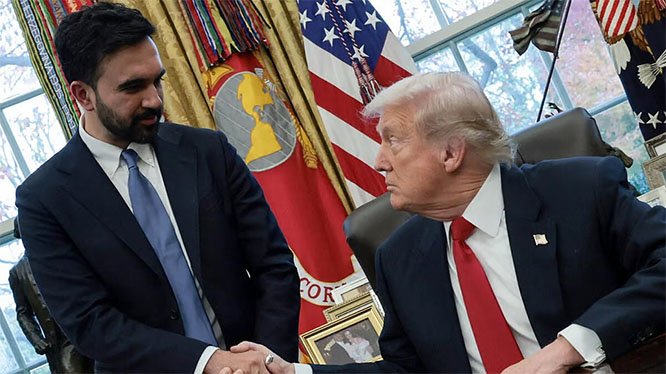
New York/Washington: US President Donald Trump has again claimed to have solved the conflict between India and Pakistan, repeating his assertion during a meeting with New York City Mayor-elect Zohran Mamdani in the Oval Office.

Mamdani flew to Washington DC for his first meeting with Trump in the White House on Friday. Trump said he “enjoyed” the meeting, which he described as “great.”

During remarks in the Oval Office, with Mamdani standing next to him, Trump repeated his claim that he solved the May conflict between India and Pakistan.

"I did eight peace deals of countries, including India and Pakistan,” he said.

On Wednesday, Trump had said he threatened to put 350 per cent tariffs on India and Pakistan if they did not end their conflict, repeating his claim that he solved the fighting between the nuclear-armed neighbours and that Prime Minister Narendra Modi had called him to say “we're not going to go to war.”

Since May 10, when Trump announced on social media that India and Pakistan had agreed to a “full and immediate” ceasefire after a “long night” of talks mediated by Washington, he has repeated his claim over 60 times that he “helped settle” the tensions between India and Pakistan.

India has consistently denied any third-party intervention. India launched Operation Sindoor on May 7, targeting terror infrastructure in Pakistan and Pakistan-occupied Kashmir in retaliation for the April 22 Pahalgam attack that killed 26 civilians. India and Pakistan reached an understanding on May 10 to end the conflict after four days of intense cross-border drone and missile strikes.

Mamdani emerged victorious in the closely-watched battle for New York City Mayor, becoming the first South Asian and Muslim to be elected to sit at the helm of the largest city in the US.

He had been the front-runner in the NYC Mayoral election for months and defeated Republican nominee Curtis Sliwa and political heavyweight former New York State Governor Andrew Cuomo, who ran as an independent candidate and was officially endorsed by Trump just hours before the elections.

Indian-descent Mamdani is the son of renowned filmmaker Mira Nair and Columbia University professor Mahmood Mamdani. He was born and raised in Kampala, Uganda and moved to New York City with his family when he was 7. Mamdani became a naturalised US citizen only recently, in 2018.

Comments

Add new comment

  • Coastaldigest.com reserves the right to delete or block any comments.
  • Coastaldigset.com is not responsible for its readers’ comments.
  • Comments that are abusive, incendiary or irrelevant are strictly prohibited.
  • Please use a genuine email ID and provide your name to avoid reject.