Citizenship Bill passed in LS amid protests

Agencies
January 8, 2019

New Delhi, Jan 8: A bill seeking to provide Indian citizenship to non-Muslims from Bangladesh, Pakistan and Afghanistan was approved by the Lok Sabha on Tuesday.
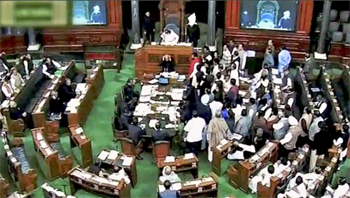
Piloting the contentious Citizenship (Amendment) Bill 2019, Home Minister Rajnath Singh told the Opposition that the bill was not against the provisions of the Constitution and would give succour to persecuted minorities in the three neighbouring countries.

The Bill provides for according Indian citizenship to the Hindus, Jains, Christians, Sikhs, Buddhists and Parsis from Bangladesh, Pakistan and Afghanistan after six years of residence in India instead of 12 years even if they do not possess any document.

"They have no place to go to, except India," he said, adding several leaders including first Prime Minister Jawaharlal Nehru were in favour of giving shelter to persecuted minorities in the neighbouring countries.

Seeking to assuage the concerns in the Northeast, which saw an 11-hour bandh on Tuesday against the legislation, Singh said the proposed law will not be confined to Assam alone.

"The burden of those persecuted migrants will be shared by the whole country. Assam alone should not have to bear the entire burden. The government of India is committed to give all help to the State Government and people of Assam," he said.

The BJP appears to have been isolated over the issue. The Asom Gana Parishad (AGP), a partner in the BJP-led Assam government, broke up with the saffron party while the NDA allies, the Shiv Sena and the JD(U), have opposed this legislation.

Mizoram and Meghalaya governments have opposed the bill by adopting a resolution against it in their respective cabinet meetings.

The home minister said the Union Cabinet has also approved the grant of ST status to six communities of Assam namely Tai Ahom, Koch Rajbongshi, Chutia, Tea Tribes, Moran and Matak.

The Union Cabinet's decision can be seen as a balancing act by the central government to strong opposition to the bill in Assam.

According to the Home Minister, "At the same time, full safeguards will be provided to protect the interests, rights and privileges of existing Scheduled Tribes of Assam.

"A separate Bill will be brought to grant ST status to Bodo Kacharis in Hill districts of Assam and Karbis in the rest of Assam. Sixth Schedule of the Constitution is also proposed to be amended to strengthen the Autonomous District Councils," he said.

Singh said the migrants - Hindus, Jains, Christians, Sikhs, Buddhists and Parsis - were earlier given protection against legal action in 2015 and 2016.

"Long term visa provision was made for them. The proposed amendment will make these persecuted migrants eligible to apply for citizenship," he said.

Singh said citizenship will be given to them only after due scrutiny and recommendation of district authorities and the state government.

The minimum residency period for citizenship is proposed to be reduced from the existing 12 years under the present law to seven years.

The legislation also seeks to provide relief to persecuted migrants who have come through western borders of the country to states like Gujarat, Rajasthan, Delhi, Madhya Pradesh and other states, the Home Minister said.

The bill will apply to all States and Union Territories of the country and the beneficiaries of the Citizenship Amendment Bill will be able to reside in any state of the country.

The bill was originally introduced in 2016 and was later sent to the JPC, which submitted its report on Monday.

On the basis of the recommendations of the JPC, a fresh bill was introduced on Tuesday.

Opposition parties have raised objections to the bill.

The Congress said many states have opposed the bill and it should be sent to a select committee. As the government did not heed to the demand, the Congress staged a walkout.

TMC's Saugata Roy dubbed the bill as "divisive" and "insidious" that goes against the basic tenets of the constitution.

"This is the worst form of vote-bank politics", Roy said.

Comments

Add new comment

  • Coastaldigest.com reserves the right to delete or block any comments.
  • Coastaldigset.com is not responsible for its readers’ comments.
  • Comments that are abusive, incendiary or irrelevant are strictly prohibited.
  • Please use a genuine email ID and provide your name to avoid reject.
News Network
December 19,2025

Saudi Arabia has abolished fees on expatriate workers employed in licensed industrial establishments, signaling a strong push to empower national factories and enhance the Kingdom’s global industrial competitiveness. The move reflects the leadership’s commitment to building a sustainable and resilient industrial economy under Saudi Vision 2030.

The decision was approved by the Council of Ministers, chaired by Crown Prince and Prime Minister Mohammed bin Salman, following a recommendation from the Council of Economic and Development Affairs (CEDA). It forms part of a broader strategy to support, modernize, and strengthen the industrial sector.

By removing fees on foreign workers, industrial establishments gain greater operational flexibility and relief from financial pressures. This is expected to help factories expand production, improve efficiency, and compete more effectively in international markets, while reinforcing long-term sustainability.

The initiative aligns closely with Saudi Vision 2030, which identifies industry as a key pillar of economic diversification. A competitive and resilient industrial base is viewed as essential for driving innovation, attracting investment, and sustaining long-term economic growth.

Overall, the fee exemption underscores the Kingdom’s commitment to creating a supportive environment for industrial development and ensuring that Saudi factories remain globally competitive and capable of leading the nation’s economic transformation.

Comments

Add new comment

  • Coastaldigest.com reserves the right to delete or block any comments.
  • Coastaldigset.com is not responsible for its readers’ comments.
  • Comments that are abusive, incendiary or irrelevant are strictly prohibited.
  • Please use a genuine email ID and provide your name to avoid reject.
News Network
December 6,2025

pilot.jpg

New Delhi: IndiGo, India’s largest airline, faced major operational turbulence this week after failing to prepare for new pilot-fatigue regulations issued by the Directorate General of Civil Aviation (DGCA). The stricter rules—designed to improve flight safety—took effect in phases through 2024, with the latest implementation on November 1. IndiGo has acknowledged that inadequate roster planning led to widespread cancellations and delays.

Below are the key DGCA rules that affected IndiGo’s operations:

1. Longer Mandatory Weekly Rest

Weekly rest for pilots has been increased from 36 hours to 48 hours.

The government says the extended break is essential to curb cumulative fatigue. This rule remains in force despite the current crisis.

2. Cap on Night Landings

Pilots can now perform only two night landings per week—a steep reduction from the earlier limit of six.

Night hours, defined as midnight to early morning, are considered the least alert period for pilots.

Given the disruptions, this rule has been temporarily relaxed for IndiGo until February 10.

3. Reduced Maximum Night Flight Duty

Flight duty that stretches into the night is now capped at 10 hours.

This measure has also been kept on hold for IndiGo until February 10 to stabilize operations.

4. Weekly Rest Cannot Be Replaced With Personal Leave

Airlines can no longer count a pilot’s personal leave as part of the mandatory 48-hour rest.

Pilots say this closes a loophole that previously reduced actual rest time.

Currently, all airlines are exempt from this rule to normalise travel.

5. Mandatory Fatigue Monitoring

Airlines must submit quarterly fatigue reports along with corrective actions to DGCA.

This system aims to create a transparent fatigue-tracking framework across the industry.

The DGCA has stressed that these rules were crafted to strengthen flight safety and align India with global fatigue-management standards. The temporary relaxations are expected to remain until February 2025, giving IndiGo time to stabilise its schedules and restore normal air travel.

Comments

Add new comment

  • Coastaldigest.com reserves the right to delete or block any comments.
  • Coastaldigset.com is not responsible for its readers’ comments.
  • Comments that are abusive, incendiary or irrelevant are strictly prohibited.
  • Please use a genuine email ID and provide your name to avoid reject.
News Network
December 7,2025

envoy.jpg

Since 1946, the United States has attempted 93 coups or “regime change” operations across the world — including two in Iran, US Special Envoy for Syria Tom Barrack has admitted.

Speaking to the UAE-based IMI Media Group, in remarks published by The National, Barrack said Washington tried twice to overthrow the Iranian government but failed both times. 

“For (Trump) then to be imputed with regime change — we had two regime changes in Iran already. Neither one worked. So I think wisely leave it to the region to solve,” said Barrack, who also serves as the US ambassador to Turkey.

His comments come six months after the US joined Israel in airstrikes against Iran during ongoing indirect nuclear negotiations between Tehran and Washington.

On June 13, Israel launched an attack on Iran that killed at least 1,064 people and hit civilian infrastructure. Days later, the United States targeted three nuclear facilities — Fordow, Natanz and Isfahan — in what Iran called a clear violation of international law. Iranian retaliation eventually forced a halt to the assault on June 24.

Barrack further claimed that US President Donald Trump and Foreign Secretary Marco Rubio are “not into regime change” and prefer a regional approach driven by Middle Eastern countries themselves. According to him, regional dialogue and non-interference by outside powers offer a more durable path forward.

He added that Washington is still open to an agreement with Tehran if Iranian authorities show “seriousness” and willingness to engage constructively.

However, Iran maintains the US has not shown readiness for meaningful talks. In an interview with Japan’s Kyodo News, Iranian Foreign Minister Abbas Araghchi said negotiations could advance only if Washington acknowledges Iran’s right to peaceful nuclear energy and lifts unilateral sanctions.

Comments

Add new comment

  • Coastaldigest.com reserves the right to delete or block any comments.
  • Coastaldigset.com is not responsible for its readers’ comments.
  • Comments that are abusive, incendiary or irrelevant are strictly prohibited.
  • Please use a genuine email ID and provide your name to avoid reject.