
The Idea of Students' Development

Muhammad Abdullah Javed
September 14, 2023

sudents.jpg

The true essence of educational process is that it continues with sustained progress and ends up with holistic development. In the pursuit of students’ progress, we often evaluate their performance with emphasis on improved test and exam results. However, in reality, the educational journey that students embark ultimately demands their comprehensive development, of which performance in exams is just one aspect. If one fails to recognise the other aspects of this process, students may in the long-run appear to be ill-equipped to solve their own problems. The proper utilization of their inbuilt soft skills may not always be possible to them. Therefore, focussing on the overall development of students becomes essential. This involves nurturing students, by cementing their growing age at the school premises, to emerge with abundant energy and enthusiasm to face the world. Students' comprehensive development can be of three dimensions: academic, moral, and social.

1) Academic Development

By academic development we mean (a) knowledge-enhancement (b) excellence and (c) knowledge-application.

(a) Knowledge: With the gradual advancement of the classes, students must expand their knowledge base. Students should not be seen as vessels for storing information; instead, they should embody the true essence of education. Else, there remain no distinction between a machine and a human being. The topics taught in any subject are brimming with information. When a teacher succeeds in transforming this information into understanding through effective teaching methods, it becomes knowledge that retains in students' memories for longer periods. Therefore, classroom lectures should not be restricted to the mere transmission of information; rather, they should be imbued with the art of transforming information into knowledge. As a result, students will grasp the essence of conceptual understanding, cultivate a culture of healthy argument and develop critical thinking skills.

(b) Excellence: The knowledge acquired through gradual process exerts a vigorous impact and enables students to excel in whatever they do. Therefore, focusing solely on scoring marks can impede their pursuit of excellence. This needs to be taught and should be considered as a parameter to gauge students' performance. From maintaining a decent physical appearance to excelling in both academic and non-academic activities, all aspects need to be in view to make excellence a synonymous with their persona.

(c) Application: The pragmatic approach towards acquired knowledge is pivotal when considering its beneficial aspects. Often, this aspect remains veiled from students, as at times they encounter difficulties in applying the knowledge they have acquired over the years. The knowledge-application aspect serves to identify the authenticity of education and paves the way for improvisation of teaching and learning methodologies. Knowledge acquired with excellence must be synchronized with its practical application. This enables students to know various answers to the question: What can students actually do with the knowledge they gain in every class?

2) Moral Development

The process of moral development for students is like teaching them how the wings of birds enable them to fly and soar high in the skies. The flip side of excellent performance is high moral standards. This implies that students have two sides: one sports their academic performance, and the other reflects their high moral standards. The moral development also has three prong prerequisites: 

(a) Self-awareness: The process of moral development begins with self-awareness. When students know who they are, the rest follows in accordance with their understanding. It sets them on untiring and exemplary journey towards excellence. By self-awareness we mean enabling students recognize their strengths and weaknesses and empowering them with the ability to enhance their strengths and overcome their weaknesses.

(b) Righteous deeds: It can serve as a parameter of one's moral character. The extension of being in good conduct involves performing good deeds. It's about benefiting others, lending a helping hand, speaking the truth, and even a simple smiling gesture….all have the power to exert a positive impact on others.

(c) Duty towards fellow being: It is the natural extension of moral deeds; it involves recognizing one’s obligation to others. The pinnacle of morality is when the people in one's vicinity benefit from either words or deeds. Morality can be summarized as 'loving for others what one loves for oneself. These shades of morality can be summarized as spirituality with the aid of which a person finds proximity with the God.

3) Social Development

Socializing students means synchronizing them with their surroundings. Every aspect, whether related to themselves, their homes, or society, has enormous potential for their educational and moral development. Socially aware students always fall under our jurisdiction. This jurisdiction doesn't rely solely on the four walls of an institution; rather, the entire city where students live becomes a kind of virtual school. Students perceive their surroundings in the way we guide them. When they leave their homes, they view every nook and corner and the surroundings through our perspectives. The influence of the school extends far beyond its physical walls, and the teaching and training process begins the moment students leave their homes.

This socialization requires a mentality of owning everything. Every person is connected to them. From the executives living in high-rise buildings to the individuals residing in small localities, to the beggars who extend their hands to earn a livelihood, all are interconnected with them in one way or another. This owning mentality helps students adopt realistic perspective. The high-rise executives can inspire them to dream big, while the beggars can motivate them to step forward and address this social evil. Their vision will be inclusive of a mission of serving people, and their earnings will be dedicated to the well-being of others through selfless service. This way, the dearth of highly qualified and educated individuals in small villages can be mitigated. This approach can encourage students to consider constructing their societies and actively contribute to the progress of the country in all spheres.

This idea of students’ development can help us make our teaching and learning system more efficient and foster a competitive spirit among both students and teachers alike.

The author is the Director of AJ Academy for Research and Development, Raichur. [email protected] 

Comments

Zaheer Ahmed
 - 
Saturday, 16 Sep 2023

Very well written article and very informative. Covered the topics in all the aspects and dimensions...

Add new comment

  • Coastaldigest.com reserves the right to delete or block any comments.
  • Coastaldigset.com is not responsible for its readers’ comments.
  • Comments that are abusive, incendiary or irrelevant are strictly prohibited.
  • Please use a genuine email ID and provide your name to avoid reject.
News Network
November 26,2025

students.jpg

Bengaluru, Nov 26: Karnataka is taking its first concrete steps towards lifting a three-decade-old ban on student elections in colleges and universities. Deputy Chief Minister D.K. Shivakumar announced Wednesday that the state government will form a small committee to study the reintroduction of campus polls, a practice halted in 1989 following incidents of violence.

Speaking at a 'Constitution Day' event organised by the Karnataka Congress, Mr. Shivakumar underscored the move's aim: nurturing new political leadership from the grassroots.

"Recently, (Leader of the Opposition in Lok Sabha) Rahul Gandhi wrote a letter to me and Chief Minister (Siddaramaiah) asking us to think about restarting student elections," Shivakumar stated. "I'm announcing today that we'll form a small committee and seek a report on this."

Student elections were banned in Karnataka in 1989, largely due to concerns over violence and the infiltration of political party affiliates into campus life. The ban effectively extinguished vibrant student bodies and the pipeline of young leaders they often produced.

Mr. Shivakumar, who also serves as the Karnataka Congress president, said that former student leaders will be consulted to "study the pros and cons" of the re-introduction.

Acknowledging the history of the ban, he added, "There were many criminal activities taking place back then. We’ll see how we can conduct (student) elections by regulating such criminal activities."

The Deputy CM reminisced about his own journey, which began on campus. He recalled his political activism at Sri Jagadguru Renukacharya College leading to his first Assembly ticket in 1985 at the age of 23. "That's how student leadership was at the time. Such leadership has gone today. College elections have stopped," he lamented, adding that for many, college elections were "like a big movement" where leaders were forged.

The move, driven by the Congress high command's push to cultivate young talent, will face scrutiny from academics and university authorities who have, in the past, expressed concern that the return of polls could disrupt the peaceful academic environment and turn campuses into political battlegrounds.

Comments

Add new comment

  • Coastaldigest.com reserves the right to delete or block any comments.
  • Coastaldigset.com is not responsible for its readers’ comments.
  • Comments that are abusive, incendiary or irrelevant are strictly prohibited.
  • Please use a genuine email ID and provide your name to avoid reject.
P A Hameed Padubidri
November 26,2025

CD.jpg

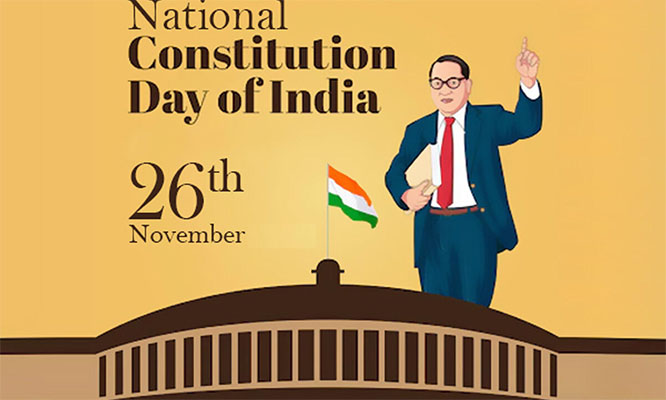
Constitution Day, also known as Samvidhan Divas, is observed every year on November 26 to honor the adoption of the Constitution of India and to recognize the visionary effort that shaped the world’s largest democracy.

Historical Background

It’s on November 26, 1949, the Constituent Assembly of India formally adopted the Constitution.This date is commemorated to acknowledge the completion of nearly three years of drafting, debate, and refinement.

On January 26, 1950, the Constitution came into force, marking India’s transition from a dominion to a sovereign republic.

The date 26 January was chosen to honor the “Purna Swaraj” declaration made in 1930 that marked the relentless efforts & sacrifices of the many. 

Why Constitution Day is Celebrated

* To honor & remember the framers of the Constitution, especially Dr. B. R. Ambedkar, the Chairman of the Drafting Committee, & many others. 

* To remind the citizens of the values, responsibilities, and rights enshrined in the Constitution.

* To promote constitutional values & literacy among students, institutions, and the general public.

* To reaffirm the nation’s commitment to justice, equality, liberty, fraternity and secular values. 

Vision and Significance of the Constitution

It establishes the fundamental political and legal framework for the nation.

Defines the structure, powers and functions of:
    •    The Executive
    •    The Legislature
    •    The Judiciary
    •    Guarantees a comprehensive set of Fundamental Rights, including:

-Equality before law
-Freedom of speech & expression
-Protection of life and personal liberty
-Freedom of religion
-Embeds Directive Principles of State Policy, guiding governance toward social justice and welfare.
-Introduces Fundamental Duties to ensure civic responsibility among citizens.

Key Features Celebrated on Constitution Day

-The Indian constitution is considered one of the longest written constitutions of the world. It’s systematically drafted considering almost all aspects that properly fits to the country. 

-Blend of multiple global constitutional principles while staying rooted in Indian values and realities.

-Framework that balances Federalism, Secularism, Democracy and Rule of Law. This makes everyone-from President to common man-below the law & are equal in the sight of law. 

-Another feature is that it’s based on built-in mechanisms for amendments, ensuring the Constitution grows with changing needs.

Message of the Day

The core ethos of this  Constitution Day is not merely about looking back at history-it’s a reminder of the continuous duty to protect democratic values, respect diversity and uphold the principles that define India as a sovereign, socialist, secular and democratic republic.

Happy Constitution Day to all my compatriots

Comments

Add new comment

  • Coastaldigest.com reserves the right to delete or block any comments.
  • Coastaldigset.com is not responsible for its readers’ comments.
  • Comments that are abusive, incendiary or irrelevant are strictly prohibited.
  • Please use a genuine email ID and provide your name to avoid reject.
P A Hameed Padubidri
November 26,2025

CD.jpg

Constitution Day, also known as Samvidhan Divas, is observed every year on November 26 to honor the adoption of the Constitution of India and to recognize the visionary effort that shaped the world’s largest democracy.

Historical Background

It’s on November 26, 1949, the Constituent Assembly of India formally adopted the Constitution.This date is commemorated to acknowledge the completion of nearly three years of drafting, debate, and refinement.

On January 26, 1950, the Constitution came into force, marking India’s transition from a dominion to a sovereign republic.

The date 26 January was chosen to honor the “Purna Swaraj” declaration made in 1930 that marked the relentless efforts & sacrifices of the many. 

Why Constitution Day is Celebrated

* To honor & remember the framers of the Constitution, especially Dr. B. R. Ambedkar, the Chairman of the Drafting Committee, & many others. 

* To remind the citizens of the values, responsibilities, and rights enshrined in the Constitution.

* To promote constitutional values & literacy among students, institutions, and the general public.

* To reaffirm the nation’s commitment to justice, equality, liberty, fraternity and secular values. 

Vision and Significance of the Constitution

It establishes the fundamental political and legal framework for the nation.

Defines the structure, powers and functions of:
    •    The Executive
    •    The Legislature
    •    The Judiciary
    •    Guarantees a comprehensive set of Fundamental Rights, including:

-Equality before law
-Freedom of speech & expression
-Protection of life and personal liberty
-Freedom of religion
-Embeds Directive Principles of State Policy, guiding governance toward social justice and welfare.
-Introduces Fundamental Duties to ensure civic responsibility among citizens.

Key Features Celebrated on Constitution Day

-The Indian constitution is considered one of the longest written constitutions of the world. It’s systematically drafted considering almost all aspects that properly fits to the country. 

-Blend of multiple global constitutional principles while staying rooted in Indian values and realities.

-Framework that balances Federalism, Secularism, Democracy and Rule of Law. This makes everyone-from President to common man-below the law & are equal in the sight of law. 

-Another feature is that it’s based on built-in mechanisms for amendments, ensuring the Constitution grows with changing needs.

Message of the Day

The core ethos of this  Constitution Day is not merely about looking back at history-it’s a reminder of the continuous duty to protect democratic values, respect diversity and uphold the principles that define India as a sovereign, socialist, secular and democratic republic.

Happy Constitution Day to all my compatriots

Comments

Add new comment

  • Coastaldigest.com reserves the right to delete or block any comments.
  • Coastaldigset.com is not responsible for its readers’ comments.
  • Comments that are abusive, incendiary or irrelevant are strictly prohibited.
  • Please use a genuine email ID and provide your name to avoid reject.