



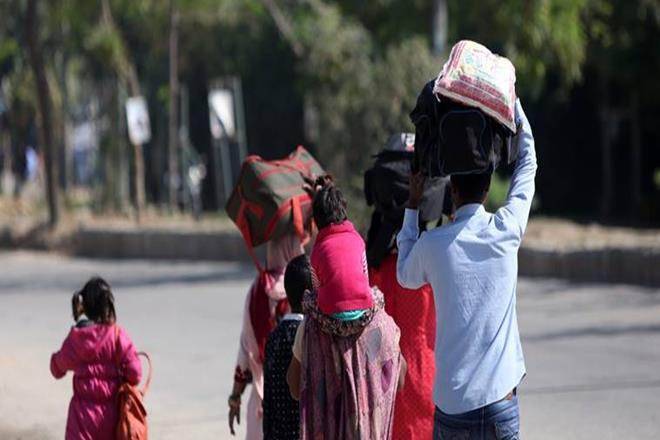
Pandemic of poverty: India's financial crisis worsens

Mafazah Sharafuddin
May 31, 2021

covidcrisis.jpg

As the country suffers the threat of death and disease, financial struggle looms over it. There has been a huge loss for several of the economy. The government has issued aid, however, it is insufficient and neglects the unorganized sector entirely. 

The estimation of the government, standing at Rs 1,250 crore, and is not close to what is needed by the people. Additionally, it does not aid those who don’t come under government schemes, meaning a huge chunk of the unorganized and industrial sector. 

The financial crisis in India due to COVID is a many headed demon. So many different issues have arisen since the start of the pandemic, and the people of India are suffering under the financial burden. 

Sudden shifts

Since the beginning of the pandemic, the word ‘unprecedented’ has been used innumerable times. Problems arrive suddenly, with no warning. People are losing their jobs all at once after years of working in the same place. 

With the magnitude of the death toll, many a times the sole breadwinner of the house passes away. This leaves the family floundering, looking for jobs and trying to keep mouths fed.

People who are newly unemployed and unable to find jobs in the same industry are left confused. They have a skillset that employers are not looking for and eventually, they have to resort to unskilled labor which gives them lower wages. 

Warning signs 

The fact is that the people are suffering. The numbers back it up. There has been a 15 to 20% increase in poverty since the pandemic began. This means more than 23 crore people have slipped below the poverty line. 

Unemployment has increased, too. 1.5 people have been lost their jobs, and those who continue to be employed face lowered salaries. The per capita income of the country has lowered by 16.8% to what it was in January of 2020. 

Within 2020, there was an increase in people partially withdrawing funds from their Employee Provident Fund accounts. While it was 54 lakh people in 2019, 2020 saw 1.27 crore people doing the same. 

According to RBI, there had been an 81.5% increase in that loans against gold jewelry by Scheduled Commercial Banks in March in comparison with the same last year. 

MFIs, MSMEs suffer losses

MFIs (Micro finance Institutions) cater to the poorer sections of Indian society. The lockdowns have has adverse effects on the functioning of NBFCs and MFIs. With the poor already suffering through unemployment and steep hospital bills, this too has caused a bad hit.

Some sectors are faring worse than others. These industries thrive on travel, face to face interactions and consumerism. Retail, MSME, and hospitality are some of them.

The pandemic has resulted in the closure of 15-20% of the MSMEs in India. Large scale supply chains are taking away their customers as they are not able to operate as usual during the pandemic. If the situation continues, there could be a much larger percentage of MSMEs closed during the pandemic. 

Small businesses run into trouble

Small businesses like family run stores are facing trouble getting customers and keeping their shops open. The lockdown hours put a huge dent in the time they can sell to people. Shops that don’t count as ‘essentials’ often cannot open at all. 

Chain supermarkets and other shops are seeing more traffic as these small businesses get neglected. Without their livelihood, the threat of COVID increases as they would not be able to afford the hospital bills and medication.

Sellers over the internet find it difficult to post packages as delivery services do not function everywhere due to COVID. Small businesses are losing customers at a large scale. 

Social workers rise to the occasion

While the situation is dire, social worker and organizations have taken the initiative to help people. All over India, social workers and volunteers are assisting on everything from grocery packages to cremations. 

The workers help with transportation, reservation of beds, intricacies of the Ayushman card, ensuring the patients and the family members staying with them are fed, etc. With the ongoing crisis with the bodies piling up with no one to deal with them, social workers are also burying and cremating bodies. 

Not just this, but they are also helping people who are not infected, but have been affected by the pandemic. Distributing food, rations etc. to those in need is another task they perform. 

However, without proper government aid to the poorer sections of society, there is no saying how bad the situation could get.

Comments

Add new comment

  • Coastaldigest.com reserves the right to delete or block any comments.
  • Coastaldigset.com is not responsible for its readers’ comments.
  • Comments that are abusive, incendiary or irrelevant are strictly prohibited.
  • Please use a genuine email ID and provide your name to avoid reject.
News Network
November 21,2025

Tejas.jpg

An Indian Air Force (IAF) Tejas fighter jet crashed on Friday, November 21, afternoon during its aerial demonstration at the Dubai Air Show, plunging to the ground at around 2:10 pm local time while performing a manoeuvre before thousands of spectators.

The IAF confirmed the incident, stating that a Tejas aircraft participating in the show had crashed and that further details were being gathered. An Air Force spokesperson said more information would be shared after initial assessments.

The crash sent thick black smoke billowing into the sky near the airport, causing panic among visitors, including families and children who had gathered to watch the display. Authorities have not yet confirmed whether the pilot managed to eject before the aircraft went down. Emergency response teams rushed to the scene, and officials have not released information on casualties or damage so far.

The Tejas is a 4.5-generation, multi-role fighter aircraft developed indigenously by Hindustan Aeronautics Limited (HAL). Designed for versatility, it is capable of offensive air support, close combat, ground attack missions and maritime operations. The aircraft family includes single-seat fighters and twin-seat trainers for both the Air Force and Navy.

HAL describes the latest version, the LCA Mk1A, as the most advanced in the series, featuring an AESA radar, an upgraded electronic warfare suite with radar-warning and self-protection jamming, smart multifunction displays, a digital map generator, a combined interrogator–transponder system and a modern radio altimeter. These enhancements significantly improve the aircraft’s combat capability and survivability.

Further updates from IAF and UAE authorities are awaited.

Comments

Add new comment

  • Coastaldigest.com reserves the right to delete or block any comments.
  • Coastaldigset.com is not responsible for its readers’ comments.
  • Comments that are abusive, incendiary or irrelevant are strictly prohibited.
  • Please use a genuine email ID and provide your name to avoid reject.
P A Hameed Padubidri
November 26,2025

CD.jpg

Constitution Day, also known as Samvidhan Divas, is observed every year on November 26 to honor the adoption of the Constitution of India and to recognize the visionary effort that shaped the world’s largest democracy.

Historical Background

It’s on November 26, 1949, the Constituent Assembly of India formally adopted the Constitution.This date is commemorated to acknowledge the completion of nearly three years of drafting, debate, and refinement.

On January 26, 1950, the Constitution came into force, marking India’s transition from a dominion to a sovereign republic.

The date 26 January was chosen to honor the “Purna Swaraj” declaration made in 1930 that marked the relentless efforts & sacrifices of the many. 

Why Constitution Day is Celebrated

* To honor & remember the framers of the Constitution, especially Dr. B. R. Ambedkar, the Chairman of the Drafting Committee, & many others. 

* To remind the citizens of the values, responsibilities, and rights enshrined in the Constitution.

* To promote constitutional values & literacy among students, institutions, and the general public.

* To reaffirm the nation’s commitment to justice, equality, liberty, fraternity and secular values. 

Vision and Significance of the Constitution

It establishes the fundamental political and legal framework for the nation.

Defines the structure, powers and functions of:
    •    The Executive
    •    The Legislature
    •    The Judiciary
    •    Guarantees a comprehensive set of Fundamental Rights, including:

-Equality before law
-Freedom of speech & expression
-Protection of life and personal liberty
-Freedom of religion
-Embeds Directive Principles of State Policy, guiding governance toward social justice and welfare.
-Introduces Fundamental Duties to ensure civic responsibility among citizens.

Key Features Celebrated on Constitution Day

-The Indian constitution is considered one of the longest written constitutions of the world. It’s systematically drafted considering almost all aspects that properly fits to the country. 

-Blend of multiple global constitutional principles while staying rooted in Indian values and realities.

-Framework that balances Federalism, Secularism, Democracy and Rule of Law. This makes everyone-from President to common man-below the law & are equal in the sight of law. 

-Another feature is that it’s based on built-in mechanisms for amendments, ensuring the Constitution grows with changing needs.

Message of the Day

The core ethos of this  Constitution Day is not merely about looking back at history-it’s a reminder of the continuous duty to protect democratic values, respect diversity and uphold the principles that define India as a sovereign, socialist, secular and democratic republic.

Happy Constitution Day to all my compatriots

Comments

Add new comment

  • Coastaldigest.com reserves the right to delete or block any comments.
  • Coastaldigset.com is not responsible for its readers’ comments.
  • Comments that are abusive, incendiary or irrelevant are strictly prohibited.
  • Please use a genuine email ID and provide your name to avoid reject.
News Network
November 21,2025

israel.jpg

Local authorities say the Israeli military has expanded the so-called “yellow line” truce demarcation in Gaza City and repositioned its forces deeper into the territory in violation of a ceasefire agreement that came into force on October 10, besieging dozens of Palestinian families.

Gaza’s Government Media Office announced in a statement on Thursday that Israeli forces widened the boundary by shifting the markers, and advanced roughly 300 meters (984 feet) into the neighborhoods of Ash-Shaaf, An-Nazzaz and Baghdad Street.

The move pushed further into civilian areas, trapping families who were unable to flee as tanks rolled forward, it added.

“The fate of many of these families remains unknown amidst the shelling that targeted the area,” the office said, adding that the expansion of the yellow line shows a “blatant disregard” for the ceasefire deal.

On Friday, sources said the Israeli military carried out continued air and artillery strikes inside the so-called “yellow line” east of Khan Younis in the southern Gaza Strip.

According to the reports, Israeli warplanes and tanks targeted areas within the zone. One Palestinian was reported killed and several others wounded in the strikes, the sources said.

The fresh aggression came only a day after 25 Palestinians were killed in Israeli airstrikes on Gaza City and Khan Younis on Wednesday.

The media office reported that Israel has consistently violated the truce deal since its implementation last month, with near-daily attacks by air, artillery and direct shootings.

The office said over 400 violations have been documented. These breaches have resulted in the deaths of more than 300 Palestinians and left hundreds injured.

The Government Media Office in Gaza urged the guarantors of the ceasefire — the US, Egypt, Qatar and Turkey — to take swift action to halt the ongoing violations and facilitate the delivery of food, shelter materials, medical aid, and infrastructure equipment.

The so-called “yellow line,” set out in the agreement between Israel and Hamas resistance movement, refers to a non-physical partition where the Israeli military repositioned itself when the truce deal took effect.

It has allowed Israel, which routinely fires at Palestinians who approach the line, to retain control over more than half of the Gaza Strip.

International bodies, including the UN Independent International Commission of Inquiry, the International Association of Genocide Scholars, Amnesty International, Human Rights Watch, B’Tselem, and other rights groups, have concluded that the Israeli war on Gaza amounts to genocide.

In the attacks in Gaza since October 2023, Israel has killed at least 69,546 people and injured 170,833 others, leveling large swaths of the territory and displacing almost all of the population. 

Comments

Add new comment

  • Coastaldigest.com reserves the right to delete or block any comments.
  • Coastaldigset.com is not responsible for its readers’ comments.
  • Comments that are abusive, incendiary or irrelevant are strictly prohibited.
  • Please use a genuine email ID and provide your name to avoid reject.