Politics amid pandemic: Modi govt’s haste to grant citizenship to non-Muslim foreigners raises speculation

Mafazah Sharafuddin
May 30, 2021

While still suffering through the deadly second wave of the pandemic, the Ministry of Home Affairs gave the go ahead to the authorities in 13 districts to grant citizenship to non-Muslim applicants from Pakistan, Afghanistan and Bangladesh under the existing rules. The authorities are to review, verify and grant citizenship based on the Citizenship Act 1955 and the Citizenship Rules 2009. 

Districts within Gujarat, Chhattisgarh, Rajasthan, Haryana and Punjab have been given the power to grant citizenship to minorities from aforementioned neighboring countries. This group of minorities is Hindus, Jains, Buddhists, Sikhs, Parsis and Christians. 

It is baffling why the government would make this move while the rules of the Citizenship Amendment Act of 2019 is still not concrete. They plan to continue the discussion while the other applicants get granted citizenship in these 13 districts. In May, the PM Narendra Modi led government sought more time, citing COVID as the reason why they are yet to give a concrete set of rules. While the rules of a law are customarily notified within 6 months, the CAA continues this way 18 months later. 

There are several reasons why this decision should be scrutinized. 

Firstly, the country is going through a massive catastrophe. Arguably the worst catastrophe India has suffered as an independent nation. It is no secret that amidst the pandemic, there is a massive health crisis, coinciding with a financial crisis. 

The public are suffering under abrupt and improperly done lockdowns, crises for oxygen, hospital beds, medicines, etc. There has been a huge wave of unemployment. Daily wage workers have been devastated financially by the lockdowns. There has been a death toll of over 3.2 lakhs. The bodies of the people who passed away are piling up, with not enough staff or area to properly deal with them. 

What the government prioritizes truly shines through after this new development. The public call for help and proper administration over social media and via various social worker groups, those pleas have seen no answer. At the same time, the enactment of the Citizenship Act is not only unnecessary, but is also likely to cause people to congregate for verification.

Not just that, but the CAA garners attention. Whether it is positive or negative, the CAA garners the attention of the people. The government, as of now, is desperately fielding questions about the underreporting of COVID deaths, future plans, vaccinations and accusations of inefficient handling of the Coronavirus crisis. It almost seems too opportune a moment for something like this to take the limelight. 

In addition to this, the vaccination drive is far from being complete. While Home Minister Amit Shah, earlier this year, said that the CAA rules will be framed after the vaccination drive is complete, the vaccination drive seems to have gone completely off track. The numbers projected and the numbers implemented differ greatly. With this in mind, it seems precarious to begin implementation of the Citizenship Act at this stage. 

The Citizenship Amendment Act 2019 was met with protests all over India. People claimed the act was unconstitutional and discriminatory. There was a huge opposition to the act, with students throughout the country taking to the streets and protesting. The protests continued till early 2020, and only ended once the pandemic made it impossible to continue. The dispersal of Shahin Bagh was somber moment for activists and sympathizers all over India.

Now, as the issue begins to brew again, the public are faced with an impossible situation. Much like in Lakshadweep, where legislations are being passed against the will of the people while they can’t take to the streets, all of India are stuck on the sidelines. 

The CAA protesters not only took to the streets, but made an active effort to spread the information needed to have an informed opinion on the issue. Prolific newspapers like The Hindu were constantly posting editorials and opinion pieces speaking against the CAA. It was a unifying protest. 

At this moment, people are unable to take to the streets. For anyone who has social responsibility, a protest of the like of those that took place at the end of 2019 and the beginning of 2020 would be impossible. Even if the CAA issue rises once more, the people are confined to media houses and social media to give their opinions. 

While this does send a message, it does not actively disrupt the comfort of the authorities. It seems curious to make this move during the heat of the second wave of the pandemic. 

There are no coincidences in politics. 

Comments

Add new comment

  • Coastaldigest.com reserves the right to delete or block any comments.
  • Coastaldigset.com is not responsible for its readers’ comments.
  • Comments that are abusive, incendiary or irrelevant are strictly prohibited.
  • Please use a genuine email ID and provide your name to avoid reject.
News Network
December 15,2025

Udupi, Dec 15: What was meant to be a post-pilgrimage gathering turned tragic in Padukere village of Brahmavar taluk, Udupi district, late Sunday night, when a clash among youths escalated into a fatal assault, leaving one man dead.

The victim has been identified as 30-year-old Santosh Mogaveera, a resident of Padukere.

According to preliminary information, the incident took place during a late-night drinking party involving a group of local youths who had recently returned after completing their pilgrimage to the Sabarimala shrine. An argument reportedly broke out among the group and soon escalated into a violent confrontation.

During the ensuing brawl, Santosh Mogaveera was allegedly assaulted and collapsed at the spot after sustaining serious injuries. He was rushed by local residents to a private hospital in Brahmavar, where doctors declared him dead.

On receiving information, senior police officials, including Brahmavar Circle Inspector Gopikrishna, Kota Police Sub-Inspector Praveen Kumar T, Station ASI Manthesh Jabagoudar, and head constables Pradeep and Ashok, visited the spot and conducted an inspection.

Police have taken four youths into custody in connection with the incident. A case has been registered at the Kota police station, and further investigation is underway to ascertain the exact sequence of events leading to the death.

Comments

Add new comment

  • Coastaldigest.com reserves the right to delete or block any comments.
  • Coastaldigset.com is not responsible for its readers’ comments.
  • Comments that are abusive, incendiary or irrelevant are strictly prohibited.
  • Please use a genuine email ID and provide your name to avoid reject.
News Network
December 13,2025

New Delhi: School-going children are picking up drug and smoking habits and engaging in consumption of alcohol, with the average age of introduction to such harmful substances found to be around 13 years, suggesting a need for earlier interventions as early as primary school, a multi-city survey by AIIMS-Delhi said.

The findings also showed substance use increased in higher grades, with grade XI/XII students two times more likely to report use of substances when compared with grade VIII students. This emphasised the importance of continued prevention and intervention through middle and high school.

The study led by Dr Anju Dhawan of AIIMS's National Drug Dependence Treatment Centre, published in the National Medical Journal of India this month, looks at adolescent substance use across diverse regions.

The survey included 5,920 students from classes 8, 9, 11 and 12 in urban government, private and rural schools across 10 cities -- Bengaluru, Chandigarh, Delhi, Dibrugarh, Hyderabad, Imphal, Jammu, Lucknow, Mumbai, and Ranchi. The data were collected between May 2018 and June 2019.

The average age of initiation for any substance was 12.9 (2.8) years. It was lowest for inhalants (11.3 years) followed by heroin (12.3 years) and opioid pharmaceuticals (without prescription; 12.5 years).

Overall, 15.1 per cent of participants reported lifetime use, 10.3 per cent reported past year use, and 7.2 per cent reported use in the past month of any substance, the study found.

The most common substances used in the past year, after tobacco (4 per cent) and alcohol (3.8 per cent), were opioids (2.8 per cent), followed by cannabis (2 per cent) and inhalants (1.9 per cent). Use of non-prescribed pharmaceutical opioids was most common among opioid users (90.2 per cent).

On being asked, 'Do you think this substance is easily available for a person of your age' separately for each substance category, nearly half the students (46.3 per cent) endorsed that tobacco products and more than one-third of the students (36.5 per cent) agreed that a person of their age can easily procure alcohol products.

Similarly, for Bhang (21.9 per cent), ganja/charas (16.1 per cent), inhalants (15.2 per cent), sedatives (13.7 per cent), opium and heroin (10 per cent each), the students endorsed that these can be easily procured.

About 95 per cent of the children, irrespective of their grade, agreed with the statement that 'drug use is harmful'.

The rates of substance use (any) among boys were significantly higher than those of girls for substance use (ever), use in the past year and use in the past 30 days. Compared to grade VIII students, grade IX students were more likely, and grade XI/XII students were twice as likely to have used any substance (ever).

The likelihood of past-year use of any substance was also higher for grade IX students and for grade XI/XII students as compared to grade VIII students.

About 40 per cent of students mentioned that they had a family member who used tobacco or alcohol each. The use of cannabis (any product) and opioid (any product) by a family member was reported by 8.2 per cent and 3.9 per cent of students, respectively, while the use of other substances, such as inhalants/sedatives by family was 2-3 per cent, the study found.

A relatively smaller percentage of students reported use of tobacco or alcohol among peers as compared to among family members, while a higher percentage reported inhalants, sedatives, cannabis or opioid use among peers.

Children using substances (past year) compared to non-users reported significantly higher any substance use by their family members and peers.

There were 25.7 per cent students who replied 'yes' to the question 'conflicts/fights often occur in your family'. Most students also replied affirmatively to 'family members are aware of how their time is being spent' and 'damily members are aware of with whom they spend their time'.

Comments

Add new comment

  • Coastaldigest.com reserves the right to delete or block any comments.
  • Coastaldigset.com is not responsible for its readers’ comments.
  • Comments that are abusive, incendiary or irrelevant are strictly prohibited.
  • Please use a genuine email ID and provide your name to avoid reject.
News Network
December 5,2025

indigoCEO.jpg

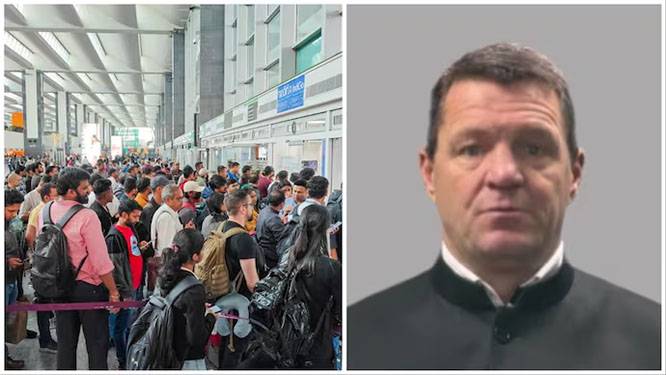
New Delhi, Dec 5: IndiGo CEO Pieter Elbers issued a public apology this evening after more than a thousand flights were cancelled today, making it the "most severely impacted day" in terms of cancellations. The biggest airline of the country cancelled "more than half" of its daily number of flights on Friday, said Elbers. He also said that even though the crisis will persist on Saturday, the airline anticipates fewer than 1,000 flight cancellations.

"Full normalisation is expected between December 10 and 15, though IndiGo cautions that recovery will take time due to the scale of operations," the IndiGo CEO said. 

IndiGo operates around 2,300 domestic and international flights daily.

Pieter Elbers, while apologising for the major inconvenience due to delays and cancellations, said the situation is a result of various causes.

The crisis at IndiGo stems from new regulations that boost pilots' weekly rest requirements by 12 hours to 48 and allow only two night-time landings per week, down from six. IndiGo has attributed the mass cancellations to "misjudgment and planning gaps".

Elbers also listed three lines of action that the airline will adopt to address the issue.

"Firstly, customer communication and addressing your needs, for this, messages have been sent on social media. And just now, a more detailed communication with information, refunds, cancellations and other customer support measures was sent," he said.

The airline has also stepped up its call centre capacity.

"Secondly, due to yesterday's situation, we had customers stranded mostly at the nation's largest airports. Our focus was for all of them to be able to travel today itself, which will be achieved. For this, we also ask customers whose flights are cancelled not to come to the airports as notifications are sent," the CEO said.

"Thirdly, cancellations were made for today to align our crew and planes to be where they need to start tomorrow morning afresh. Earlier measures of the last few days, regrettable, have proven not to be enough, but we have decided today to reboot all our systems and schedules, resulting in the highest numbers of cancellations so far, but imperative for progressive improvements starting from tomorrow," he added.

As airports witnessed chaotic scenes, the Directorate General of Civil Aviation (DGCA) stepped in to grant IndiGo a temporary exemption from stricter night duty rules for pilots. It also allowed substitution of leaves with a weekly rest period. 

Civil Aviation Minister Ram Mohan Naidu has said a high-level inquiry will be ordered and accountability will be fixed.

Comments

Add new comment

  • Coastaldigest.com reserves the right to delete or block any comments.
  • Coastaldigset.com is not responsible for its readers’ comments.
  • Comments that are abusive, incendiary or irrelevant are strictly prohibited.
  • Please use a genuine email ID and provide your name to avoid reject.