



One night in August here, an angry mob ran amok, burning trucks and government property and forcing traffic to halt and factories to shut.
The rioters were incensed over an issue arguably as old as India itself: the eating of beef, which the country's majority Hindus have considered sacrilegious for at least a thousand years.
Perhaps surprisingly in a country where so many people view cows as sacred, India could soon become the world's biggest beef exporter, according to the United States Department of Agriculture (USDA).
Most, though not all, of the beef India exports is buffalo, an animal less venerated than the hump-backed indigenous Indian cow. But the trade, even in buffalo beef, still evokes revulsion among Hindu nationalists. The sharpest criticism comes from the Bharatiya Janata Party. Its candidate for Prime Minister in next year's elections, Narendra Modi, has slammed what he calls the government's "pink revolution," (a play on the original agricultural or "green" revolution in India) and its "secret agenda ... for export of beef."
India's vegetarian traditions and the Hindu aversion to beef mean only 2.1 million tonnes of beef are consumed domestically a year. That compares with 11.5 million tonnes a year in the United States, which has just a quarter India's population.
But exports of beef from India are likely to hit close to 1.8 million tonnes in 2013, second only to Brazil, according to an April forecast by the USDA. The value of India's exports has nearly doubled from $1.9 billion in 2010/11 to $3.2 billion in 2012/13, according to the government's Agricultural and Processed Food Products Export Development Authority (APEDA). That's about one percent of India's $300 billion annual exports last financial year.
While beef is unlikely to emerge as a major issue ahead of next year's election, Modi has made his opposition to the trade clear. In a blog on his website in 2012, he attacked the current government's policies and called for a halt to the beef trade.
"Our ancient Indian ethos and values doesn't (sic) teach us to kill mother cow ... sadly, the (government) seems unbothered about this rich ethos of our culture. It wants to make India the biggest exporter of beef!" he wrote in August last year. "Our future generation is not getting sufficient milk and this government wants to kill cows that provide us a 'ladder for life.' I'm sure that you will contribute your might in stopping such an insane act."
Modi has not commented on the trade in recent months, perhaps because he is trying to downplay his Hindu nationalism ahead of national elections to be held by next May. The BJP has won sweeping victories in state elections this month, sending the stock market to a record high on expectations Modi, widely seen to be more business-friendly than the current Congress Party-led government, will lead his party to power.
In India, the beef issue can even stir sectarian divisions. Beef production is dominated by Muslims, a minority in the country. Many Muslims mistrust the BJP and Modi, because he ran the state of Gujarat during anti-Muslim riots there in 2002. Modi denies any role in the riots or bias against Muslims.
This year's unrest along the Delhi-Jaipur highway shows how quickly beef can stir anger. Passers-by reported a foul smell coming from a truck that had broken down; rumours spread that it was loaded with cow meat. Slogan-shouting youths swept through the town of Dharuhera, some 40 km (25 miles) from Delhi, ransacking the truck and tearing out its cargo of ice-covered meat. By the time police calmed the riot, 74 trucks and buses had been burned.
In the end, the cargo turned out to be buffalo meat, not cow. But Sailesh Soni, a member of the Rashtriya Swayamsevak Sangh, a powerful Hindu nationalist group that backs the BJP and wants stricter enforcement of a ban on cattle killing, said all Hindus should be ready to defend all cattle.
"If somebody targets my mother, what would I do? I will stand and save her, isn't it? Likewise, you should get up, gather and save our mother cow," he said.
Mythology
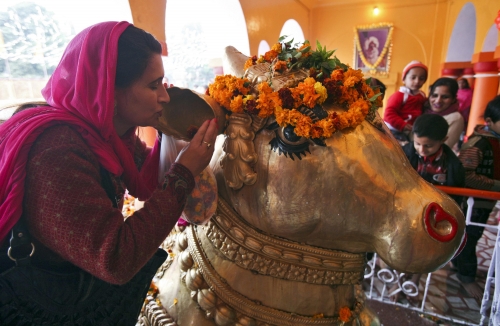
In a cavern under the well-swept courtyard of a Hindu temple off the narrow streets of Old Delhi, a calf blinks as it takes in the world for the first time and nuzzles for its mother's udder.
This is a goshala, a shelter for cows brought there by Hindus as thanks to the gods for good fortune, or simply pulled in off the streets where they wander, disrupting traffic and feeding on rubbish.
Hindus believe that Nandi, a bull, is the steed of powerful deity Lord Shiva, and that Lord Krishna was born as a cow-herd.
Many rural households in India, the world's biggest producer of milk, own at least one cow or buffalo. Female buffaloes, in particular, are prized for their creamy milk, while the males are used for pulling carts and ploughs, and their dung keeps home fires burning in villages that have little or no access to power.
Statistically, there are enough cows and buffalo in India for every rural household to have about two. But once cows are past their productive life, owners will often simply turn them out, unwilling to spend on fodder for no return.
Buffaloes and cows are increasingly ending up in abattoirs mushrooming across the country, according to industry participants and officials Reuters spoke with. Buffalo makes up by far the bulk of India's beef exports. Cow meat is banned from export, but animal rights groups say some finds its way abroad.
In all, India has half the buffaloes in the world, according to the Indian Council of Agricultural Research, and the largest number of cattle, with 327 million head, according to the USDA. The United States has around 89 million cattle.
Booming beef industry
Sitting in his airy ground-floor office in an abattoir about 8 km (5 miles) from the town of Aligarh, Mahendra Singh says business is booming. His production of buffalo meat has increased to 150 tonnes a day from 100-120 tonnes around a year ago.
His employer, Hind Agro industries Ltd, has sought the local government's permission to lift its daily output limit to 250 tonnes to meet rising demand.
"Earlier there was only our plant but now there are more than five more units in this area alone," Singh, the plant's General Manager, said.
One of the company's leading suppliers is Salim Qureshi, who cuts an imposing figure dressed all in white as he strides between boot-polish-black buffalo at Gulaothi animal market.
Men greet him warmly, addressing him as Haji Salim in respect for his three pilgrimages to Mecca, and calling him over to see their animals.
Qureshi casts his eye over a large bull and weighs the beast by sight, judging it to be about 300 kg (660 lbs), worth as much as $650. The beast is skin and bone compared to American steers, which can weigh more than twice as much.
"I have around 100 suppliers working for me," Salim says as he settles the price. "There were just 30 animal suppliers a few years back but now every plant has around 30 to 40."
Striking deals conforms to a long-standing tradition among Muslim traders, and highlights the way the industry works on both trust and secrecy.
Standing slightly apart from the crowd, one supplier speaks in whispers to the owner of a hefty-looking buffalo. He puts a one-rupee piece into the other man's palm as a token of good faith.
"I bought 70 heavyweight buffalo," says Mohammad Sheikh, one trader. "I hope I have estimated the weight correctly or I'll make a big loss," he says, replacing his wallet in the pocket of his brown wool waistcoat.
Qureshi outlines plans for his own slaughter house as he offers snacks in the salon of his eye-catchingly colourful house outside Aligarh. The dates are as plump as the velvet cushions and the cashews are perfect crescents.
"This business is profitable," he says.
Is China buying?
A dull thud announces the arrival of another black carcass on the conveyor belt and, 30 seconds later, a buffalo hangs from an overhead hook through its foreleg, swaying gently as it waits in line to be stripped to white, slippery flesh.
The abbatoir's conveyor belt moves slowly, taking the body past a succession of men who each remove some part of the animal. Skin, hooves, ears, head; every bit is stripped from about 1,500 buffalo a day.
Hind Agro sells most of its meat to the Middle East and Southeast Asia, but the government says India's biggest beef buyers are Vietnam, Malaysia, Thailand and Egypt.
China, where beef consumption is growing rapidly, could soon be on the official customer list after the two countries signed a framework deal earlier this year.
China may already be buying huge amounts of Indian beef via Vietnam, according to industry experts who would speak only on condition of anonymity. According to Vietnam's customs data, the country imports no buffalo meat from India.
Global demand for exports of buffalo - leaner and cheaper than cow meat - is growing at around 30 percent a year. The lack of growth hormones in Indian beef provides an additional attraction for health-conscious consumers, said M. Kalim Khan, vice-president of exports and marketing at Hind Agro.
India might not be able to increase supplies quickly enough to meet that demand given the lack of dedicated buffalo farms or rearing facilities. Analysts at Credit Suisse say about 10.5 million animals are likely to be slaughtered in India in the financial year 2013/14, but add that there's a limit.
"It is hard to see this number rising much higher, as ... of the 105 million buffaloes in 2007, only 20 million were males, and less than 2 million were females beyond reproductive age," they said in a research note.
High stakes and hijacks
The rapid expansion of the sector, rising prices and demand have encouraged cattle smuggling, animal activists and officials say.
"Abandoned animals are picked up from the streets for slaughter. No one is bothered because everyone, including the police, get their share from the agents," says Arvind Shah, a founder of Karuna, a charity for animal welfare in the city of Mumbai.
Shah, whose tall and thin physique has made him a well-known figure among residents near his tiny office, describes violent clashes between truck drivers and animal rights activists.
"Stopping trucks on highways in the middle of the night is a very risky business. I was chased by masked men and threatened," the 49-year-old activist says.
Activists get tip-offs from villagers and even rival suppliers about the route and timing of vehicles carrying meat or animals, and then they work out a strategy to stop them.
"We go in a group of 30 to 40 people and carry wooden sticks. Most of the time, we succeed in stopping the trucks and releasing the animals," says Brijesh Shah, a 34-year-old member of Jiv Rakshak Dal, which literally means animal protection group. "Sometimes ... they attack us with iron rods and other sharp weapons."
The group has stopped 120 trucks since 2002 and saved around 8,000 animals, he says.
Truck drivers, for their part, have stories of beatings and robberies.
"We are fed up of paying bribes to policemen and getting beaten up by animal rights people and political party members," said Mohammad Gulfam, a driver at the Gulaothi market.
While government regulations on the transport of animals are strict, implementation is often weak and cattle are squeezed into trucks to cut costs. Animals often make the journey to the slaughter house without food or water and are sometimes left in the baking heat while drivers take their breaks.
Even beef producer Qureshi admits the rules are flouted. The law allows transport of only seven animals in a 22-foot-long vehicle. Suppliers load around 14 animals to save the transportation charges, he said. Most have their own trucks to transport animals.
Playing politics
And there are dangers for beef traders even when they are operating legally.
"On my way to make a delivery at Hind Agro, our truck was stopped by about 15 people belonging to some political party," said Mohammad Yusaf, a driver waiting to load up at Gulaothi market. "They beat me and my co-worker and robbed us of 25,000 rupees," he added.
While Modi's heartland of Gujarat is not on any of the main routes to ports, Qureshi no longer lets his trucks travel there even if it's a shortcut for some deliveries.
"It's the most troubled route. We face a lot of problems in Gujarat ... The chief minister himself is against this trade," he said.
Gujarat's BJP government says the state bans the slaughter of cows and transportation of beef but that buffalo meat is not banned. However, a home department official said local "cow protection committees" stop vehicles ferrying meat and pressure police to act. "They take legal action if the vehicles are found to be ferrying beef, but many times even genuine firms have to suffer," the official said.
After the outbreak of violence outside New Delhi, Muslim elders and clerics decided that preserving the peace was far more important than eating beef.
Anyone killing cows, including the ones left to stray, will now be fined 115,000 rupees, they announced. Since then, tensions have eased in the area, where Hindus and Muslims live side-by-side and chat in each other's front yards.
"This wasn't such a problem before, but some people are trying to create trouble between the communities," said Mohammad Shaikh, a young cleric at a local mosque. "We have told our people not to do anything provocative at this time."

Comments
After checking out a few of the articles on your website, I honestly
like your way of writing a blog. I added it to my bookmark website list and will be checking back in the near
future. Please visit my website as well and tell me how you feel.
Also visit my web page League of Legends PBE: http://retrotop.comule.com/index.php?a=stats&u=myrnaevers2
Add new comment