60,000 Saudis unable to repay their debts

February 6, 2013

60000_Saudis

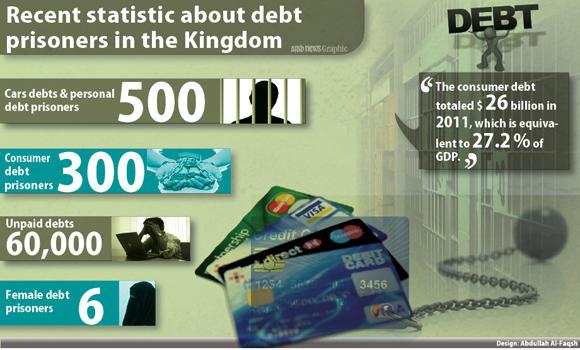
Jeddah, Feb 6: About 60,000 Saudis are unable to pay off their loans, said Abdullah Marei bin Mahfouz, chairman of the Jeddah branch of the national committee for the care of prisoners and their families.

Bin Mahfouz said that currently about 300 Saudis are imprisoned in the Kingdom who are unable to settle their bank debts. In addition, about 500 prisoners are unable to pay off credit card debts, and car installments.

Between 2009 and 2011 the increased effectiveness of the payment system — which protects the rights of banks — contributed to lowering the number of people who borrowed money to buy consumer goods, he said.

“I think Saudis are becoming more cautious about getting indebted due to the strict procedures that banks are following. Still, too many Saudis make debts to fund their summer vacation or to buy a luxurious car,” he said.

He added, “The majority of Saudis who are unable to refund their debts, start looking for another source of money, like car companies. They buy two or three cars on an installment system. Then they sell these cars for cash. In most cases the borrowers are unable to refund the car installments.”

According to Bin Mahfouz, sometimes husbands make their wives borrow money for them.

“We currently have six women in prison that were unable to repay their debts. They work as teachers and their husbands forced them to take out bank loans, knowing they would be unable to refund it,” he said.

The bank system is extremely strict in collecting the debts on time.

“When the money is not repaid in due time, the bank freezes the account, stops all electronic transactions of the debtor, and then sends them notifications through the police department,” said Bin Mahfouz.

He added, “Most convicts who are in jail because they couldn’t repay, are Saudis. Expatriates are committed to settling their debts. There are a few Filipino debtors in prison. These are locked up because of credit card debts for amounts starting around SR 10,000. In contrast, Saudis debtors in jail run debts from SR 100,000 and more.”

The Saudi Arabian Monetary Agency (SAMA) recently issued a report on consumer debts. It said these reached SR 246.9 billion in the first quarter of 2012. Compared to the same period in the previous year, the number was up by 19 percent.

SAMA had warned banks against rescheduling unpaid debts of individuals, saying that 45 percent of the debts should be repayable within three years.

Saudi Banker Fadhel Albu Ainain told Arab News that the ratio of consumer debts is high; many people are in debt. He expected the ratio to decrease with the entrance of the mortgage law.

“In Saudi Arabia the rate of consumer debts, used to buy consumer goods, is estimated at about 75 percent. This is unhealthy for the Saudi market. A healthy market would show that most of the loans are used for acquiring stable commercial investments and real estate. Unfortunately, most of the borrowers are employees whose their salaries can’t cover these loans,” he said. “The problem in Saudi Arabia is that people who earn a low wage often tend to incur debts to live a luxurious life.”

Albu Ainain is opposed to increasing the payment period to more than five years.

“Some people are now calling for expanding the debts repayment period to more than five years. There are also calls to increase the maximum amount people can borrow. This is would increase the size of loans and weaken people’s ability to repay their debts,” he said.

Comments

Shana
 - 
Sunday, 4 Jun 2017

Today, I went tto the beach with my kids. I found a sea shell and gave
it to my 4 year old daughter and said \You can hear the ocean if you put this to your ear.\" She placed the shelol to her ear and
screamed. There was a hermit crab inside and it pinched her ear.

She never wants to goo back! LoL I know this is entirely off topic but I had too tell someone!

my webpage

Add new comment

  • Coastaldigest.com reserves the right to delete or block any comments.
  • Coastaldigset.com is not responsible for its readers’ comments.
  • Comments that are abusive, incendiary or irrelevant are strictly prohibited.
  • Please use a genuine email ID and provide your name to avoid reject.
News Network
November 24,2025

israelsyra.jpg

Israeli forces have pushed over the Syrian frontier, erecting a checkpoint and stopping vehicles in the southwestern city of Quneitra, in yet another breach of the Arab country’s sovereignty.

The violation took place on Sunday, when the troops made their way across the border, setting up the outpost near the Ain al-Bayda junction in northern Quneitra, Syrian outlets reported.

According to the al-Ikhbariya paper, an Israeli detachment positioned itself at the junction, halting cars and conducting searches.

The Syrian Arab News Agency (SANA) reported that three Israeli military vehicles then moved further into the northern countryside, deploying between the town of Jubata al-Khashab and the villages of Ofaniya and Ain al-Bayda. The agency added that a separate Israeli unit mounted a new incursion in the central region, approaching the villages of Umm Batina and al-Ajraf.

Residents said such activities have surged in recent months, pointing to Israeli advances onto farmland, leveling of extensive forested areas, arrests, and spread of mobile checkpoints.

The Israeli regime began markedly increasing its military aggression against Syria last year.

The escalation coincided with increasingly ferocious onslaughts throughout the country by the so-called Hay'at Tahrir al-Sham (HTS) Takfiri terrorist group, which the government of President Bashar al-Assad had confined to northwestern Syria. The HTS, however, managed to overthrow the government as the Israeli attacks would pummel the country’s civilian and defensive infrastructure.

Various reports have shown that, during the escalation, the regime conducted more than 1,000 airstrikes on the Syrian territory and over 400 ground raids into the south.

Following the collapse of the Assad government, Tel Aviv also widened its grip over the occupied Golan Heights by taking control of a demilitarized buffer zone, in defiance of a 1974 Disengagement Agreement. Earlier this month, senior Israeli officials, including Prime Minister Benjamin Netanyahu, visited the buffer zone, prompting expressions of alarm on the part of the United Nations.

The United States, the regime’s biggest ally, has, meanwhile, been fraternizing the HTS head Abu Mohammed al-Jolani amid the widely reported prospect of rapprochement with Tel Aviv.

Comments

Add new comment

  • Coastaldigest.com reserves the right to delete or block any comments.
  • Coastaldigset.com is not responsible for its readers’ comments.
  • Comments that are abusive, incendiary or irrelevant are strictly prohibited.
  • Please use a genuine email ID and provide your name to avoid reject.
News Network
November 21,2025

israel.jpg

Local authorities say the Israeli military has expanded the so-called “yellow line” truce demarcation in Gaza City and repositioned its forces deeper into the territory in violation of a ceasefire agreement that came into force on October 10, besieging dozens of Palestinian families.

Gaza’s Government Media Office announced in a statement on Thursday that Israeli forces widened the boundary by shifting the markers, and advanced roughly 300 meters (984 feet) into the neighborhoods of Ash-Shaaf, An-Nazzaz and Baghdad Street.

The move pushed further into civilian areas, trapping families who were unable to flee as tanks rolled forward, it added.

“The fate of many of these families remains unknown amidst the shelling that targeted the area,” the office said, adding that the expansion of the yellow line shows a “blatant disregard” for the ceasefire deal.

On Friday, sources said the Israeli military carried out continued air and artillery strikes inside the so-called “yellow line” east of Khan Younis in the southern Gaza Strip.

According to the reports, Israeli warplanes and tanks targeted areas within the zone. One Palestinian was reported killed and several others wounded in the strikes, the sources said.

The fresh aggression came only a day after 25 Palestinians were killed in Israeli airstrikes on Gaza City and Khan Younis on Wednesday.

The media office reported that Israel has consistently violated the truce deal since its implementation last month, with near-daily attacks by air, artillery and direct shootings.

The office said over 400 violations have been documented. These breaches have resulted in the deaths of more than 300 Palestinians and left hundreds injured.

The Government Media Office in Gaza urged the guarantors of the ceasefire — the US, Egypt, Qatar and Turkey — to take swift action to halt the ongoing violations and facilitate the delivery of food, shelter materials, medical aid, and infrastructure equipment.

The so-called “yellow line,” set out in the agreement between Israel and Hamas resistance movement, refers to a non-physical partition where the Israeli military repositioned itself when the truce deal took effect.

It has allowed Israel, which routinely fires at Palestinians who approach the line, to retain control over more than half of the Gaza Strip.

International bodies, including the UN Independent International Commission of Inquiry, the International Association of Genocide Scholars, Amnesty International, Human Rights Watch, B’Tselem, and other rights groups, have concluded that the Israeli war on Gaza amounts to genocide.

In the attacks in Gaza since October 2023, Israel has killed at least 69,546 people and injured 170,833 others, leveling large swaths of the territory and displacing almost all of the population. 

Comments

Add new comment

  • Coastaldigest.com reserves the right to delete or block any comments.
  • Coastaldigset.com is not responsible for its readers’ comments.
  • Comments that are abusive, incendiary or irrelevant are strictly prohibited.
  • Please use a genuine email ID and provide your name to avoid reject.