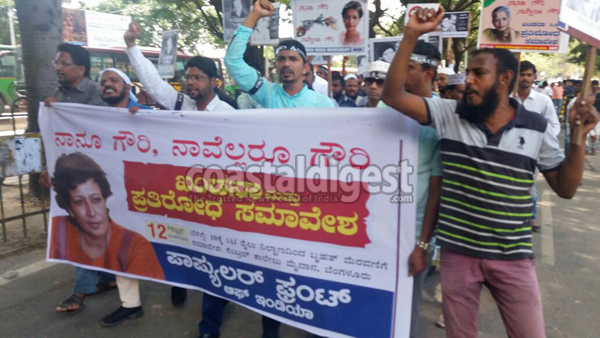
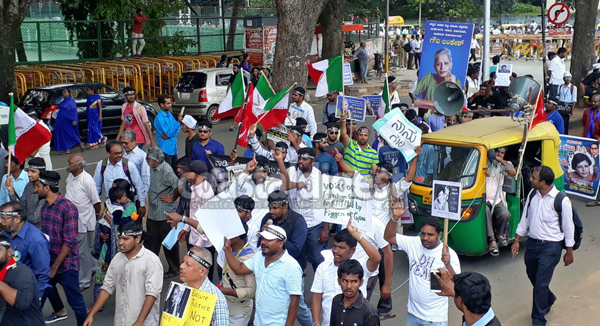
Bengaluru resonates with #IAmGauri as protesters throng Central College grounds

coastaldigest.com news network
September 12, 2017

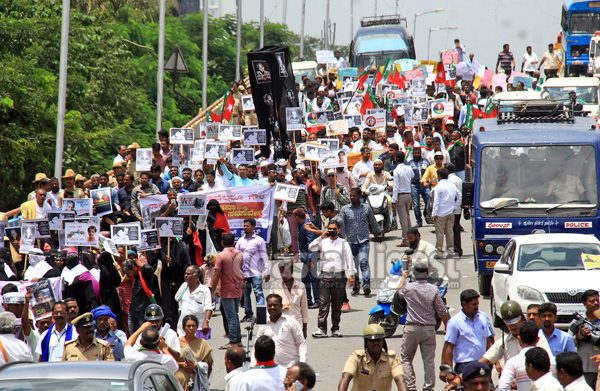
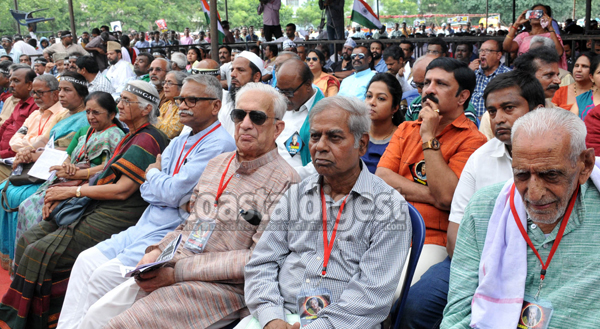
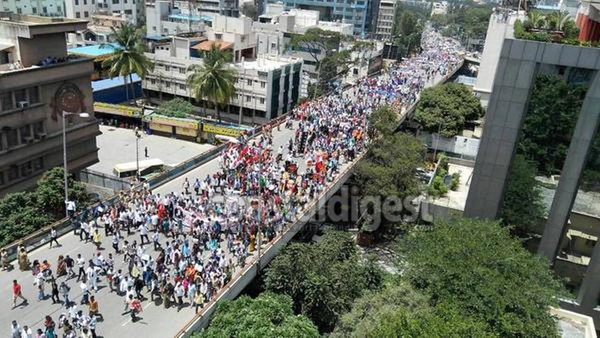
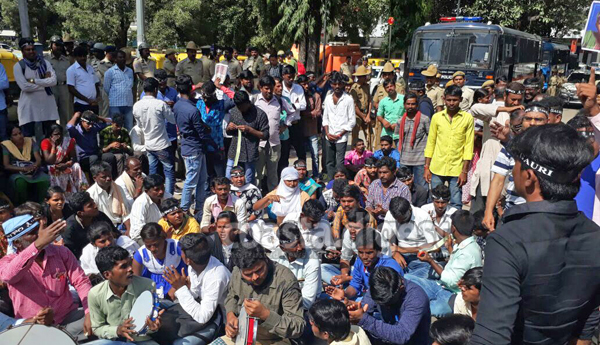
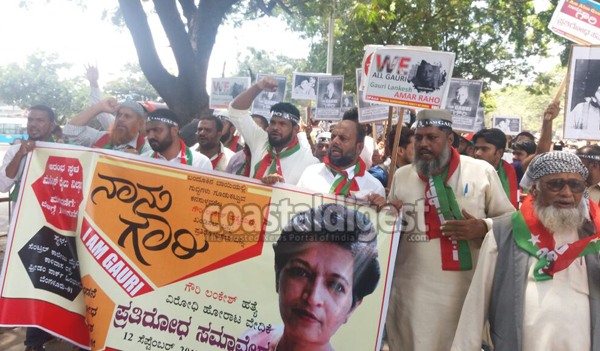
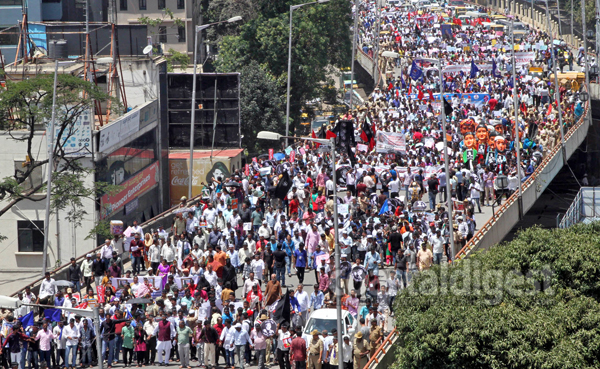
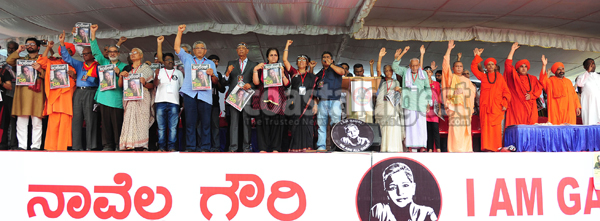
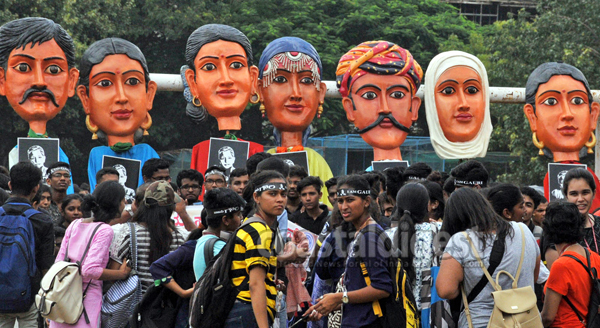
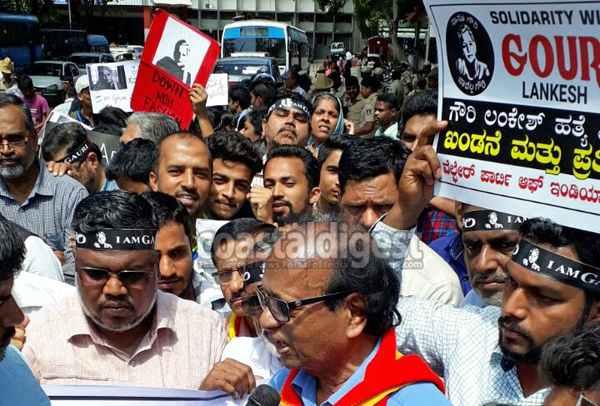
Bengaluru, Sept 12: Thousands of fans of slain journalist-activist Gauri Lankesh including progressive thinkers, writers and rights activists came together on Tuesday to protest the coldblooded murder of one of the most fearless journalists the country has ever produced.
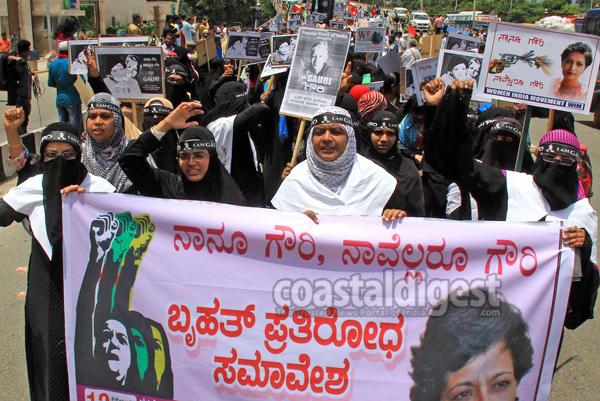
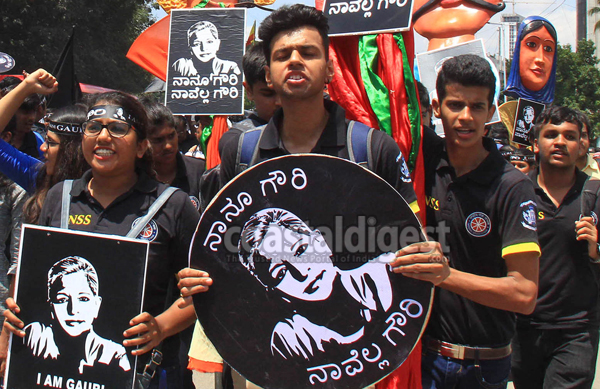
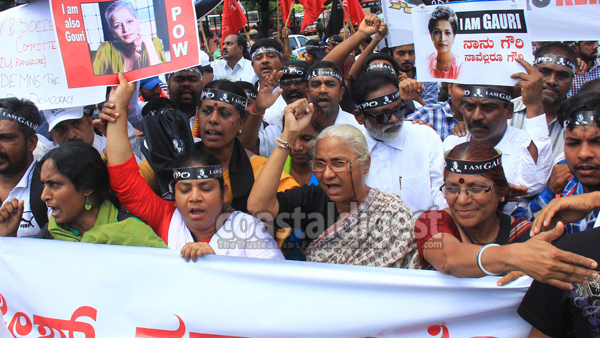
Sporting black badges that read - #IAmGauri - the protesters took out a rally from the Sangolli Rayanna Railway Station to the Central College grounds, where a protest meeting was held. Over 300 policemen were deployed in and around the Central College.

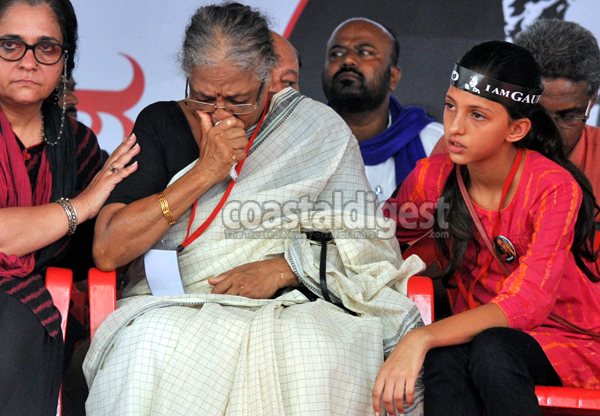
Choking with emotion, Gauri’s mother Indira Lankesh said: “She [Gauri] fought with every fibre of her body. For me, all of you are my Gauris.”

Social activist Teesta Setalvad recalled her association with Gauri. “Though we are of the same age, she called me her little sister, as I had a lot to learn from her. The only thing bearable in the death is the support that has come now. We can't let cohesion resistance go in vain,” she said.

She also said Gauri believed that the youth were the real opposition. “She had a rational outlook and believed in the freedom of questioning. No majoritarian fascist can take it away from us. We can't afford to be sectarian under individual flags. We can't let the death go in vain.”

Chandrashekar Patil, writer, read out a poem as a tribute to Gauri. “A few years ago, I was Dabholkar... then, Pansare. And, two years ago, when my classmate, colleague and comrade M.M. Kalburgi was assassinated, I became Kalburgi. Now, I’m Gauri,” he said.

CPI (M) leader Sitaram Yechury said, “I'm here as a foot soldier of Indian democracy and idea of India. It isn't abstract. It's concrete and alive. It can coexist only if there is opportunity to discuss and debate without bullets to kill. That's the spirit to kill caste, religious minorities. The battle of ideas is the idea of India. My India doesn't remain if it is killed through bullets.”

He added that the country had lost a person who disagreed verbally, who was an active participant and who never eliminated ideas.

“What has happened with Gauri is unacceptable and is not an isolated incident. We're here because we're now realising that we are in the path of a movement where those in authority and power are creating a totalitarian state. It is the antithesis of India,” he said.

While referring to the RSS and the BJP filing cases, he said that one cannot be cowed down. “Remember, Mahatma Gandhi was a victim of the Hindu Rashtra and those against diversity.”

Acclaimed Kannada writer and Dalit activist Devanur Mahadeva said that when India got Independence, there were dreams of an ideal Indian society, of how it should be in the future. “What has happened now? Our mentality is going backwards. The dream has become a nightmare. Now, the majority is ‘Indianness’. And Kalburgi, Gauri are being killed as the majority marches on.”

It is not just intellectuals, even religious heads are facing threats, claimed Shivamurthy Swamiji of Chitradurga Muruga Mutt.

Narmada Bachao Andolan leader Medha Patkar said that the coming together of so many voices on one stage was reason for optimism. “Those who want to crush, not just the Constitution, but aspirations of equality are in power today,” she remarked.

A special edition of Gauri Lankesh weekly was released. The protest meeting is likely to go on till evening.
Comments

Rameez
 - 
Tuesday, 12 Sep 2017

Good gather. Good to see pfi and sdpi

Add new comment

  • Coastaldigest.com reserves the right to delete or block any comments.
  • Coastaldigset.com is not responsible for its readers’ comments.
  • Comments that are abusive, incendiary or irrelevant are strictly prohibited.
  • Please use a genuine email ID and provide your name to avoid reject.
News Network
January 23,2026

Mangaluru: The Karnataka Government Polytechnic (KPT), Mangaluru, has achieved autonomous status from the All India Council for Technical Education (AICTE), becoming the first government polytechnic in the country to receive such recognition in its 78-year history. The status was granted by AICTE, New Delhi, and subsequently approved by the Karnataka Board of Technical Education in October last year.

Officials said the autonomy was conferred a few months ago. Until recently, AICTE extended autonomous status only to engineering colleges, excluding diploma institutions. However, with a renewed national focus on skill development, several government polytechnics across India have now been granted autonomy.

KPT, the second-largest polytechnic in Karnataka, was established in 1946 with four branches and has since expanded to offer eight diploma programmes, including computer science and polymer technology. The institution is spread across a 19-acre campus.

Ravindra M Keni, the first dean of the institution, told The Times of India that AICTE had proposed autonomous status for polytechnic institutions that are over 25 years old. “Many colleges applied. In the first round, 100 institutions were shortlisted, which was further narrowed down to 15 in the second round. We have already completed one semester after becoming an autonomous institution,” he said. He added that nearly 500 students are admitted annually across eight three-year diploma courses.

Explaining the factors that helped KPT secure autonomy, Keni said the institution has consistently recorded 100 per cent admissions and placements for its graduates. He also noted its strong performance in sports, with the college emerging champions for 12 consecutive years, along with active student participation in NCC and NSS activities.

Autonomous status allows KPT to design industry-oriented curricula, conduct examinations, prepare question papers, and manage academic documentation independently. The institution can also directly collaborate with industries and receive priority funding from AICTE or the Ministry of Education. While academic autonomy has been granted, financial control will continue to rest with the state government.

“There will be separate committees for examinations, question paper setting, boards of studies, and boards of examiners. The institution will now have the freedom to conduct admissions without government notifications and issue its own marks cards,” Keni said, adding that new academic initiatives would be planned after a year of functioning under the autonomous framework.

Comments

Add new comment

  • Coastaldigest.com reserves the right to delete or block any comments.
  • Coastaldigset.com is not responsible for its readers’ comments.
  • Comments that are abusive, incendiary or irrelevant are strictly prohibited.
  • Please use a genuine email ID and provide your name to avoid reject.
News Network
February 1,2026

Bengaluru: Karnataka Deputy Chief Minister D K Shivakumar on Sunday criticised the Union Budget presented by Finance Minister Nirmala Sitharaman, claiming it offered no tangible benefit to the state.

Though he said he was yet to study the budget in detail, Shivakumar asserted that Karnataka had gained little from it. “There is no benefit for our state from the central budget. I was observing it. They have now named a programme after Mahatma Gandhi, after repealing the MGNREGA Act that was named after him,” he said.

Speaking to reporters here, the Deputy Chief Minister demanded the restoration of MGNREGA, and made it clear that the newly enacted rural employment scheme — VB-G RAM G — which proposes a 60:40 fund-sharing formula between the Centre and the states, would not be implemented in Karnataka.

“I don’t see any major share for our state in this budget,” he added.

Shivakumar, who also holds charge of Bengaluru development, said there were high expectations for the city from the Union Budget. “The Prime Minister calls Bengaluru a ‘global city’, but what has the Centre done for it?” he asked.

He also drew attention to the problems faced by sugar factories, particularly those in the cooperative sector, alleging a lack of timely decisions and support from the central government.

Noting that the Centre has the authority to fix the minimum support price (MSP) for agricultural produce, Shivakumar said the Union government must take concrete steps to protect farmers’ interests.

Comments

Add new comment

  • Coastaldigest.com reserves the right to delete or block any comments.
  • Coastaldigset.com is not responsible for its readers’ comments.
  • Comments that are abusive, incendiary or irrelevant are strictly prohibited.
  • Please use a genuine email ID and provide your name to avoid reject.
News Network
January 20,2026

Mangaluru: In a major step towards strengthening rural innovation, the Office of the Principal Scientific Adviser (PSA) to the Government of India is supporting the establishment of RuTAGe Smart Village Centres (RSVCs) across the country through collaborations with academic institutions, civil society organisations and philanthropic partners.

As part of this national initiative, Nitte (Deemed to be University) will set up the first RSVCs in the region at Nitte GP in Udupi district and at the Nitte Health Centre, Sevanjali Trust, Farangipete, in Dakshina Kannada district. The centres will be inaugurated on January 21. In South India, the programme is being implemented by the Section Infin-8 Foundation (SI-8).

Speaking to reporters on Monday, SI-8 founder-director Vishwas US said experts from Nitte University and SI-8 would work closely with farmers, students, youth and local entrepreneurs to adapt and deploy technologies tailored to local needs.

Project head Prof Iddya Karunasagar, representing Nitte DU, said the RSVCs at Nitte and Farangipete would serve as demonstration hubs for a wide range of agriculture, energy, skill-development and assistive technologies. These include solar dryers for fruits, vegetables and crops; soil-testing solutions; power weeders and women-friendly farm tools; wind-powered devices for rural artisans; grain storage systems; grass-cutting and tree-climbing equipment; and liquid fertiliser production using cowshed waste.

SI-8 CEO Aravind C Kumar said the centres would also provide access to digital and knowledge-based platforms such as ISRO applications, government scheme portals, market linkage tools and gamified learning resources, along with assistive technologies for persons with visual impairments.

Highlighting the broader impact of the initiative, Principal Scientific Adviser Prof Ajay Kumar Sood said it demonstrated how applied research could bridge the rural–urban divide and help create self-reliant, technology-enabled villages.

The initiative has been made possible through philanthropic support from Dr NC Murthy of ACM Business Solutions, LLC, USA. Dr Sapna Poti, Director (Strategic Alliances) at the Office of the Principal Scientific Adviser, said the long-term objective is to build self-sufficient, technology-driven communities capable of generating sustainable livelihoods on their own.

Comments

Add new comment

  • Coastaldigest.com reserves the right to delete or block any comments.
  • Coastaldigset.com is not responsible for its readers’ comments.
  • Comments that are abusive, incendiary or irrelevant are strictly prohibited.
  • Please use a genuine email ID and provide your name to avoid reject.