Bengaluru, Nov 21: The Karnataka government is facing pressure to overhaul its employment system after a high-level Cabinet sub-committee recommended the complete phase-out of job outsourcing in government offices, boards, and corporations by March 2028. The move is aimed at tackling a systemic issue that has led to the potential violation of constitutional reservation policies and the exploitation of workers.
The Call for Systemic Change
With over three lakh vacant posts currently being filled through private agencies on an outsource, insource, or daily wage basis, the sub-committee highlighted a significant lapse. "As a result, reservations are not being followed as per the Constitution and state laws. It’s an urgent need to take serious steps to change the system. It has been recommended to completely stop the system of outsourcing by March 2028," the panel stated in a document.
The practice of outsourcing involves private companies hiring workers to perform duties for a government agency. Critics argue this model results in lesser salaries, a lack of social security benefits (otherwise available to permanent government employees), and a failure to adhere to the provisions of Articles 14 and 15 of the Constitution, which guarantee equality before the law and prohibit discrimination.
The 'Bidar Model' as a Stop-Gap Solution
To regulate the current mode of employment and reduce worker exploitation until the 2028 deadline, the government plans to establish workers’ services multi-purpose cooperative societies across all districts, following the successful "Bidar Model."
The Bidar District Services of Labour Multi-purpose Cooperative Society Ltd., which operates under the District Commissioner, is cited as a successful example of providing a measure of social security to outsourced staff. Labour Department officials argue this society ensures workers receive their due wages and statutory facilities like ESI (Employees' State Insurance) and PF (Provident Fund), in exchange for a 1% service fee collected from the employees.
legislative push and Priority Insourcing
The recommendations, led by the sub-committee headed by Law and Parliamentary Affairs Minister H K Patil, are set to be discussed at the next Cabinet meeting. The committee has proposed the introduction of the Karnataka Outsourced Employees (Regulation, Placement and Welfare) Bill 2025.
In a move addressing immediate concerns, Labour Minister Santosh Lad, a member of the sub-committee, has reportedly assured that steps will be taken over the next 2-3 years to insource workers in "life-threatening services" on a priority basis. This includes essential personnel like pourakarmikas (sanitation workers), drivers, electrical staff in the Energy Department, and Health Department staff handling contagious diseases. The transition aims to grant these workers the long-term security and benefits they currently lack under the outsourcing system.





Comments
Hahahah... What a joke!!!
What these RSS Terrorists contributed for India? They supported British. If you search in history Muslims taught them everything. Even they were not knowing how to bath, how to wear clothes, how to cook, how to build buildings. All the food recipe they learnt from Muslims. These aryans run away from Iran and now looting our India. All the Buildings and culture they are using were built by Muslims. What did they build??? Toilets????
AS PER WIKIPEDIA,
The Mughal Empire (Urdu: مغلیہ سلطنت, translit. Mughliyah Salṭanat)[7] or Mogul Empire,[8] self-designated as Gurkani (Persian: گورکانیان, Gūrkāniyān, meaning "son-in-law"),[9] was an empire in the Indian subcontinent, founded in 1526. It was established and ruled by a Muslim dynasty with Turco-Mongol Chagatai roots from Central Asia,[10][11][12] but with significant Indian Rajput and Persian ancestry through marriage alliances;[13][14] only the first two Mughal emperors were fully Central Asian, while successive emperors were of predominantly Rajput and Persian ancestry.[15] The dynasty was Indo-Persian in culture,[16] combining Persianateculture[8][17] with local Indian cultural influences[16] visible in its traits and customs.[18]
The Mughal Empire at its peak extended over nearly all of the Indian subcontinent[5] and large parts of Afghanistan. It was the second largest empire to have existed in the Indian subcontinent, spanning four million square kilometres at its zenith,[4] after only the Maurya Empire, which spanned five million square kilometres. The Mughal Empire began a period of proto-industrialization,[19]and Mughal India became the world's largest economic power, with 24.4% of world GDP,[20] and the world leader in manufacturing,[21] producing 25% of global industrial output up until the 18th century.[22] The Mughal Empire is considered "India's last golden age"[23] and one of the three Islamic Gunpowder Empires (along with the Ottoman Empire and Safavid Persia).[24]
The beginning of the empire is conventionally dated to the victory by its founder Babur over Ibrahim Lodi, the last ruler of the Delhi Sultanate, in the First Battle of Panipat (1526). The Mughal emperors had roots in the Turco-Mongol Timurid dynasty of Central Asia, claiming direct descent from both Genghis Khan (founder of the Mongol Empire, through his son Chagatai Khan) and Timur (Turco-Mongol conqueror who founded the Timurid Empire). During the reign of Humayun, the successor of Babur, the empire was briefly interrupted by the Sur Empire. The "classic period" of the Mughal Empire started in 1556 with the ascension of Akbar the Great to the throne. Under the rule of Akbar and his son Jahangir, the region enjoyed economic progress as well as religious harmony, and the monarchs were interested in local religious and cultural traditions. Akbar was a successful warrior who also forged alliances with several Hindu Rajput kingdoms. Some Rajput kingdoms continued to pose a significant threat to the Mughal dominance of northwestern India, but most of them were subdued by Akbar. All Mughal emperors were Muslims; Akbar, however, propounded a syncretic religion in the latter part of his life called Dīn-i Ilāhī, as recorded in historical books like Ain-i-Akbari and Dabistān-i Mazāhib.[25]
The Mughal Empire did not try to intervene in the local societies during most of its existence, but rather balanced and pacified them through new administrative practices[26][27] and diverse and inclusive ruling elites,[28] leading to more systematic, centralised, and uniform rule.[29] Traditional and newly coherent social groups in northern and western India, such as the Marathas, the Rajputs, the Pashtuns, the Hindu Jats and the Sikhs, gained military and governing ambitions during Mughal rule, which, through collaboration or adversity, gave them both recognition and military experience.[30][31][32][33]
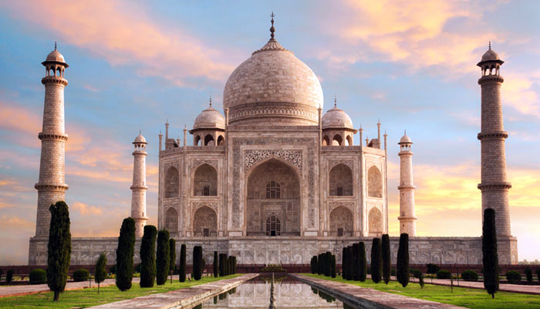
The reign of Shah Jahan, the fifth emperor, between 1628 and 1658 was the golden age of Mughal architecture. He erected several large monuments, the best known of which is the Taj Mahal at Agra, as well as the Moti Masjid, Agra, the Red Fort, the Jama Masjid, Delhi, and the Lahore Fort. The Mughal Empire reached the zenith of its territorial expanse during the reign of Aurangzeb and also started its terminal decline in his reign due to Maratha military resurgence under Shivaji Bhosale. During his lifetime, victories in the south expanded the Mughal Empire to its greatest extent, ruling over more than 150 million subjects, nearly one quarter of the world's population at the time, with a GDP of over $90 billion.[34][35]
By the mid-18th century, the Marathas had routed Mughal armies and won over several Mughal provinces from the Punjab to Bengal.[36] Internal dissatisfaction arose due to the weakness of the empire's administrative and economic systems, leading to its break-up and declarations of independence of its former provinces by the Nawab of Bengal, the Nawab of Awadh, the Nizam of Hyderabad and other small states. In 1739, the Mughals were crushingly defeated in the Battle of Karnal by the forces of Nader Shah, the founder of the Afsharid dynasty in Persia, and Delhi was sacked and looted, drastically accelerating their decline. During the following century Mughal power had become severely limited, and the last emperor, Bahadur Shah II, had authority over only the city of Shahjahanabad. He issued a firman supporting the Indian Rebellion of 1857 and following the defeat was therefore tried by the British East India Company for treason, imprisoned and exiled to Rangoon.[37] The last remnants of the empire were formally taken over by the British, and the Government of India Act 1858 let the British Crown formally assume direct control of India in the form of the new British Raj.
Aryan cowboys who invaded India, enslved the original inhabitants destroying their culture, imposed Vedic divisive foreign inhuman cast system. India is still suffering from their terror mindset. They are the people who supported the British and responsible for death of millions of Indian freedom fighters. These traitors who licked the British boots, now lecuring us about patriotism. When Mughals came to this land, there was no India, they built India and contributed richly to its history. If these anti-human gang cant digest the truth, let them NOT use any of the Mughal or Muslims contribution and jump into Sarayu or Ganga enmasse.
If Owais is committing intolerance, Oh Blind, deaf, dumb BJP chelas, puffets, what the hell is happening specially in UP, is it tolerance? Killing in the name of gow rakshaks, killing small children, is it tolerance?
Add new comment