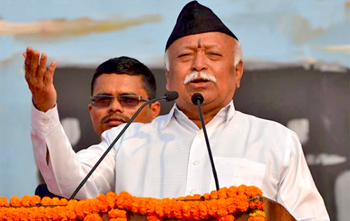
Ram, 'Gau Mata' basis of Hindu culture: Bhagwat

Agencies
February 7, 2019

Dehradun, Feb 7: Describing Ram and 'Gau Mata' as the "basis of the Hindu culture", RSS chief Mohan Bhagwat on Wednesday said every Indian "must feel" that the Ram temple in Ayodhya should be built at its original place.

"We revere Ram. Gau mata and Ram form the basis of the Hindu culture. Every Indian must feel that the Ram temple in Ayodhya should be built at its original place. If it comes up there, the identity of Hinduism will be established in the world," the RSS chief said during his interaction with retired officials in the course of his four-day stay here.

On the final day of the Vishwa Hindu Parishad's conclave at the Kumbh Mela here, RSS chief Mohan Bhagwat said Friday the Ayodhya issue was at a decisive stage, suggesting that those campaigning for the construction of a Ram temple should wait it out for a few months.

On Wednesday, he said madarsas "will have to be taught" the meaning of Indianness which believes in non-discrimination between religions and the language of peace.

"Muslims are free to follow their method of worship but they must feel that we belong to the same country and culture and that our ancestors were the same," he said.

This collective thinking alone can lead to the building of a strong society and nation, the RSS chief said.

Bhagwat claimed that ancestors of all sections of the Indian population, apart from those of Afghanistan and Pakistan, were the same. They belong to the same culture, he said.

Citing an example, he said, "Music is forbidden in Islam, but in Afghanistan and Pakistan qawwali is sung. Islam is against idolatry but people in these countries come close to it when they offer prayers at tombs."

"It shows we are all Hindus by culture. Gautam Buddha, Guru Nanak and Mahavir may have spoken different languages but they were constituents of the same Hindu society," the RSS chief said.

Comments

Kannadiga
 - 
Thursday, 7 Feb 2019

First of all, Hindu religion is recognized fro AHIMSA non voilant - Which was proven by our Father Of Nation Mahtma Gandhi. Who spent his whole life for the sake of all INDIANS and not or his self benifit. Only because of his daring step and policy all patriot Indians united and fought for the Independnece wiht out any cast adn colour discrepnacy.

The group supported the british behind the screen and with in short perod of our independence assasinated

the mahtma and now talking ablut Hindu religion by regularly holding a lathi  is not the sign of HINDU religion.  In Hindu religion all are with ONE status adn there is no upper and lower cast.  All human  created by ONE god.  Then how come  there is upper cast brhamin. Why these   rss terrorists omit cast poison all over India.   This fellow bhagawath and his terrorist  group as no rght to talk abuot hindu religion. Shortly rss is ONLY the enemy of Hindu and Hindustan.

All must boycot and kick  vanish them from our graeat India.


Jai Hind !

Shankar
 - 
Thursday, 7 Feb 2019

The people who worship IDOL will directly go to Hell forever there is no second chance in this..


people must think who created idol first, its a man made item which you cannot bow down.


now in india many babas takes advantage of it, even politician


GOD says clearly there is no image of him, he is supreme and we cant see him bcoz our eye dont have capability.


This ch**iya man talks about patrotism, they are the people who are slave of british when people of real indian fighting for freedom.


patriotism does not comes by ugly mouth, this shoul come from action when it need for our country.


dont ever belive these marons will fight to defend india when it need.


Add new comment

  • Coastaldigest.com reserves the right to delete or block any comments.
  • Coastaldigset.com is not responsible for its readers’ comments.
  • Comments that are abusive, incendiary or irrelevant are strictly prohibited.
  • Please use a genuine email ID and provide your name to avoid reject.
News Network
December 16,2025

bengal.jpg

The deletion of over 58 lakh names from West Bengal’s draft electoral rolls following a Special Intensive Revision (SIR) has sparked widespread concern and is likely to deepen political tensions in the poll-bound state.

According to the Election Commission, the revision exercise has identified 24 lakh voters as deceased, 19 lakh as relocated, 12 lakh as missing, and 1.3 lakh as duplicate entries. The draft list, published after the completion of the first phase of SIR, aims to remove errors and duplication from the electoral rolls.

However, the scale of deletions has raised fears that a large number of eligible voters may have been wrongly excluded. The Election Commission has said that individuals whose names are missing can file objections and seek corrections. The final voter list is scheduled to be published in February next year, after which the Assembly election announcement is expected. Notably, the last Special Intensive Revision in Bengal was conducted in 2002.

The development has intensified the political row over the SIR process. Chief Minister Mamata Banerjee and her Trinamool Congress have strongly opposed the exercise, accusing the Centre and the Election Commission of attempting to disenfranchise lakhs of voters ahead of the elections.

Addressing a rally in Krishnanagar earlier this month, Banerjee urged people to protest if their names were removed from the voter list, alleging intimidation during elections and warning of serious consequences if voting rights were taken away.

The BJP, meanwhile, has defended the revision and accused the Trinamool Congress of politicising the issue to protect what it claims is an illegal voter base. Leader of the Opposition Suvendu Adhikari alleged that the ruling party fears losing power due to the removal of deceased, fake, and illegal voters.

The controversy comes amid earlier allegations by the Trinamool Congress that excessive work pressure during the SIR led to the deaths by suicide of some Booth Level Officers (BLOs), for which the party blamed the Election Commission. With the draft list now out, another round of political confrontation appears imminent.

As objections begin to be filed, the focus will be on whether the correction mechanism is accessible, transparent, and timely—critical factors in ensuring that no eligible voter is denied their democratic right ahead of a crucial election.

Comments

Add new comment

  • Coastaldigest.com reserves the right to delete or block any comments.
  • Coastaldigset.com is not responsible for its readers’ comments.
  • Comments that are abusive, incendiary or irrelevant are strictly prohibited.
  • Please use a genuine email ID and provide your name to avoid reject.
News Network
December 15,2025

Mangaluru, Dec 15: Educational institutions in Mangaluru that rely on the popular Mangala Stadium for their annual sports events are bracing for an inconvenience as the city's key sporting venue is set to close its gates for a significant upgrade. The stadium is expected to be unavailable for approximately two months starting from January 15, 2026.

The closure is necessitated by a proposed overhaul of the stadium's facilities, with a special focus on upgrading the synthetic track. Pradeep Dsouza, Assistant Director of the District of Youth Empowerment and Sports (DYES), Dakshina Kannada, confirmed the development.

"Experts have visited the stadium, conducted a thorough inspection, and have given the go-ahead for a complete makeover," Dsouza stated. "Funds have been allocated for the project, and we are currently awaiting the final green signal from state officials to commence the work. We anticipate that the work will likely begin in the second week of January. Consequently, we have stopped renting out the stadium to colleges and other organizations in preparation for the upgrade."

The timing presents a logistical challenge for colleges, as many schools have already concluded their sports meets.

"Colleges will now be organizing their events and will need to find alternative locations to host their sports meets," Dsouza added. He suggested a few potential venues, including the Dakshina Kannada police ground, University College grounds, Panambur grounds, Swaraj Maidan in Moodbidri, and the Mangalore University sports grounds in Konaje.

However, many institutions note that finding a comparable venue will be difficult. While the DK police ground and University College grounds are closer to the city center, they do not possess the extensive facilities and infrastructure offered by Mangala Stadium.

Dr. P Dayananda Pai - P Satisha Govt First Grade College, Carstreet, is one such institution dependent on the stadium. Principal Jayakar Bhandary expressed hope for a swift completion of the work. "We expect the work to be completed at the earliest. If not, we will be forced to look for other venues to host the sports day for our students," Bhandary said, highlighting the pressing need for the city's main sporting facility.

Comments

Add new comment

  • Coastaldigest.com reserves the right to delete or block any comments.
  • Coastaldigset.com is not responsible for its readers’ comments.
  • Comments that are abusive, incendiary or irrelevant are strictly prohibited.
  • Please use a genuine email ID and provide your name to avoid reject.
News Network
December 13,2025

New Delhi: School-going children are picking up drug and smoking habits and engaging in consumption of alcohol, with the average age of introduction to such harmful substances found to be around 13 years, suggesting a need for earlier interventions as early as primary school, a multi-city survey by AIIMS-Delhi said.

The findings also showed substance use increased in higher grades, with grade XI/XII students two times more likely to report use of substances when compared with grade VIII students. This emphasised the importance of continued prevention and intervention through middle and high school.

The study led by Dr Anju Dhawan of AIIMS's National Drug Dependence Treatment Centre, published in the National Medical Journal of India this month, looks at adolescent substance use across diverse regions.

The survey included 5,920 students from classes 8, 9, 11 and 12 in urban government, private and rural schools across 10 cities -- Bengaluru, Chandigarh, Delhi, Dibrugarh, Hyderabad, Imphal, Jammu, Lucknow, Mumbai, and Ranchi. The data were collected between May 2018 and June 2019.

The average age of initiation for any substance was 12.9 (2.8) years. It was lowest for inhalants (11.3 years) followed by heroin (12.3 years) and opioid pharmaceuticals (without prescription; 12.5 years).

Overall, 15.1 per cent of participants reported lifetime use, 10.3 per cent reported past year use, and 7.2 per cent reported use in the past month of any substance, the study found.

The most common substances used in the past year, after tobacco (4 per cent) and alcohol (3.8 per cent), were opioids (2.8 per cent), followed by cannabis (2 per cent) and inhalants (1.9 per cent). Use of non-prescribed pharmaceutical opioids was most common among opioid users (90.2 per cent).

On being asked, 'Do you think this substance is easily available for a person of your age' separately for each substance category, nearly half the students (46.3 per cent) endorsed that tobacco products and more than one-third of the students (36.5 per cent) agreed that a person of their age can easily procure alcohol products.

Similarly, for Bhang (21.9 per cent), ganja/charas (16.1 per cent), inhalants (15.2 per cent), sedatives (13.7 per cent), opium and heroin (10 per cent each), the students endorsed that these can be easily procured.

About 95 per cent of the children, irrespective of their grade, agreed with the statement that 'drug use is harmful'.

The rates of substance use (any) among boys were significantly higher than those of girls for substance use (ever), use in the past year and use in the past 30 days. Compared to grade VIII students, grade IX students were more likely, and grade XI/XII students were twice as likely to have used any substance (ever).

The likelihood of past-year use of any substance was also higher for grade IX students and for grade XI/XII students as compared to grade VIII students.

About 40 per cent of students mentioned that they had a family member who used tobacco or alcohol each. The use of cannabis (any product) and opioid (any product) by a family member was reported by 8.2 per cent and 3.9 per cent of students, respectively, while the use of other substances, such as inhalants/sedatives by family was 2-3 per cent, the study found.

A relatively smaller percentage of students reported use of tobacco or alcohol among peers as compared to among family members, while a higher percentage reported inhalants, sedatives, cannabis or opioid use among peers.

Children using substances (past year) compared to non-users reported significantly higher any substance use by their family members and peers.

There were 25.7 per cent students who replied 'yes' to the question 'conflicts/fights often occur in your family'. Most students also replied affirmatively to 'family members are aware of how their time is being spent' and 'damily members are aware of with whom they spend their time'.


Comments

Add new comment

  • Coastaldigest.com reserves the right to delete or block any comments.
  • Coastaldigset.com is not responsible for its readers’ comments.
  • Comments that are abusive, incendiary or irrelevant are strictly prohibited.
  • Please use a genuine email ID and provide your name to avoid reject.