Mangaluru’s 3 decades old Beggars’ Rehabilitation Centre has plenty of life transformation stories to tell

Chetana Nayak K
March 15, 2019

A host of home-grown vegetables welcome the visitors at Beggars’ Rehabilitation Centre (BRC) at Pachanady in Vamanjoor on the outskirts of the coastal city of Mangaluru. Once barren land with laterite rocks, today the 2-acre land boasts of its lush-green vegetation across its one-acre landscape. Brinjal, Coriander, Drumstick, Green chilli, Pumpkin, Spinach, Mint leaves, Jackfruit, Mango; are among the several vegetables that the inmates have raised with their labour.

"Although, it was initially a challenge to motivate them, now most of them, either through self motivation or inspired by others have taken to cultivation on their own. They tend to the crops as their own and use it for self-consumption," Ashok, in-charge of BRC said.

Besides vegetation, the Centre ensures that inmates do not spend their time idling. Beyond the normal rest or sleeping hours, the inmates are involved in pre-seeding work, tilling the soil, watering the soil beds, preparing organic manure, timely harvesting and gardening.

While some of the woman inmates engage in agriculture, they also involve in envelope making, crafts, early morning walks, exercise or at least their routine chores such as washing their own clothes.

Well educated, hailing from an affluent family, with two brothers employed in reputed banks, Anupama* (28) had everything she had asked for. But in an unfortunate turn of events, the sudden demise of her parents few years ago, Anupama found herself roaming around the streets of Pandeshwar in Mangaluru.

Beyond recognition, begging for food with pedestrians, she would sleep on the streets and roam about aimlessly. Reported by the local residents in 2014, Anupama’s plight caught attention of the jurisdictional Pandeshwar police, who shifted her to BRC.

In a span of one year, Anupama, who formerly found solace in anonymity and in begging alms, today has become a tailor. She came out of the BRC and eked out her living through tailoring. Anupama also slapped legal cases against her brothers who had allegedly cheated her of property. “She currently owns a property in Karkala, with bank deposits bequeathed in her name by her mother,” her case officer adds.

Another, Ramesh*, an electronics and electrical engineer from Chennai addicted to drinking and drug abuse had abandoned his family. He was brought to BRC that kicked-out his alcohol habit. Now working in an MNC, Ramesh is back on top of his game and works for a multinational company in Chennai.

BRC that began in 1991 under Karnataka Social Welfare Department today has grown to be one of the most trusted of the 14 Centre’s in the state.

Upon the identification of an individual as a destitute or a beggar, Mangaluru City Commissioner (MCC), Taluk court, Chief Executive Officer (CEO) of Taluk Panchayat, District level officer(s), and jurisdictional Police Sub-Inspector are empowered to detain and surrender destitute/beggars at the Centre.

In-charge of BRC, Ashok says that the Centre’s team and staff guard travel around their respective districts and identify the beggars and bring them to the court within 24 hours. As per the current provisions, they can house a beggar for one-year. During which, through a series of vocational and counseling sessions, it can encourage a destitute to quit begging and live independently. “Once the Centre is reassured of their skills, the Centre informs their family members and requests to take them back. In the absence of the family, the member is referred to a government aided Centre.” Ashok said.

Over the year, BRC has aggregated destitute from different parts of the country in its Mangaluru Centre. "Since, Mangalore Central Railway Station is the last station in the region, majority of them de-board the train here and venture into the city. Most of our inmates are from Karnataka, Tamil Nadu, Kerala and Andhra Pradesh," a BRC official says.

A team of psychiatrists, doctors, skin specialists, who visit once in 15-days, have the mandate to ensure that the inmates are hale and healthy. Over the years, for about 137 destitute in Dakshina Kannada, BRC has become a haven for transformation; Owing to alcohol, substance abuse, financial stress and family issues, these inmates who had once resorted to begging today claim of confidence to thrive with their abilities.

Comments

Ann Pinto
 - 
Thursday, 9 May 2019

Thanks to coastal digest for publishing such articles and showing the positive change brought about by BRC so that these people can live a dignified life with the skills they they are taught..

SD
 - 
Tuesday, 26 Mar 2019

Wow! Impressed May God bless all involved in making the beggers life easy.The general principle of alleviating poverty by facilitating self-sufficiency has a long history

Add new comment

  • Coastaldigest.com reserves the right to delete or block any comments.
  • Coastaldigset.com is not responsible for its readers’ comments.
  • Comments that are abusive, incendiary or irrelevant are strictly prohibited.
  • Please use a genuine email ID and provide your name to avoid reject.
News Network
November 21,2025

Bengaluru, Nov 21: The Karnataka government is facing pressure to overhaul its employment system after a high-level Cabinet sub-committee recommended the complete phase-out of job outsourcing in government offices, boards, and corporations by March 2028. The move is aimed at tackling a systemic issue that has led to the potential violation of constitutional reservation policies and the exploitation of workers.

The Call for Systemic Change

With over three lakh vacant posts currently being filled through private agencies on an outsource, insource, or daily wage basis, the sub-committee highlighted a significant lapse. "As a result, reservations are not being followed as per the Constitution and state laws. It’s an urgent need to take serious steps to change the system. It has been recommended to completely stop the system of outsourcing by March 2028," the panel stated in a document.

The practice of outsourcing involves private companies hiring workers to perform duties for a government agency. Critics argue this model results in lesser salaries, a lack of social security benefits (otherwise available to permanent government employees), and a failure to adhere to the provisions of Articles 14 and 15 of the Constitution, which guarantee equality before the law and prohibit discrimination.

The 'Bidar Model' as a Stop-Gap Solution

To regulate the current mode of employment and reduce worker exploitation until the 2028 deadline, the government plans to establish workers’ services multi-purpose cooperative societies across all districts, following the successful "Bidar Model."

The Bidar District Services of Labour Multi-purpose Cooperative Society Ltd., which operates under the District Commissioner, is cited as a successful example of providing a measure of social security to outsourced staff. Labour Department officials argue this society ensures workers receive their due wages and statutory facilities like ESI (Employees' State Insurance) and PF (Provident Fund), in exchange for a 1% service fee collected from the employees.

legislative push and Priority Insourcing

The recommendations, led by the sub-committee headed by Law and Parliamentary Affairs Minister H K Patil, are set to be discussed at the next Cabinet meeting. The committee has proposed the introduction of the Karnataka Outsourced Employees (Regulation, Placement and Welfare) Bill 2025.

In a move addressing immediate concerns, Labour Minister Santosh Lad, a member of the sub-committee, has reportedly assured that steps will be taken over the next 2-3 years to insource workers in "life-threatening services" on a priority basis. This includes essential personnel like pourakarmikas (sanitation workers), drivers, electrical staff in the Energy Department, and Health Department staff handling contagious diseases. The transition aims to grant these workers the long-term security and benefits they currently lack under the outsourcing system. 

Comments

Add new comment

  • Coastaldigest.com reserves the right to delete or block any comments.
  • Coastaldigset.com is not responsible for its readers’ comments.
  • Comments that are abusive, incendiary or irrelevant are strictly prohibited.
  • Please use a genuine email ID and provide your name to avoid reject.
News Network
November 29,2025

DKSsiddu.jpg

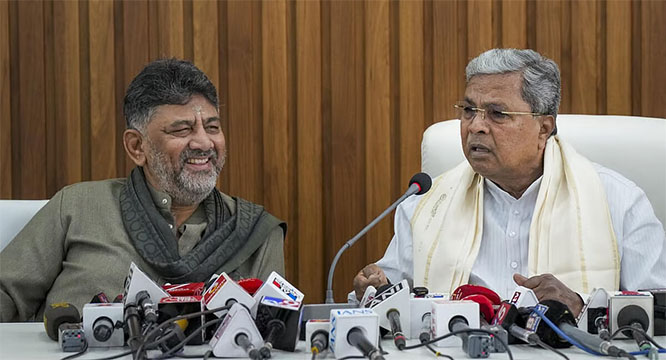
New Delhi: Karnataka chief minister Siddaramaiah and deputy CM DK Shivakumar on Saturday put up a dramatic display of unity at a closely watched joint press briefing, firmly dismissing weeks of speculation about a power-sharing tussle within the Congress. With the high command nudging both leaders to sit together and settle the dust, the meeting became a political spectacle, ending with the duo declaring that there was “no confusion, no differences.”

Calling the reports of a rift “manufactured confusion,” Siddaramaiah said the talks had gone smoothly, even joking about their breakfast. “Breakfast was very good. All three of us enjoyed it,” he said. “We want to end this confusion once and for all. For local elections and for 2028, our mission is clear — Congress must return to power. There is no difference between me and DKS, not now, not before.”

He blamed the media for fuelling rumours and reiterated absolute adherence to the party leadership. “From tomorrow, let there be no confusion. What the high command says, we will follow.”

Siddaramaiah also assured that the Assembly session starting December 8 would run smoothly and vowed that Congress would take on the BJP and JD(S) “together.”

Shivakumar echoed the chief minister word for word, stressing loyalty and discipline. “People have given us a massive mandate. It is our duty to deliver,” he said. “This government was formed under Siddaramaiah’s leadership. We both have complete trust in the high command. If they tell me to wait, I will wait.”

He added that the two leaders had discussed strategy for the 2028 Assembly elections. “Whatever the CM says, I agree. We are loyal soldiers of the party. The party may be facing challenges nationally, but we will keep it strong in Karnataka.”

Shivakumar also said Siddaramaiah would soon visit his home for lunch or dinner — another symbolic gesture meant to underline their unity.

Both leaders later posted on social media describing the breakfast meeting as “productive” and focused on “Karnataka’s priorities.”

The BJP, however, rejected the show of camaraderie as “pure bunkum,” accusing Congress of trying to paper over an internal power struggle. But Siddaramaiah and Shivakumar insisted their united front would continue — and that there was “no confusion” within the state leadership.

Comments

Add new comment

  • Coastaldigest.com reserves the right to delete or block any comments.
  • Coastaldigset.com is not responsible for its readers’ comments.
  • Comments that are abusive, incendiary or irrelevant are strictly prohibited.
  • Please use a genuine email ID and provide your name to avoid reject.