


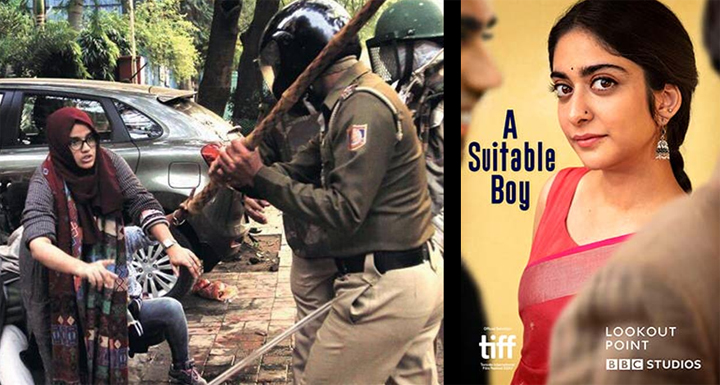
Netflix’s ‘A Suitable Boy’ & Modi era

Safiyat Naseem
November 9, 2020

suitable.jpg

Recently binge-watched a six part mini series directed by Mira Nair on Netflix, titled “A Suitable Boy”, an adaptation of Vikram Seth’s novel of the same title. And while I am neither a movie critic or reviewer, nor a fan of watching series with a backdrop of the post Independence era, I was still moved to write about it. To lay down my emotions on paper with nothing but words. It isn’t extra-ordinary, or brilliantly amazing, neither the characters are made to grow on you nor the plot is meticulously twisted, then what was it, you may ask.

It was Relatable, I would remark.

I usually don’t prefer series or movies that lay down the post Independence India theme with 1950s timeline because I don’t relate to it’s story or characters, and I don’t know if I watched it for Tanya Manikalata who played the character of Lata in the series or the fact that this series was on number 1 on Netflix, but I know for sure that I don’t regret watching it.

Being an Indian Muslim Women, it was shocking or rather depressing to relate to the newly Independent India even after 73 years. The political clashes, the Hindu-Muslim riots, the hatered based on religion, the stigma layed down on love between hindu and muslim, lack of women empowerment and discrimination, what was there is still here, now and growing more than ever.

It’s been 73 years and we as a Nation are still dealing with the same issues, we haven’t grown together, the lack of secularism is till there, the hatred and fear still reside or worse, it’s reoccurring.

When in the first episode the issue of Mosque was depicted, where the muslims demanded a peaceful place to pray, for those who still stayed in India, and the Raja started establishing a mandir in its direction to make them deprived of this right, I remembered the recent demolition of Babri Masjid and the Supreme Court’s judgement and acquittal of the accused.

As Maan went to the village with Rasheed, and acknowledged the miseries of farmers and labourers, the atrocious behaviour towards womens and workers, it wasn’t surprising or new. I thought about the Farm Bill 2020, the egregious condition of the working class amidsts pandemic, the walks they took barefoot and with empty bellies to go back to their hometowns as they were dealing with unemployment, lack of resources and ignorance of the Government and society. I remembered the Hathras case and other numerous sexual harassment as well as domestic violence cases. How I wish to get shocked by the problems of 1950s shown in the series, but unfortunately I was’t, I am rather acclimated to it. I have been there, heard it, been a part of it…even after 73 years, I have still seen it.

And as Rasheed told Maan “Aur bhi dukh hain Zamane mai mohabbat ke siva” (There are many other sorrows in this world besides love)… Indeed Rasheed, Indeed.

In the later episodes, as a communal riot emerged as Muslim and Hindu mobs were crossing roads, and one of them pushed the other, my mind instantly went towards the Delhi Riots. As Maan and Firoz were running together to save their lives, I connected with them and my eyes filled with tears as I remembered the misfortunate event that took place in Jamia Millia Islamia on 15th December 2019. Being a Jamia Student I remembered hiding under the table in the old library of my campus where Delhi Police showered us with tear gas shells.

When Maan and Firoz gets caught by the angry mob, and one of them asked Maan to say Gayatri Mantar to prove he’s not a muslim, and Maan obliged and did the same to save his and Firoz’s life, but Firoz couldn’t say it being a Muslim. I remembered the viral video on the internet that showed two people in the car, forcing a Muslim man to say Jai Mata Di, and were constantly abusing him.

As the main plot evolves, we see Lata falling in love with his schoolmate whose name’s not known up until the time when Lata’s friend warns her to not meet the guy, as he a Muslim, named Kabir Durrani. But Lata follows her heart and as predicted her mother took her away from the city to find her a suitable boy, and definitely not a Muslim. Tanishq’s advertisement flashed across my mind, the controversy revolving around how it depicts so called ‘love jihad’, whereas all it does is showcase communal harmony, and how they had to shut down the ad because apparently it hurts the “sentiment” of people. It’s been 73 years, and communal harmony still hurts the sentiment?

In the first episode, as the establishment of the mandir was taking place, it was already mentioned that there were bound to be protests regarding the same, still the government didn’t uphold the security levels and gave direct orders to shoot if the protesters didn’t stop. Not shockingly, it was a peaceful protest until the police started shooting, 20 people died. And as we see later in the Parliament meeting, the government was nonchalant to this action of police. Remember again, the attack on Jamia Millia Islamia, peaceful protest, tear gas shells and bullets… similar isn’t it? Potato-Patato, same thing…no?

Well, I believe nothing much has changed, the situation in 1947 and Modi era are almost the same, one way or the other. Except that in 1947, India was a newly democratic and independent country where freedom of speech was introduced, Jamia was a symbol of resistance and nationalism and people were the priority of the government. Whereas in Modi era, India is a newly non-democratic country, where freedom of speech is a myth, Jamia is an anti-national University, Islam is terrorism, people are least of the priority and Modi is God.

Comments

Add new comment

  • Coastaldigest.com reserves the right to delete or block any comments.
  • Coastaldigset.com is not responsible for its readers’ comments.
  • Comments that are abusive, incendiary or irrelevant are strictly prohibited.
  • Please use a genuine email ID and provide your name to avoid reject.
News Network
December 4,2025

Mangaluru: Chaos erupted at Mangaluru International Airport (MIA) after IndiGo flight 6E 5150, bound for Mumbai, was repeatedly delayed and ultimately cancelled, leaving around 100 passengers stranded overnight. The incident highlights the ongoing country-wide operational disruptions affecting the airline, largely due to the implementation of new Flight Duty Time Limitations (FDTL) norms for crew.

The flight was initially scheduled for 9:25 PM on Tuesday but was first postponed to 11:40 PM, then midnight, before being cancelled around 3:00 AM. Passengers expressed frustration over last-minute communication and the lack of clarity, with elderly and ailing travellers particularly affected. “Though the airline arranged food, there was no proper communication, leaving us confused,” said one family member.

An IndiGo executive at MIA cited the FDTL rules, designed to prevent pilot fatigue by limiting crew working hours, as the cause of the cancellation. While alternative arrangements, including hotel stays, were offered, about 100 passengers chose to remain at the airport, creating tension. A replacement flight was arranged but also faced delays due to the same constraints, finally departing for Mumbai around 1:45 PM on Wednesday. Passengers either flew, requested refunds, or postponed their travel.

The Mangaluru delay is part of a broader crisis for IndiGo. The airline has been forced to make “calibrated schedule adjustments”—a euphemism for widespread cancellations and delays—after stricter FDTL norms came into effect on November 1.

While an IndiGo spokesperson acknowledged unavoidable flight disruptions due to technology issues, operational requirements, and the updated crew rostering rules, the DGCA has intervened, summoning senior airline officials to explain the chaos and outline corrective measures.

The ripple effect has been felt across the country, with major hubs like Bengaluru and Mumbai reporting numerous cancellations. The Mangaluru incident underscores the systemic operational strain currently confronting India’s largest carrier, leaving passengers nationwide grappling with uncertainty and delays.

Comments

Add new comment

  • Coastaldigest.com reserves the right to delete or block any comments.
  • Coastaldigset.com is not responsible for its readers’ comments.
  • Comments that are abusive, incendiary or irrelevant are strictly prohibited.
  • Please use a genuine email ID and provide your name to avoid reject.
News Network
December 4,2025

indigoflight.jpg

Domestic carrier IndiGo has cancelled over 180 flights from three major airports — Mumbai, Delhi and Bengaluru — on Thursday, December 4, as the airline struggles to secure the required crew to operate its flights in the wake of new flight-duty and rest-period norms for pilots.

While the number of cancellations at Mumbai airport stands at 86 (41 arrivals and 45 departures) for the day, at Bengaluru, 73 flights have been cancelled, including 41 arrivals, according to a PTI report that quoted sources.

"IndiGo cancelled over 180 flights on Thursday at three airports-Mumbai, Delhi and Bengaluru," the source told the news agency.

Besides, it had cancelled as many as 33 flights at Delhi airport for Thursday, the source said, adding, "The number of cancellations is expected to be higher by the end of the day."

The Gurugram-based airline's On-Time Performance (OTP) nosedived to 19.7 per cent at six key airports — Delhi, Mumbai, Chennai, Kolkata, Bengaluru and Hyderabad — on December 3, as it struggled to get the required crew to operate its services, down from almost half of December 2, when it was 35 per cent.

"IndiGo has been facing acute crew shortage since the implementation of the second phase of the FDTL (Flight Duty Time Limitations) norms, leading to cancellations and huge delays in its operations across the airports," a source had told PTI on Wednesday.

Chaos continued at several major airports for the third day on Thursday because of the cancellations.

A spokesperson for the Kempegowda International Airport (KIA) in Bengaluru said that 73 IndiGo flights had been cancelled on Thursday.

At least 150 flights were cancelled and dozens of others delayed on Wednesday, airport sources said, leaving thousands of travellers stranded, according to news agency Reuters.

The Directorate General of Civil Aviation (DGCA) has said it is investigating IndiGo flight disruptions and has asked the airline to submit the reasons for the current situation, as well as its plans to reduce flight cancellations and delays.

It may be mentioned here that the pilots' body, Federation of Indian Pilots (FIP), has alleged that IndiGo, despite getting a two-year preparatory window before the full implementation of new flight duty and rest period norms for cockpit crew, "inexplicably" adopted a "hiring freeze".

The FIP said it has urged the safety regulator, the DGCA, not to approve airlines' seasonal flight schedules unless they have adequate staff to operate their services "safely and reliably" in accordance with the New Flight Duty Time Limitations (FDTL) norms.

In a letter to the DGCA late on Wednesday, the FIP urged the DGCA to consider re-evaluating and reallocating slots to other airlines, which have the capacity to operate them without disruption during the peak holiday and fog season if IndiGo continues to "fail in delivering on its commitments to passengers due to its own avoidable staffing shortages."

Comments

Add new comment

  • Coastaldigest.com reserves the right to delete or block any comments.
  • Coastaldigset.com is not responsible for its readers’ comments.
  • Comments that are abusive, incendiary or irrelevant are strictly prohibited.
  • Please use a genuine email ID and provide your name to avoid reject.
News Network
November 21,2025

Bengaluru, Nov 21: The Karnataka government is facing pressure to overhaul its employment system after a high-level Cabinet sub-committee recommended the complete phase-out of job outsourcing in government offices, boards, and corporations by March 2028. The move is aimed at tackling a systemic issue that has led to the potential violation of constitutional reservation policies and the exploitation of workers.

The Call for Systemic Change

With over three lakh vacant posts currently being filled through private agencies on an outsource, insource, or daily wage basis, the sub-committee highlighted a significant lapse. "As a result, reservations are not being followed as per the Constitution and state laws. It’s an urgent need to take serious steps to change the system. It has been recommended to completely stop the system of outsourcing by March 2028," the panel stated in a document.

The practice of outsourcing involves private companies hiring workers to perform duties for a government agency. Critics argue this model results in lesser salaries, a lack of social security benefits (otherwise available to permanent government employees), and a failure to adhere to the provisions of Articles 14 and 15 of the Constitution, which guarantee equality before the law and prohibit discrimination.

The 'Bidar Model' as a Stop-Gap Solution

To regulate the current mode of employment and reduce worker exploitation until the 2028 deadline, the government plans to establish workers’ services multi-purpose cooperative societies across all districts, following the successful "Bidar Model."

The Bidar District Services of Labour Multi-purpose Cooperative Society Ltd., which operates under the District Commissioner, is cited as a successful example of providing a measure of social security to outsourced staff. Labour Department officials argue this society ensures workers receive their due wages and statutory facilities like ESI (Employees' State Insurance) and PF (Provident Fund), in exchange for a 1% service fee collected from the employees.

legislative push and Priority Insourcing

The recommendations, led by the sub-committee headed by Law and Parliamentary Affairs Minister H K Patil, are set to be discussed at the next Cabinet meeting. The committee has proposed the introduction of the Karnataka Outsourced Employees (Regulation, Placement and Welfare) Bill 2025.

In a move addressing immediate concerns, Labour Minister Santosh Lad, a member of the sub-committee, has reportedly assured that steps will be taken over the next 2-3 years to insource workers in "life-threatening services" on a priority basis. This includes essential personnel like pourakarmikas (sanitation workers), drivers, electrical staff in the Energy Department, and Health Department staff handling contagious diseases. The transition aims to grant these workers the long-term security and benefits they currently lack under the outsourcing system. 

Comments

Add new comment

  • Coastaldigest.com reserves the right to delete or block any comments.
  • Coastaldigset.com is not responsible for its readers’ comments.
  • Comments that are abusive, incendiary or irrelevant are strictly prohibited.
  • Please use a genuine email ID and provide your name to avoid reject.