



High ranking Iranian nuclear scientist assassinated

Agencies
November 28, 2020

assasination.JPG

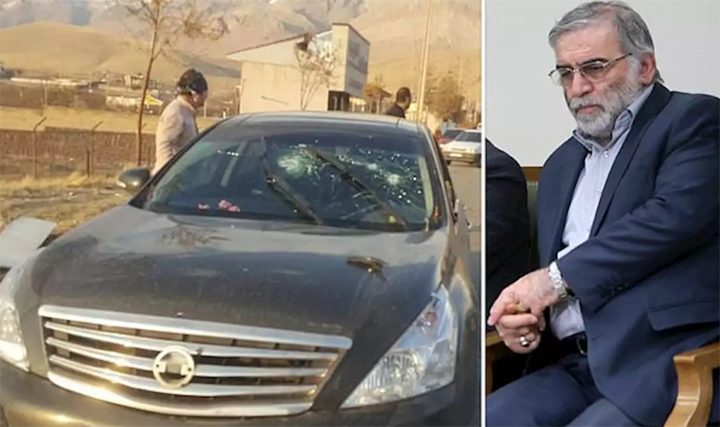
High-ranking Iranian nuclear physicist Mohsen Fakhrizadeh, named by the West as leading the Islamic Republic’s military nuclear programme until its disbanding in the early 2000s, has been assassinated in an ambush near Tehran.

Fakhrizadeh was shot “by terrorists” in his vehicle in Absard, a suburb in eastern Tehran, and he later succumbed to his injuries in what amounted to a “martyr’s death”, Iran’s Foreign Ministry said on Friday.

Local authorities had confirmed Fakhrizadeh’s death several hours earlier and also said that several attackers were killed.

Fakhrizadeh served as the head of the Research and Innovation Organisation of the defence ministry at the time of his death.

Iran’s foreign minister alleged the killing of Mohsen Fakhrizadeh bore “serious indications” of an Israeli role, but did not elaborate.

Israel declined to immediately comment on the killing of Fakhrizadeh, whom Israeli Prime Minister Benjamin Netanyahu once called out in a news conference saying: “Remember that name.”

Israel has long been suspected of carrying out a series of targeted killings of Iranian nuclear scientists nearly 10 years ago.

Photos and video shared online showed a Nissan sedan with bullet holes through windshield and blood pooled on the road.

The semiofficial Fars News Agency said witnesses heard the sound of an explosion and then machine gun fire. The attack targeted the car Fakhrizadeh was travelling in, the agency said.

Those wounded, including Fakhrizadeh’s bodyguards, were taken to a local hospital, the agency said.

No group immediately claimed responsibility for the attack.

Al Jazeera’s Assed Baig, reporting from Tehran, said that according to Fars News Agency, Fakhrizadeh “came under attack by three-four unknown assailants”.

“They also say three-four people were killed in that incident,” Baig said.

“We have had the head of the Revolutionary Guard say that assassinating nuclear scientists is an attempt by hegemonic powers to stop Iran from gaining new sciences.”

‘Serious indications’ of Israeli role

Iran’s foreign minister called on the international community to condemn “this act of state terror”.

“Terrorists murdered an eminent Iranian scientist today. This cowardice – with serious indications of Israeli role – shows desperate warmongering of perpetrators,” Mohammad Javad Zarif wrote on Twitter on Friday.

In a letter to UN Secretary-General Antonio Guterres and the UN Security Council on Friday, Iran also said there are “serious indications of Israeli responsibility” in the attack and said it reserves the right to defend itself.

“Warning against any adventuristic measures by the United States and Israel against my country, particularly during the remaining period of the current administration of the United States in office, the Islamic Republic of Iran reserves its rights to take all necessary measures to defend its people and secure its interests,” Iran’s UN envoy, Majid Takht Ravanchi, wrote in the letter, which was seen by Reuters news agency.

Fakhrizadeh, 63, had been a member of Iran’s Revolutionary Guard and was an expert in missile production. Fars said that is why Israeli secret services had long sought to eliminate him for many years.

A military adviser to Iranian Supreme Leader Ayatollah Ali Khamenei accused Israel of killing Fakhrizadeh to try to provoke a war.

“In the last days of the political life of their … ally [US President Donald Trump], the Zionists (Israel) seek to intensify pressure on Iran and create a full-blown war,” commander Hossein Dehghan tweeted.

He said Fakhrizadeh’s work will continue to be a “nightmare” for Iran’s enemies.

Fakhrizadeh was one of “the people who are fighting without any claims behind the scenes of political battles and achieved martyrdom in this path”, Dehghan tweeted.

The US Pentagon declined to comment on reports of the attack.

‘More detrimental to Iran’s antagonists’

Mohammad Marandi, a professor at the University of Tehran, told Al Jazeera that the assassination “is going to make Iranians more assertive when it comes to dealing with its antagonists” and that it was too late for hostile entities to do anything about Iran’s nuclear programme.

“Fifty years ago, if they carried out this attack it would’ve had an impact. But now Iran’s nuclear programme is developed, it’s highly diverse. It has many young scientists and these murders will be more detrimental to Iran’s antagonists, I believe, than Iran,” Marandi said.

“[Fakharizadeh] was one of the first generation of people in Iran who helped develop nuclear technology.”

Fakhrizadeh led Iran’s so-called Amad (Hope) programme. Israel and the West have alleged it was a military operation looking at the feasibility of building a nuclear weapon in Iran. Tehran has long maintained its nuclear programme is peaceful.

The International Atomic Energy Agency says the Amad programme ended in the early 2000s. Its inspectors now monitor Iranian nuclear sites.

The assassination comes as Trump, who has been fervently backed by Israel in his “maximum pressure” campaign on Iran, is slated to leave office in less than two months after losing the presidential election to Democrat Joe Biden.

In recent weeks, multiple reports by American media have said, citing unnamed sources, that Trump has been seriously considering a military attack on Iran, even on its main nuclear site in Natanz.

In May 2018, Trump unilaterally withdrew from Iran’s 2015 nuclear deal with world powers and imposed harsh economic sanctions that have only escalated since.

In the first European reaction to Fakhrizadeh’s assassination, Carl Bildt, co-chair of the European Council on Foreign Relations, said the attack may be related to Biden’s promise to return to the nuclear deal.

“It’s not unlikely that this targeted killing was part of efforts to prevent the Biden administration from reviving diplomacy with Iran and going back to the nuclear agreement,” he tweeted.

In the past year, the Trump administration has also tried to make it harder for a Biden administration to come back to the nuclear accord through retargeting Iranian entities and individuals that were already sanctioned with new terrorism-related designations.

Friday’s assassination marks the second high-profile targeted killing of a top Iranian official after IRGC Quds Force chief General Qassem Soleimani’s killing in a US air strike in January this year.

Hillary Mann Leverett, founder of political consultancy group Stratega, said while the killing was not as “shocking” as that of Soleimani’s assassination, it was still “very disturbing”.

“It is certainly one of the most high-level assassinations we have seen in the past year,” she told Al Jazeera over Skype from Mclean, Virginia.

“I think it is intended to stoke tensions particularly in this interim period between the current administration and the Biden administration.”

“The Trump administration have openly said that they will exert what they call ‘maximum pressure’ in its most maximum essence between now and when they have to leave office on January 20,” Leverett said.

Iran has previously called the Trump administration’s “maximum pressure” strategy an instance of “economic and medical terrorism”.

Comments

Mohammad Sagar
 - 
Thursday, 10 Dec 2020

I want to go back uae how I gate apporwal

Add new comment

  • Coastaldigest.com reserves the right to delete or block any comments.
  • Coastaldigset.com is not responsible for its readers’ comments.
  • Comments that are abusive, incendiary or irrelevant are strictly prohibited.
  • Please use a genuine email ID and provide your name to avoid reject.
News Network
November 26,2025

students.jpg

Bengaluru, Nov 26: Karnataka is taking its first concrete steps towards lifting a three-decade-old ban on student elections in colleges and universities. Deputy Chief Minister D.K. Shivakumar announced Wednesday that the state government will form a small committee to study the reintroduction of campus polls, a practice halted in 1989 following incidents of violence.

Speaking at a 'Constitution Day' event organised by the Karnataka Congress, Mr. Shivakumar underscored the move's aim: nurturing new political leadership from the grassroots.

"Recently, (Leader of the Opposition in Lok Sabha) Rahul Gandhi wrote a letter to me and Chief Minister (Siddaramaiah) asking us to think about restarting student elections," Shivakumar stated. "I'm announcing today that we'll form a small committee and seek a report on this."

Student elections were banned in Karnataka in 1989, largely due to concerns over violence and the infiltration of political party affiliates into campus life. The ban effectively extinguished vibrant student bodies and the pipeline of young leaders they often produced.

Mr. Shivakumar, who also serves as the Karnataka Congress president, said that former student leaders will be consulted to "study the pros and cons" of the re-introduction.

Acknowledging the history of the ban, he added, "There were many criminal activities taking place back then. We’ll see how we can conduct (student) elections by regulating such criminal activities."

The Deputy CM reminisced about his own journey, which began on campus. He recalled his political activism at Sri Jagadguru Renukacharya College leading to his first Assembly ticket in 1985 at the age of 23. "That's how student leadership was at the time. Such leadership has gone today. College elections have stopped," he lamented, adding that for many, college elections were "like a big movement" where leaders were forged.

The move, driven by the Congress high command's push to cultivate young talent, will face scrutiny from academics and university authorities who have, in the past, expressed concern that the return of polls could disrupt the peaceful academic environment and turn campuses into political battlegrounds.

Comments

Add new comment

  • Coastaldigest.com reserves the right to delete or block any comments.
  • Coastaldigset.com is not responsible for its readers’ comments.
  • Comments that are abusive, incendiary or irrelevant are strictly prohibited.
  • Please use a genuine email ID and provide your name to avoid reject.
News Network
December 2,2025

Puttur: The long-cherished dream of a government medical college in Puttur has moved a decisive step closer to reality, with the Karnataka State Finance Department granting its official approval for the construction of a new 300-bed hospital.

Puttur MLA Ashok Kumar Rai announced the crucial development to reporters on Monday, confirming that the official communication from the finance department was issued on November 27. This 300-bed facility is intended to be the cornerstone for the establishment of the government medical college, a project announced in the state budget.

Fast-Track Implementation

The MLA outlined an aggressive timeline for the project:

•    A Detailed Project Report (DPR) for the hospital is expected to be ready within 45 days.

•    The tender process for the construction will be completed within two months.

Following the completion of the tender process, Chief Minister Siddaramaiah is scheduled to lay the foundation stone for the project.

"Setting up a medical college in Puttur is a historical decision by the Congress government in Karnataka," Rai stated. The project has an estimated budget allocation of Rs 1,000 crore for the medical college.

Focus on Medical Education Department

The MLA highlighted a key strategic move: requesting the government to implement the hospital construction through the Medical Education Department instead of the Health and Family Welfare Department. This is intended to streamline the entire process of establishing the full medical college, ensuring the facilities—including labs, operation theatres, and other necessary infrastructure—adhere to the strict guidelines set by the Medical Council of India (MCI). The proposed site for the project is in Bannur.

Rai also took the opportunity to address political criticism, stating that the government has fulfilled its promise despite "apprehensions" and "mocking and criticising" from opposition parties who had failed to take similar initiatives when they were in power. "Chief Minister Siddaramaiah has kept his word," he added.

Comments

Add new comment

  • Coastaldigest.com reserves the right to delete or block any comments.
  • Coastaldigset.com is not responsible for its readers’ comments.
  • Comments that are abusive, incendiary or irrelevant are strictly prohibited.
  • Please use a genuine email ID and provide your name to avoid reject.
News Network
December 4,2025

indigoflight.jpg

Domestic carrier IndiGo has cancelled over 180 flights from three major airports — Mumbai, Delhi and Bengaluru — on Thursday, December 4, as the airline struggles to secure the required crew to operate its flights in the wake of new flight-duty and rest-period norms for pilots.

While the number of cancellations at Mumbai airport stands at 86 (41 arrivals and 45 departures) for the day, at Bengaluru, 73 flights have been cancelled, including 41 arrivals, according to a PTI report that quoted sources.

"IndiGo cancelled over 180 flights on Thursday at three airports-Mumbai, Delhi and Bengaluru," the source told the news agency.

Besides, it had cancelled as many as 33 flights at Delhi airport for Thursday, the source said, adding, "The number of cancellations is expected to be higher by the end of the day."

The Gurugram-based airline's On-Time Performance (OTP) nosedived to 19.7 per cent at six key airports — Delhi, Mumbai, Chennai, Kolkata, Bengaluru and Hyderabad — on December 3, as it struggled to get the required crew to operate its services, down from almost half of December 2, when it was 35 per cent.

"IndiGo has been facing acute crew shortage since the implementation of the second phase of the FDTL (Flight Duty Time Limitations) norms, leading to cancellations and huge delays in its operations across the airports," a source had told PTI on Wednesday.

Chaos continued at several major airports for the third day on Thursday because of the cancellations.

A spokesperson for the Kempegowda International Airport (KIA) in Bengaluru said that 73 IndiGo flights had been cancelled on Thursday.

At least 150 flights were cancelled and dozens of others delayed on Wednesday, airport sources said, leaving thousands of travellers stranded, according to news agency Reuters.

The Directorate General of Civil Aviation (DGCA) has said it is investigating IndiGo flight disruptions and has asked the airline to submit the reasons for the current situation, as well as its plans to reduce flight cancellations and delays.

It may be mentioned here that the pilots' body, Federation of Indian Pilots (FIP), has alleged that IndiGo, despite getting a two-year preparatory window before the full implementation of new flight duty and rest period norms for cockpit crew, "inexplicably" adopted a "hiring freeze".

The FIP said it has urged the safety regulator, the DGCA, not to approve airlines' seasonal flight schedules unless they have adequate staff to operate their services "safely and reliably" in accordance with the New Flight Duty Time Limitations (FDTL) norms.

In a letter to the DGCA late on Wednesday, the FIP urged the DGCA to consider re-evaluating and reallocating slots to other airlines, which have the capacity to operate them without disruption during the peak holiday and fog season if IndiGo continues to "fail in delivering on its commitments to passengers due to its own avoidable staffing shortages."

Comments

Add new comment

  • Coastaldigest.com reserves the right to delete or block any comments.
  • Coastaldigset.com is not responsible for its readers’ comments.
  • Comments that are abusive, incendiary or irrelevant are strictly prohibited.
  • Please use a genuine email ID and provide your name to avoid reject.