



After tech giants banish Donald Trump, things get complicated

Agencies
January 13, 2021

San Francisco Jan 13: As the world adjusts to a Twitter without @realdonaldtrump, the next big question is: “Now what?"

Major tech platforms, long accused of giving President Donald Trump special treatment not allotted to regular users, have shown him the door in the wake of his incitement of violence by supporters at the US Capitol on January 6. He's gone from Twitter, Facebook, Snapchat — even Shopify.

But in many ways, booting the president was the easy part.

Will companies now hold other world leaders to the same standard? Will they wade further into deciding what is and isn't allowed on their platforms, potentially alienating large swaths of their user base? Will all this lead to further online splintering, pushing those flirting with extreme views to fringe sites and secret chat groups?

Although they've long sought to remain neutral, Facebook, Twitter and other social platforms are slowly waking up to the active role they and their algorithms have played in shaping a modern world filled with polarised, angry groups and huge factions falling for bogus conspiracies and misinformation about science, politics and medicine.

“What we're seeing is a shift from the platforms from a stance of free-speech absolutism, towards an understanding of speech moderation as a matter of public health," said civic media professor Ethan Zuckerman of the University of Massachusetts-Amherst.

None of this can be fixed soon, if ever. Certainly not by blocking a president with just a few days left in his term.

But there are blueprints for future action. Remember “Plandemic?" That was the slickly-produced, 26-minute, misinformation-ridden video promoting COVID-19 conspiracies that emerged seemingly out of nowhere and racked up millions of views in a matter of days.

Facebook, Twitter and YouTube scrambled to take it down — too late. But they were ready for the sequel, which failed to attract even a fraction of the attention of the first.

“Sharing disinformation about COVID is a danger because it makes it harder for us to fight the disease," Zuckerman said.

“Similarly, sharing disinformation about voting is an attack on our democracy.”

Unsurprisingly, it's been easier for tech giants to act decisively on matters of public health than on politics. Corporate bans of the US president and his supporters have led to loud, if generally unfounded, cries of censorship as well as charges of left-wing bias.

It's even attracted criticism from European leaders such as German Chancellor Angela Merkel — not exactly a friend of Trump's.

Merkel's spokesman, Steffen Seibert, said freedom of opinion is a fundamental right of “elementary significance.”

“This fundamental right can be intervened in, but according to the law and within the framework defined by legislators — not according to a decision by the management of social media platforms,” he told reporters in Berlin.

“Seen from this angle, the chancellor considers it problematic that the accounts of the US president have now been permanently blocked.”

From that German perspective, it should be the government, and not private companies like Facebook and Twitter, who decides what counts as dangerous speech on social platforms.

That approach might be feasible in Europe, but it's much more complicated in the US, where the First Amendment of the US Constitution protects freedom of expression from government interference, although not from corporate policy on privately owned communication platforms.

Governments, of course, remain free to regulate tech companies, another area of ferment. Over the past year, Trump, other Republicans and some Democrats have called for revoking a fundamental 1996 legal provision known as Section 230.

That protects social platforms, which can host trillions of messages, from being sued into oblivion by anyone who feels wronged by something someone else has posted. But so far there's been more heat than light on the issue.

Still, few are happy with the often sluggish, after-the-fact, three-strikes takedowns and suspensions that have characterized Twitter and Facebook for years.

Particularly in the light of the Capitol insurrection, the deadly Charlottesville rally in 2017 and live-streamed mass shootings.

Sarita Schoenebeck, University of Michigan professor who focuses on online harassment, said it might be time for platforms to reevaluate how they approach problematic material on their sites.

“For years, platforms have evaluated what kinds of content are appropriate or not by evaluating the content in isolation, without considering the broader social and cultural context that it takes place in,” she said.

“We need to revisit this approach. We should rely on a combination of democratic principles, community governance and platform rules to shape behavior.”

Jared Schroeder, an expert in social media and the First Amendment at Southern Methodist University, thinks the Trump bans will encourage his base of followers to move towards other social platforms where they can organise and communicate with fewer — if any — restrictions.

“It's likely the bans will fuel the us-against-them narrative – and it's also likely other forums will get a boost in traffic, as we saw after the 2020 election," he said.

“The bans have taken away the best tools for organizing people and for Trump to speak to the largest audiences, but these are by no means the only tools."

Comments

robert Riepe
 - 
Wednesday, 13 Jan 2021

You look at the pictures of the doos to congress you will see the pictures of Antifa thugs wearing trump supporter gear and the guards letting them in.

Add new comment

  • Coastaldigest.com reserves the right to delete or block any comments.
  • Coastaldigset.com is not responsible for its readers’ comments.
  • Comments that are abusive, incendiary or irrelevant are strictly prohibited.
  • Please use a genuine email ID and provide your name to avoid reject.
News Network
January 23,2026

modIKERALA.jpg

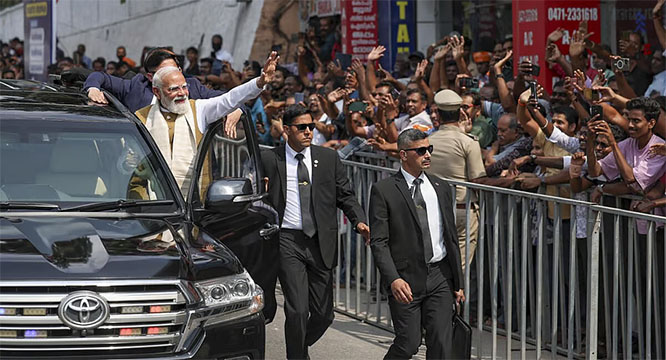
Prime Minister Narendra Modi, during his visit to Thiruvananthapuram on Friday, January 23, indicated that the Bharatiya Janata Party (BJP) is aiming to expand its political footprint in Kerala ahead of the Assembly elections scheduled in the coming months.

Speaking at a BJP-organised public meeting, Modi drew parallels between the party’s early electoral gains in Gujarat and its recent victory in the Thiruvananthapuram Municipal Corporation. The civic body win, which ended decades of Left control, was cited by the Prime Minister as a possible starting point for the party’s broader ambitions in the state.

Recalling BJP’s political trajectory in Gujarat, Modi said the party was largely insignificant before 1987 and received little media attention. He pointed out that the BJP’s first major breakthrough came with its victory in the Ahmedabad Municipal Corporation that year.

“Just as our journey in Gujarat began with one city, Kerala’s journey has also started with a single city,” Modi said, suggesting that the party’s municipal-level success could translate into wider electoral acceptance.

The Prime Minister alleged that successive governments led by the Left Democratic Front (LDF) and the United Democratic Front (UDF) had failed to adequately develop Thiruvananthapuram. He accused both fronts of corruption and neglect, claiming that basic infrastructure and facilities were denied to the capital city for decades.

According to Modi, the BJP’s control of the civic body represents a shift driven by public dissatisfaction with the existing political alternatives. He asserted that the BJP administration in Thiruvananthapuram had begun working towards development, though no specific details or timelines were outlined.

Addressing the gathering at Putharikandam Maidan, Modi said the BJP intended to project Thiruvananthapuram as a “model city,” reiterating his party’s commitment to governance-led change.

The Prime Minister’s visit to Kerala also included the inauguration of several development projects and the flagging off of new train services, as the BJP intensifies its political outreach in the poll-bound state.

Comments

Add new comment

  • Coastaldigest.com reserves the right to delete or block any comments.
  • Coastaldigset.com is not responsible for its readers’ comments.
  • Comments that are abusive, incendiary or irrelevant are strictly prohibited.
  • Please use a genuine email ID and provide your name to avoid reject.
News Network
January 31,2026

trumpkill.jpg

The US Department of Justice has released millions of new documents linked to the case of convicted child sex offender Jeffrey Epstein, before removing some pages that contained complaints mentioning President Donald Trump.

Deputy Attorney General Todd Blanche said on Friday that approximately 3.5 million files were published to comply with the Epstein Transparency Act, following criticism that the administration had missed a December 19 deadline set by Congress.

The documents include FBI communications and complaints submitted as tips, some of which list comments mentioning Trump and others who had social or professional ties to Epstein.

Trump has repeatedly denied any wrongdoing in relation to his past association with Epstein.

Pages removed from DOJ website

After their publication, pages containing complaints that mentioned Trump were removed from the DOJ website and now return a “page not found” message. Copies of the documents, however, have circulated widely on social media. CNN anchor Jake Tapper was among those who publicly noted that the pages had been taken down.

One complaint, filed by a friend of a victim, says Trump forced a girl aged 13–14 to perform “oral sex” approximately 35 years ago in New Jersey. The document states that an investigator was sent to Washington to conduct an interview.

Another complaint says Trump regularly paid an individual to perform sexual acts and adds that he was present when her newborn child was murdered by a relative. The paperwork notes that there was “no contact made” with the complainant.

A separate complaint, which provided no contact information, said “calendar girls” parties at Trump’s Mar-a-Lago involved children and sexual abuse. The document also names several public figures as present at such events.

In another account, a complainant said they witnessed a “sex trafficking ring” at Trump National Golf Club in Rancho Palos Verdes, California, in the mid-1990s. The person noted “threats” from Trump’s head of security if she spoke publicly about what she had seen.

Other figures mentioned in the files

The latest release also includes a draft email Epstein wrote to himself in 2013, referring to Microsoft co-founder Bill Gates. In the message, Epstein said Gates asked him to delete emails and referenced “personal matters.”

The DOJ has not provided a detailed explanation for why certain pages were removed after publication. The department said the document release was ongoing.

Comments

Add new comment

  • Coastaldigest.com reserves the right to delete or block any comments.
  • Coastaldigset.com is not responsible for its readers’ comments.
  • Comments that are abusive, incendiary or irrelevant are strictly prohibited.
  • Please use a genuine email ID and provide your name to avoid reject.
News Network
January 23,2026

Karnataka Governor Thaawarchand Gehlot read only three lines from the 122-paragraph address prepared by the Congress-led state government while addressing the joint session of the Legislature on Thursday, effectively bypassing large sections critical of the BJP-led Union government.

The omitted portions of the customary Governor’s address outlined what the state government described as a “suppressive situation in economic and policy matters” under India’s federal framework. The speech also sharply criticised the Centre’s move to replace the Mahatma Gandhi National Rural Employment Guarantee Act (MGNREGA) with the Viksit Bharat–Guarantee for Rozgar and Ajeevika Mission (Gramin) Act, commonly referred to as the VB-GRAM (G) Act.

Governor Gehlot had earlier conveyed his objection to several paragraphs that were explicitly critical of the Union government. On Thursday, he confined himself to the opening lines — “I extend a warm welcome to all of you to the joint session of the State legislature. I am extremely pleased to address this august House” — before jumping directly to the concluding sentence of the final paragraph.

He ended the address by reading the last line of paragraph 122: “Overall, my government is firmly committed to doubling the pace of the State’s economic, social and physical development. Jai Hind — Jai Karnataka.”

According to the prepared speech, the Karnataka government demanded the scrapping of the VB-GRAM (G) Act, describing it as “contractor-centric” and detrimental to rural livelihoods, and called for the full restoration of MGNREGA. The state government argued that the new law undermines decentralisation, weakens labour protections, and centralises decision-making in violation of constitutional norms.

Key points from the unread sections of the speech:

•    Karnataka facing a “suppressive” economic and policy environment within the federal system

•    Repeal of MGNREGA described as a blow to rural livelihoods

•    VB-GRAM (G) Act accused of protecting corporate and contractor interests

•    New law alleged to weaken decentralised governance

•    Decision-making said to be imposed by the Centre without consulting states

•    Rights of Adivasis, women, backward classes and agrarian communities curtailed

•    Labourers allegedly placed under contractor control

•    States facing mounting fiscal stress due to central policies

•    VB-GRAM (G) Act accused of enabling large-scale corruption

Comments

Add new comment

  • Coastaldigest.com reserves the right to delete or block any comments.
  • Coastaldigset.com is not responsible for its readers’ comments.
  • Comments that are abusive, incendiary or irrelevant are strictly prohibited.
  • Please use a genuine email ID and provide your name to avoid reject.