



New Delhi, Feb 28: Finance Minister Arun Jaitley today announced a 5 per cent reduction in corporate tax over next four years, abolished wealth tax and replaced it with an additional 2 per cent surcharge on super-rich individuals, while increasing service tax that will result in higher cost of variety of services.
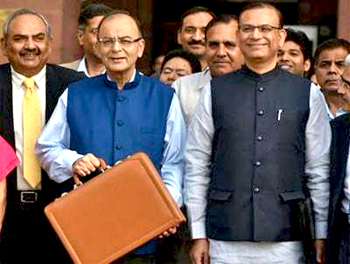
In the first full-year Budget of the NDA government that shunned populism, he proposed no changes in personal and corporate income-tax rates for 2015-16 but extended benefits to middle-class by increasing the limit of deduction on health insurance premium from Rs 15,000 to Rs 20,000.
For senior citizens, it will go up from Rs 20,000 to Rs 30,000 and for those above 80 years, not covered by health insurance, deduction of Rs 30,000 towards expenditure on medical treatment will be allowed.
Combining these incentives with others including an enhanced deduction of Rs 1.5 lakh on account of contribution to pension fund as against Rs 1 lakh now, the relief of tax deductions under various sections, including 80C and 80CCD, go up to Rs 4.42 lakh.
The transport allowance exemption has been doubled to Rs 1,600. With the levy of 2 per cent additional surcharge, the total surcharge on 'super-rich' individuals with an income of over Rs 1 crore, becomes 12 per cent as against 10 per cent now. In the case of domestic companies having income between Rs 1 crore and Rs 10 crore, it will be 7 per cent and 12 per cent for firms with income above Rs 10 crore.
Presenting the Budget in the Lok Sabha, Jaitley announced fresh measures to tackle blackmoney, including a comprehensive legislation that will make concealment of income and assets abroad a punishment with rigorous imprisonment of 10 years.
Stashing blackmoney abroad will be made a non- compoundable offense, providing for a penalty of 300 per cent of tax on concealed income and assets. The concealed assets and income will be taxable at the maximum marginal rate and no deduction and exemptions will be allowed. It will be made a predicate offence.
In a bid to encourage foreign investors, Jaitley announced deferring of the implementation of controversial GAAR (General Anti-Avoidance Rules) by 2 years.
The Budget also provided for increased funding of Rs 70,000 crore for infrastructure as also higher allocation for social sector schemes like MNREGA.
It decided to re-issue tax-free infra bonds and announced introduction of a sovereign gold bond as an alternative to purchasing metal gold. The bond will carry a fixed rate of interest and will be redeemable in cash on the face value of gold.
The social sector spending for poor and disadvantaged have been kept at allocation of Rs 68,968 crore to education sector, Rs 33,152 crore for health, Rs 77,526 crore for rural development including MNREGA, and Rs 22,407 crore for housing and urban development.
Defence expenditure has been pegged at Rs 2,22,370 crore for 2015-16, up by 11 per cent over Rs 2,46,727 crore in the current fiscal.
The Budget estimates for 2015-16 pegs the non-plan expenditure at Rs 13,12,200 crore and plan spending at Rs 4,65,277 crore. Total expenditure has been estimated at Rs 17,77,477 crore.
Gross tax receipts are estimated to be Rs 14,49,490 crore. Devolution to states will be Rs 5,23,958 crore and states will get Rs 9,19,842 crore. Non tax revenues are estimated at Rs 2,21,733 crore.
The fiscal deficit has been pegged at 3.9 per cent of the GDP in 2015-16 against 4.1 per cent in current fiscal while the revenue deficit has been put at 2.8 per cent of GDP.
The Finance Minister announced plans to bring fiscal deficit down to 3 per cent over the next two years.
In indirect taxes, the Budget reduced basic customs duty on raw materials, excise duty on leather footwear while excise duty on cigarettes is being increased by 25 per cent on cigarettes exceeding 65 mm length and by 15 per cent for cigarettes of other length.
Excise duty on variety of electronics and hardware goods has been reduced. This includes wafers of manufacture of IC for smart cards, mobile phones and inputs for use of LED drivers and LED lights.
100 per cent deduction, other than CSR contributions, has been allowed for donations to Swachh Bharat and Clean Ganga Funds.
While the direct tax proposals will involve a revenue outgo of Rs 8,315 crore, the indirect tax proposals are expected to yield Rs 23,383 crore. The net impact of all tax proposals would be a revenue gain of Rs 15,068 crore.
The education cess of 2 per cent and 1 per cent higher education cess is proposed to be continued in the next year for all tax payers.
Jaitley said the Indian Economy has turned around dramatically in the last nine months with the real GDP growth expected to accelerate to 7.4 per cent, making India the fastest growing large economy in the world.
Growth next fiscal will be between 8 to 8.5 per cent and aiming for a double-digit rate seems feasible very soon.
He said macro-economic stability has been restored and conditions created for sustainable poverty elimination, job creation and durable double-digit economic growth.
India, he said, has now embarked on two game changing reforms -- GST and the JAM Trinity - Jan Dhan, Aadhar and Mobile - to implement direct transfer of benefits.
GST will put in place a state-of-the art indirect tax system by April 1, 2016 while the JAM Trinity will allow transfer benefits in a leakage-proof, well-targetted and cashless manner.
Jaitley said a Monetary Policy Framework Agreement has been concluded with RBI to keep inflation below 6 per cent.
The Finance Minister counted five major challenges faced by the Indian economy which are agricultural income under stress, weak private sector investment in infrastructure, decline in manufacturing, resource crunch in view of higher devolution in taxes to states and maintaining fiscal discipline.
Assuring that the challenging fiscal deficit target of 4.1 per cent of GDP this fiscal will be met, he said the Government was firm to reach fiscal deficit target of 3 per cent of GDP, which will be achieved in three years rather than two years.
Jaitley emphasized on the need to cut subsidy leakages. To achieve it, the Government is committed to the process of rationalizing subsidies.
He said the direct transfer of benefits, started mostly in scholarship schemes, will be further expanded with a view to increasing the number of beneficiaries from the present one crore to 10.3 crore.
An allocation of Rs 5,300 crore to support micro- irrigation, watershed development and the Pradhan Mantri Krishi Sinchai Yojana has been made in the Budget.
In order to support the agriculture sector with the help of effective agriculture credit with a focus on small and marginal farmers, the Finance Minister proposed to allocate Rs 25,000 crore to the corpus of Rural Infrastructure Development fund (RIDF) set up in NABARD, Rs 15,000 crore for Long Term Rural Credit Fund; Rs 45,000 crore for Short Term Cooperative Rural Credit Refinance Fund and Rs 15,000 crore for Short Term RRB Refinance Fund.
He said the Government has set up an ambitious target of Rs 8.5 lakh crore of agricultural credit and proposes to create a Micro Units Development Refinance Agency (MUDRA) Bank, with a corpus of Rs
20,000 crore, and credit guarantee corpus of Rs 3,000 crore, which will refinance Micro-Finance Institutions through a Pradhan Mantri Mudra Yojana.
Announcing new insurance schemes, he said Pradhan Mantri Suraksha Bima Yojana will cover accidental death risk of Rs 2 lakh for a premium of just Rs 12 per year and the Atal Pension Yojana will provide a defined pension, depending on the contribution.
The Pradhan Mantri Jeevan Jyoti Bima Yojana will cover both natural and accidental death risk of Rs 2 lakh on a premium of Rs 330 per year for the age group 18-50.



Comments
Add new comment