Cyclone Titli leaves 8 dead in AP, causes widespread damage in Odisha

Agencies
October 11, 2018

Amaravati(AP)/Bhubaneswar, Oct 11: Cyclone 'Titli' made landfall on the eastern coast of the country early on Thursday claiming eight lives and wrecking havoc in Srikakulam and Vizianagaram districts of Andhra Pradesh, while causing widespread damage in neighbouring Odisha.

While no loss of lives were reported in Odisha, the "very severe" cyclonic storm left a trail of destruction in Gajapati and Ganjam districts of state, uprooting trees, electric poles and damaging hutments.

According to the India Meteorological Department (IMD), Cyclone Titli made its landfall near Palasa in Srikakulam district, south west of Gopalpur in Odisha with an estimated maximum sustained surface wind speed of 140-150 kmph gusting to 165 kmph between 4.30 am and 5.30 am.

The Andhra Pradesh State Disaster Management Authority (SDMA) said the cyclone caused widespread damage in Srikakulam and Vizianagaram, and threw normal life out of gear as heavy to very heavy rains lashed the two north coastal districts districts since late Wednesday night.

While a 62-year-old woman died at Gudivada Agraharam village after a tree fell on her, a 55-year-old man died in a house collapse at Rotanasa village in Srikakulam district, the SDMA said.

The Andhra Pradesh Chief Minister's Office (CMO) said the six others killed were fishermen who had ventured into the sea.

Of the 67 fishing boats that had gone into the sea over the last few days from Kakinada in East Godavari district, 65 had returned to the shore safely, the CMO said, adding efforts were on to bring back the remaining two boats.

The road network in Srikakulam district suffered extensive damage, while the power distribution network was also severely affected. More than 2,000 electric poles were uprooted by strong winds.

The Eastern Power Distribution Company, that caters to the electricity needs of the north coastal districts of Andhra Pradesh, reported that the distribution system for 4,319 villages and six towns in Srikakulam district was affected.

In Odisha, Cyclone Titli led to very heavy rainfall in Ganjam, Gajapati and Puri districts and caused minor damage to power supply and communication.

In all, eight districts -- Ganjam, Gajapati, Khurda, Puri, Jagatsinghpur, Kendrapara, Bhadrak and Balasore -- have been affected by the cyclonic storm, Special Relief Commissioner B P Sethi said.

"There has been no major destruction or report of casualty from any part of the state so far. Some damages like uprooting of trees and electric poles and damage to hutments were reported from Ganjam and Gajapati districts," he said.

Power supply and telephone links got disrupted, and road communication snapped due to uprooted trees at many places in Gajapati district, Sethi said, adding efforts are now on to clear the blocked roads and to restore power supply in affected areas.

Odisha Chief Minister Naveen Patnaik reviewed the situation in the state and instructed officials to expedite restoration efforts once the situation improves. He also directed the officials concerned to provide relief materials to cyclone-affected people.

"The chief minister gave instruction to send two more teams of NDRF to Gajapati where extensive damage has been caused to roads, hutments, electric and telephone poles," Chief Secretary A P Padhi said.

Thirteen teams of the National Disaster Response Force (NDRF) and Orissa Disaster Rapid Action Force have been deployed in affected areas along with fire brigade personnel.

"The damage is less than what we had feared," the chief secretary said.

Padhi said the state government on Wednesday evacuated over three lakh people to safe places, which helped avoid loss of life in the natural calamity.

The evacuees are housed in 1,112 shelters where food and sanitation facilities are available, he said.

Traffic on the Chennai-Kolkata National Highway was hit at places due to uprooted trees.

According to East Coast Railway sources, train services between Khurda Road in Odisha and Vizianagaram in Andhra Pradesh remained suspended since 10 pm Wednesday.

"We are optimistic about restoration of train services on the route by (Thursday) evening," said East Coast Railway Chief PRO J P Mishra.

Some railway station buildings were damaged at a few places, including in Palasa. Signal poles and overhead electric masts were damaged at places between Palasa and Kottabomali stations, he said.

The South Central Railway as well as the East Coast Railway cancelled several trains while some were terminated midway. A few express trains were diverted.

Horticulture crops suffered extensive damage in Srikakulam district while paddy suffered damage in Vizianagaram. Coconut plantations, banana and mango trees were the worst hit in the cyclonic storm, according to a preliminary report by the SDMA.

The cyclonic storm system is now moving northeastwards towards Gangetic West Bengal across Odisha and will weaken gradually, the IMD said.


Comments

Add new comment

  • Coastaldigest.com reserves the right to delete or block any comments.
  • Coastaldigset.com is not responsible for its readers’ comments.
  • Comments that are abusive, incendiary or irrelevant are strictly prohibited.
  • Please use a genuine email ID and provide your name to avoid reject.
News Network
December 16,2025

bengal.jpg

The deletion of over 58 lakh names from West Bengal’s draft electoral rolls following a Special Intensive Revision (SIR) has sparked widespread concern and is likely to deepen political tensions in the poll-bound state.

According to the Election Commission, the revision exercise has identified 24 lakh voters as deceased, 19 lakh as relocated, 12 lakh as missing, and 1.3 lakh as duplicate entries. The draft list, published after the completion of the first phase of SIR, aims to remove errors and duplication from the electoral rolls.

However, the scale of deletions has raised fears that a large number of eligible voters may have been wrongly excluded. The Election Commission has said that individuals whose names are missing can file objections and seek corrections. The final voter list is scheduled to be published in February next year, after which the Assembly election announcement is expected. Notably, the last Special Intensive Revision in Bengal was conducted in 2002.

The development has intensified the political row over the SIR process. Chief Minister Mamata Banerjee and her Trinamool Congress have strongly opposed the exercise, accusing the Centre and the Election Commission of attempting to disenfranchise lakhs of voters ahead of the elections.

Addressing a rally in Krishnanagar earlier this month, Banerjee urged people to protest if their names were removed from the voter list, alleging intimidation during elections and warning of serious consequences if voting rights were taken away.

The BJP, meanwhile, has defended the revision and accused the Trinamool Congress of politicising the issue to protect what it claims is an illegal voter base. Leader of the Opposition Suvendu Adhikari alleged that the ruling party fears losing power due to the removal of deceased, fake, and illegal voters.

The controversy comes amid earlier allegations by the Trinamool Congress that excessive work pressure during the SIR led to the deaths by suicide of some Booth Level Officers (BLOs), for which the party blamed the Election Commission. With the draft list now out, another round of political confrontation appears imminent.

As objections begin to be filed, the focus will be on whether the correction mechanism is accessible, transparent, and timely—critical factors in ensuring that no eligible voter is denied their democratic right ahead of a crucial election.

Comments

Add new comment

  • Coastaldigest.com reserves the right to delete or block any comments.
  • Coastaldigset.com is not responsible for its readers’ comments.
  • Comments that are abusive, incendiary or irrelevant are strictly prohibited.
  • Please use a genuine email ID and provide your name to avoid reject.
News Network
December 6,2025

indigoticket.jpg

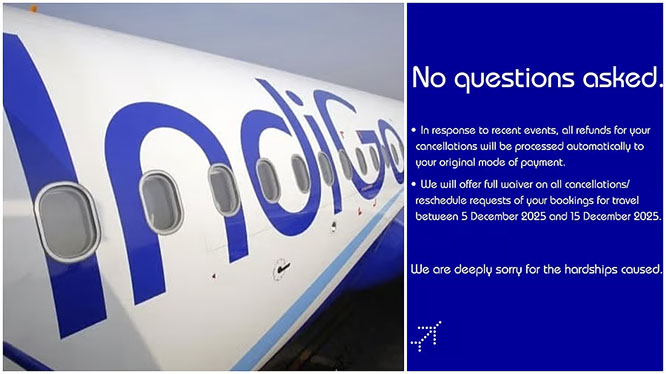
With IndiGo flight disruptions impacting thousands of passengers, the airline on Saturday said that it will offer full waiver on all cancellations/reschedule requests for travel bookings between December 5, 2025 and December 15, 2025.

Earlier in the day, the civil aviation ministry had directed the airline to complete the ticket refund process for the cancelled flights by Sunday evening, as well as ensure baggage separated from the travellers are delivered in the next two days.

In a post on X, titled 'No questions asked', IndiGo wrote, "In response to recent events, all refunds for your cancellations will be processed automatically to your original mode of payment."

"We are deeply sorry for the hardships caused," it further added.

Several passengers, however, complained of not getting full refund as promised by the airline.

Netizens have shared screenchots of getting charged for airline cancellation fee and convenience fee.

"Please tell me why u have did this airline cancellation charges when u say full amount will be refunded (sic)," a user wrote sharing a screenshot of the refund page.

"Well, but you have still debited the convenience charges," wrote another.

Passengers have also raised concerns about the "cancel" option being disabled on the IndiGo app. "First enable the 'Cancel' button on your App & offer full refund on tickets cancelled by customers between the said dates," wrote a user.

A day after the country's largest airline, IndiGo, cancelled more than 1,000 flights and caused disruptions for the fifth day on Saturday, the ministry said that any delay or non-compliance in refund processing will invite immediate regulatory action.

The refund process for all cancelled or disrupted flights must be completed by 8 pm on Sunday, the ministry said in a statement.

"Airlines have also been instructed not to levy any rescheduling charges for passengers whose travel plans were affected by cancellations," it said.

On Saturday, more than 400 flights were cancelled at various airports.

IndiGo has also been instructed to set up dedicated passenger support and refund facilitation cells.

Comments

Add new comment

  • Coastaldigest.com reserves the right to delete or block any comments.
  • Coastaldigset.com is not responsible for its readers’ comments.
  • Comments that are abusive, incendiary or irrelevant are strictly prohibited.
  • Please use a genuine email ID and provide your name to avoid reject.
News Network
December 6,2025

pilot.jpg

New Delhi: IndiGo, India’s largest airline, faced major operational turbulence this week after failing to prepare for new pilot-fatigue regulations issued by the Directorate General of Civil Aviation (DGCA). The stricter rules—designed to improve flight safety—took effect in phases through 2024, with the latest implementation on November 1. IndiGo has acknowledged that inadequate roster planning led to widespread cancellations and delays.

Below are the key DGCA rules that affected IndiGo’s operations:

1. Longer Mandatory Weekly Rest

Weekly rest for pilots has been increased from 36 hours to 48 hours.

The government says the extended break is essential to curb cumulative fatigue. This rule remains in force despite the current crisis.

2. Cap on Night Landings

Pilots can now perform only two night landings per week—a steep reduction from the earlier limit of six.

Night hours, defined as midnight to early morning, are considered the least alert period for pilots.

Given the disruptions, this rule has been temporarily relaxed for IndiGo until February 10.

3. Reduced Maximum Night Flight Duty

Flight duty that stretches into the night is now capped at 10 hours.

This measure has also been kept on hold for IndiGo until February 10 to stabilize operations.

4. Weekly Rest Cannot Be Replaced With Personal Leave

Airlines can no longer count a pilot’s personal leave as part of the mandatory 48-hour rest.

Pilots say this closes a loophole that previously reduced actual rest time.

Currently, all airlines are exempt from this rule to normalise travel.

5. Mandatory Fatigue Monitoring

Airlines must submit quarterly fatigue reports along with corrective actions to DGCA.

This system aims to create a transparent fatigue-tracking framework across the industry.

The DGCA has stressed that these rules were crafted to strengthen flight safety and align India with global fatigue-management standards. The temporary relaxations are expected to remain until February 2025, giving IndiGo time to stabilise its schedules and restore normal air travel.

Comments

Add new comment

  • Coastaldigest.com reserves the right to delete or block any comments.
  • Coastaldigset.com is not responsible for its readers’ comments.
  • Comments that are abusive, incendiary or irrelevant are strictly prohibited.
  • Please use a genuine email ID and provide your name to avoid reject.