Eating leaves to survive in Myanmar's 'ethnic cleansing' zone

Agencies
September 27, 2017

Myanmar/Maungdaw, Sept 27: Along the main road that stretches nearly 40 kilometres north from Maungdaw town in Myanmar's violence-riven Rakhine State, all but one of the villages that were once home to tens of thousands of people have been turned into smouldering ash.

Hundreds of cows roam through deserted settlements and charred paddy fields. Hungry dogs eat small goats. The remains of local mosques, markets and schools - once bustling with Rohingya Muslims - are silent.

Despite strict controls on access to northern Rakhine, Reuters independently travelled to parts of the most-affected area in early September, the first detailed look by reporters inside the region where the United Nations says Myanmar's security forces have carried out ethnic cleansing.

Nearly 500 people have been killed and 480,000 Rohingya have fled since Aug. 25, when attacks on 30 police posts and a military base by Muslim militants provoked a fierce army crackdown. The government has rejected allegations of arson, rape and arbitrary killings levelled against its security forces.

"We were scared that the army and the police would shoot us if they found us ... so we ran away from the village," said Suyaid Islam, 32, from Yae Khat Chaung Gwa Son, near the area visited by Reuters north of Maungdaw. He was speaking by phone from a refugee camp in Bangladesh after leaving his village soon after the attacks.

Residents of his village told Reuters it had been burned down by security forces in an earlier operation against Rohingya insurgents late last year. Those that did not flee have been surviving since in makeshift shacks, eating food distributed by aid agencies.

Satellite photos showed that tens of thousands of homes in northern Rakhine have been destroyed in 214 villages, New York-based Human Rights Watch (HRW) said. The U.N. detected 20 sq km (8 sq miles) of destroyed structures.

The government said more than 6,800 houses have been set on fire. It blames the Rohingya villagers and the Arakan Rohingya Salvation Army (ARSA), which staged the Aug. 25 attacks.

"The information we obtained on this side is that terrorists did the burnings," said Zaw Htay, spokesman for national leader Aung San Suu Kyi.

Reuters reporters have made two trips to northern Rakhine, visiting the townships of Maungdaw, Buthidaung and Rathedaung, and driving from Maungdaw through the most affected area along the main road north to the town of Kyein Chaung.

The reporters talked briefly to residents but, because many were scared of being seen speaking to outsiders, most interviews were carried out by phone from outside the army operation area.

Food running low

Little aid has made it to northern Rakhine since the U.N. had to suspend operations because of the fighting and after the government suggested its food was sustaining insurgents. Convoys organised by the Red Cross have twice been stopped and searched by hostile ethnic Rakhines in the state capital Sittwe.

In U Shey Kya, where last October Rohingya residents accused the Myanmar army of raping several women, a teacher who spoke to Reuters from the village by phone said only about 100 families out of 800 households have stayed behind.

Those who remain are playing a cat-and-mouse game with the soldiers, who come to the village in the morning prompting the residents to hide in the forest and return at night.

"We don't even have food to eat for this evening. What can we do?" said the teacher. "We are close to the forest where we have leaves we can eat and find some water to survive." He refused to give his name because he had been warned by the authorities not to talk to reporters.

The man said escaping through bush in monsoon rain with his elderly parents, six children and pregnant wife was not an option.

Zaw Htay said the government has prioritised humanitarian assistance to the area.

"If there are any locations where aid has not reached yet, people should let us know, we will try to reach them as soon as we can," he said.

About 30,000 non-Muslim residents of northern Rakhine have also been displaced.

Before the latest exodus there were around 1.1 million Rohingya Muslims in Myanmar, mostly living in Rakhine, where they are denied citizenship and are regarded as interlopers from Bangladesh by the Buddhist majority.

"Happy they're gone now"

Rohingya who have fled to Bangladesh and human rights organisations say ethnic Rakhine vigilantes have aided the military in driving out the Muslim population.

Kamal Hussein, 22, from Alel Than Kyaw, south of Maungdaw town said his village was destroyed in early September, after which he fled to Bangladesh, where he spoke to Reuters.

Hussein said Rakhine mobs "poured petrol on the houses. Then, they came out and the military fired a grenade launcher at a house to set it alight".

Government spokesman Zaw Htay said some empty buildings in the area had been burned by ethnic Rakhines. "We told the regional government to take action on that," he said.

The damage caused by the fires, Reuters interviews and satellite pictures show, is by far the largest in Maungdaw, where the bulk of insurgent attacks took place. Across the mostly coastal area, stretching more than 100 km (60 miles) through thick bush and monsoon-swollen streams, most villages have been burned.

Maungdaw town itself, until recently ethnically mixed with Rakhine Buddhists, Muslims and some Hindus, is now segregated, with the remaining Rohingya shuttered in their homes. Some 450 houses in Rohingya parts of the town were burned down in the first week after the attacks, HRW said citing satellite photographs.

"Those who stored food, sold it and raised money to flee to Bangladesh," Mohammad Salem, 35, who used to sell cosmetics at the market, told Reuters by phone from the town.

In ethnically-mixed Rathedaung township, 16 out of 21 Rohingya villages have been burned, according to residents and humanitarian workers.

Of the remaining five, two villages in the south are now cut off from food and threatened by hostile Rakhine neighbours.

In many places people have no access to medicines, residents said.

Reuters talked to two Rakhine Buddhist officials who corroborated the scale of the damage.

Tin Tun Soe, a Rakhine administrator in Chein Khar Li, where a security post had come under attack, said the army response was rapid and all the Rohingya had been driven out. Nearly 1,600 houses were burned down a day after the attacks, he said, though he blamed the fires on the insurgents.

"They have so many people. If they are here, we're afraid to live," said Tin Tun Soe. "I am very happy that now all of them are gone."


Comments

Add new comment

  • Coastaldigest.com reserves the right to delete or block any comments.
  • Coastaldigset.com is not responsible for its readers’ comments.
  • Comments that are abusive, incendiary or irrelevant are strictly prohibited.
  • Please use a genuine email ID and provide your name to avoid reject.
News Network
December 4,2025

Udupi: A 40-year-old NRI from Udupi has reportedly lost more than Rs 12.25 lakh in an online investment scam operated through Telegram.

According to a complaint filed at the CEN police station, Leo Jerome Mendonsa, who has been working in Dubai for the past 15 years in computer accessories sales, maintains NRI accounts in Karkala and Nitte.

On November 12, 2025, Mendonsa was added to a Telegram group called Instaflow Earnings by unknown individuals. Users identified as Priya and Dipannita persuaded him to invest in “Revenue Tasks.” Initially, Mendonsa transferred Rs 1,100 multiple times and received the promised returns, encouraging him to continue.

On November 14, another user, Nishmitha Shetty, directed him to register on a website, digitvisionuoce.cc, and invest Rs 4 lakh in various shares. Over the next few days, he made multiple transfers totaling Rs 12,25,000, including Rs 50,000 via Google Pay, believing the scheme was legitimate.

After receiving the money, the alleged handlers stopped responding, and neither the invested amount nor the promised profits were returned.

The CEN police have registered a case under Sections 66(C) and 66(D) of the IT Act and Section 318(4) of the Bharatiya Nyaya Sanhita (BNS), and investigations are ongoing.

Comments

Add new comment

  • Coastaldigest.com reserves the right to delete or block any comments.
  • Coastaldigset.com is not responsible for its readers’ comments.
  • Comments that are abusive, incendiary or irrelevant are strictly prohibited.
  • Please use a genuine email ID and provide your name to avoid reject.
News Network
December 2,2025

Puttur: The long-cherished dream of a government medical college in Puttur has moved a decisive step closer to reality, with the Karnataka State Finance Department granting its official approval for the construction of a new 300-bed hospital.

Puttur MLA Ashok Kumar Rai announced the crucial development to reporters on Monday, confirming that the official communication from the finance department was issued on November 27. This 300-bed facility is intended to be the cornerstone for the establishment of the government medical college, a project announced in the state budget.

Fast-Track Implementation

The MLA outlined an aggressive timeline for the project:

•    A Detailed Project Report (DPR) for the hospital is expected to be ready within 45 days.

•    The tender process for the construction will be completed within two months.

Following the completion of the tender process, Chief Minister Siddaramaiah is scheduled to lay the foundation stone for the project.

"Setting up a medical college in Puttur is a historical decision by the Congress government in Karnataka," Rai stated. The project has an estimated budget allocation of Rs 1,000 crore for the medical college.

Focus on Medical Education Department

The MLA highlighted a key strategic move: requesting the government to implement the hospital construction through the Medical Education Department instead of the Health and Family Welfare Department. This is intended to streamline the entire process of establishing the full medical college, ensuring the facilities—including labs, operation theatres, and other necessary infrastructure—adhere to the strict guidelines set by the Medical Council of India (MCI). The proposed site for the project is in Bannur.

Rai also took the opportunity to address political criticism, stating that the government has fulfilled its promise despite "apprehensions" and "mocking and criticising" from opposition parties who had failed to take similar initiatives when they were in power. "Chief Minister Siddaramaiah has kept his word," he added.

Comments

Add new comment

  • Coastaldigest.com reserves the right to delete or block any comments.
  • Coastaldigset.com is not responsible for its readers’ comments.
  • Comments that are abusive, incendiary or irrelevant are strictly prohibited.
  • Please use a genuine email ID and provide your name to avoid reject.
coastaldigest.com news network
November 28,2025

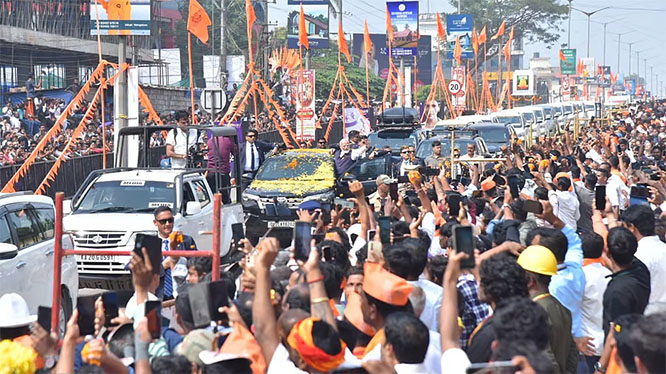
roadshow.jpg

Udupi district transformed into a sea of saffron and celebration on Friday, November 28, as Prime Minister Narendra Modi’s roadshow swept through the coastal temple town. Thousands of residents lined the streets, turning the event into a vibrant public spectacle filled with cheers, flags, and festive energy.

The procession route—from the helipad to the historic Sri Krishna Math—was decked with buntings, saffron flags, and multilayered security barricades. One of the district’s largest-ever security deployments was put in place for the high-profile visit, with over 3,000 police personnel on duty. The arrangement included ten SPs, 27 DSPs, 49 inspectors, 127 sub-inspectors, 232 assistant sub-inspectors, 1,608 constables, and 39 women staff.

Six platoons of the Karnataka State Reserve Police, six Quick Response Teams, bomb detection units, and dog squads were stationed across Udupi. Enhanced surveillance covered Adi Udupi, Bannanje bus stand, and the Sri Krishna Math parking zone, with combing operations carried out along the roadshow corridor.

At the 800-year-old Sri Krishna Math, preparations reached a ceremonial peak. Paryaya Puttige Math seer Sugunendra Teertha Swamiji said the Prime Minister would take part in the Laksha Kantha Geetha Parayana, a mass chanting of the Bhagavad Gita by one lakh devotees, and inaugurate the new Suvarna Teertha Mantapa.

“He will first offer floral tributes to saint-poet Kanakadasa and then unveil the golden covering over the Kanakana Kindi,” the seer said.

The Prime Minister will also receive a Poorna Kumbha welcome and have darshan of Lord Sri Krishna, Mukhyaprana Devaru, and the Suvarna Paduke. Union Minister Pralhad Joshi, Karnataka Governor Thaawarchand Gehlot, Minister Bairathi Suresh, Dharmadhikari D. Veerendra Heggade, and seers from the Ashta Maths are expected to join the ceremony.

Ahead of his arrival, the Prime Minister posted on X that he felt “honoured” to attend the spiritually significant gathering. “This is a special occasion that brings together people from different sections of society for a recital of the Gita. This Matha has a very special significance in our cultural life,” he wrote, noting the institution’s long-standing legacy rooted in the teachings of Sri Madhvacharya.

roadshow2.jpg

Comments

Add new comment

  • Coastaldigest.com reserves the right to delete or block any comments.
  • Coastaldigset.com is not responsible for its readers’ comments.
  • Comments that are abusive, incendiary or irrelevant are strictly prohibited.
  • Please use a genuine email ID and provide your name to avoid reject.