Ethiopian army chief, regional president killed

Agencies
June 23, 2019

Addis Ababa, Jun 23: Ethiopia's army chief and the president of a key region have been shot dead in a wave of violence highlighting the political instability in the country as Prime Minister Abiy Ahmed tries to push through reforms.
The latest unrest in the Horn of Africa nation flared on Saturday afternoon in Amhara, one of nine autonomous regions, when a "hit squad" attacked a meeting of top officials, Abiy's office said Sunday.

Spokeswoman Billene Seyoum told journalists the attack was led by Amhara's security chief Asaminew Tsige, and resulted in regional president Ambachew Mekonnen and another top official being shot.

The men were "gravely injured in the attack and later died of their wounds," she said.

"Several hours later in what seems like a coordinated attack, the chief of the staff of the national security forces Seare Mekonnen was killed in his home by his bodyguard" in the capital Addis Ababa, she added.

Also shot dead was a retired general who had been visiting him, Billene added.

The bodyguard has been apprehended while Asaminew is still on the loose, sources said.

The link between the two attacks was not immediately clear.

The internet has been cut nationwide since Saturday evening, after being severed for much of the previous week.

A journalist in the regional capital Bahir Dar told AFP shooting had begun shortly after sunset and continued for several hours before ceasing.

The United States embassy issued alerts about reported gunfire in the capital Addis Ababa, and violence around Amhara's main city Bahir Dar.

An analyst said Saturday's incident showed the seriousness of the political crisis in Ethiopia, where efforts by Abiy to loosen the iron-fisted grip of his predecessors and push through reforms have unleashed a wave of unrest.

"These tragic incidents, unfortunately, demonstrate the depth of Ethiopia's political crisis," said International Crisis Group analyst William Davison.

"It is now critical that actors across the country do not worsen the instability by reacting violently or trying to exploit this unfolding situation for their own political ends," the expert said.

Amhara in Ethiopia's northern highlands is the homeland of the ethnic group by the same name and is the birthplace of many of its emperors as well as the national language Amharic.

The Amhara are the second-largest ethnic grouping after the Oromo, and both spearheaded two years of anti-government protests which led to the resignation of former prime minister Hailemariam Desalegn.

Abiy, an Oromo, took power in April 2018 and has been lauded for a string of efforts to reform a nation which has known only the authoritarian rule of emperors and strongmen.

He has embarked on economic reforms, allowed dissident groups back into the country, sought to crack down on rights abuses and arrested dozens of top military and intelligence officials He also sealed a peace deal with neighbouring Eritrea, a longtime foe.

However, the loosening of the reins has also unleashed a wave of unrest.

Ethiopia's 1995 constitution, written by the Ethiopian People's Revolutionary Democratic Front (EPRDF) after it unseated the Derg military junta in 1991, partitioned the country into nine autonomous regions with borders following ethnic lines.

The EPRDF itself is a coalition of four parties from Oromia, Amhara, Tigray and the Southern Nations, Nationalities, and Peoples' Region.

Observers say that Abiy's plans to hold an election in 2020 have stirred up resentment in local politics, with other regional parties contesting the hold of those within the EPRDF, and seen a rise in ethnonationalism.

At the same time, longstanding tensions in a country of more than 80 ethnic groups have burst into the open, often over land and resources in Africa's second-most-populous nation.

Over a million people have been displaced by ethnic clashes, which analysts attribute to multiple causes, such as the weakening of the once all-powerful ruling EPRDF and different groups trying to take advantage of opportunities presented by the political transition.

In other regions, dozens of people have been killed in the last few months in clashes between residents of northern Benishangul Gumuz and Amhara states.

The security chief Asaminew, accused of being behind the attack in Amhara, was in 2018 released from prison after being held over a 2009 coup plot by the armed opposition group Ginbot 7 and Davison described him as an Amhara hardliner.

The coup attempt comes a year after a grenade explosion at a rally Abiy was addressing left two people dead.


Comments

Add new comment

  • Coastaldigest.com reserves the right to delete or block any comments.
  • Coastaldigset.com is not responsible for its readers’ comments.
  • Comments that are abusive, incendiary or irrelevant are strictly prohibited.
  • Please use a genuine email ID and provide your name to avoid reject.
coastaldigest.com news network
November 28,2025

roadshow.jpg

Udupi district transformed into a sea of saffron and celebration on Friday, November 28, as Prime Minister Narendra Modi’s roadshow swept through the coastal temple town. Thousands of residents lined the streets, turning the event into a vibrant public spectacle filled with cheers, flags, and festive energy.

The procession route—from the helipad to the historic Sri Krishna Math—was decked with buntings, saffron flags, and multilayered security barricades. One of the district’s largest-ever security deployments was put in place for the high-profile visit, with over 3,000 police personnel on duty. The arrangement included ten SPs, 27 DSPs, 49 inspectors, 127 sub-inspectors, 232 assistant sub-inspectors, 1,608 constables, and 39 women staff.

Six platoons of the Karnataka State Reserve Police, six Quick Response Teams, bomb detection units, and dog squads were stationed across Udupi. Enhanced surveillance covered Adi Udupi, Bannanje bus stand, and the Sri Krishna Math parking zone, with combing operations carried out along the roadshow corridor.

At the 800-year-old Sri Krishna Math, preparations reached a ceremonial peak. Paryaya Puttige Math seer Sugunendra Teertha Swamiji said the Prime Minister would take part in the Laksha Kantha Geetha Parayana, a mass chanting of the Bhagavad Gita by one lakh devotees, and inaugurate the new Suvarna Teertha Mantapa.

“He will first offer floral tributes to saint-poet Kanakadasa and then unveil the golden covering over the Kanakana Kindi,” the seer said.

The Prime Minister will also receive a Poorna Kumbha welcome and have darshan of Lord Sri Krishna, Mukhyaprana Devaru, and the Suvarna Paduke. Union Minister Pralhad Joshi, Karnataka Governor Thaawarchand Gehlot, Minister Bairathi Suresh, Dharmadhikari D. Veerendra Heggade, and seers from the Ashta Maths are expected to join the ceremony.

Ahead of his arrival, the Prime Minister posted on X that he felt “honoured” to attend the spiritually significant gathering. “This is a special occasion that brings together people from different sections of society for a recital of the Gita. This Matha has a very special significance in our cultural life,” he wrote, noting the institution’s long-standing legacy rooted in the teachings of Sri Madhvacharya.

roadshow2.jpg

Comments

Add new comment

  • Coastaldigest.com reserves the right to delete or block any comments.
  • Coastaldigset.com is not responsible for its readers’ comments.
  • Comments that are abusive, incendiary or irrelevant are strictly prohibited.
  • Please use a genuine email ID and provide your name to avoid reject.
News Network
November 28,2025

ministerPM.jpg

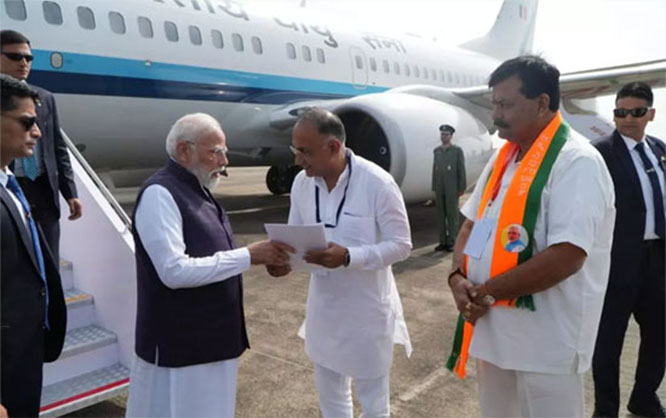
Mangaluru, Nov 28: Karnataka Health Minister and Dakshina Kannada district in-charge minister Dinesh Gundu Rao on Friday handed over Chief Minister Siddaramaiah’s letter to Prime Minister Narendra Modi, highlighting the severe distress faced by farmers due to crashing crop prices.

PM Modi arrived at the Mangaluru International Airport en route to Udupi, where Gundu Rao welcomed him and submitted the letter. The chief minister’s message stressed that farmers are suffering heavy losses because maize and green gram are being bought far below the Minimum Support Price (MSP). The state urged the Centre to immediately begin procurement at MSP.

According to the letter, Karnataka has a bumper harvest this year—over 54.74 lakh metric tons of maize and 1.98 lakh metric tons of green gram—yet farmers are unable to secure fair prices. Against the MSP of ₹2,400/MT for maize and ₹8,768/MT for green gram, market rates have plunged to ₹1,600–₹1,800 and ₹5,400 respectively.

The chief minister has requested the Centre to:

• Direct NAFED, FCI and NCCF to start MSP procurement immediately.
• Ensure ethanol units purchase maize directly from farmers or FPOs.
• Increase Karnataka’s ethanol allocation, citing high production capacity.
• Stop maize imports, which have depressed domestic prices.
• Relax quality norms for green gram, allowing up to 10% discoloration due to rains.

The letter stresses that MSP is crucial for farmer dignity and income stability and calls for swift central intervention to prevent a deepening crisis.

Comments

Add new comment

  • Coastaldigest.com reserves the right to delete or block any comments.
  • Coastaldigset.com is not responsible for its readers’ comments.
  • Comments that are abusive, incendiary or irrelevant are strictly prohibited.
  • Please use a genuine email ID and provide your name to avoid reject.