



Facets of Mahatma Gandhi's life depicted in 22 tableaux take centre stage at Rajpath

Agencies
January 26, 2019

New Delhi, Jan 26: Various facets of Mahatma Gandhi's life journey were displayed by the 22 tableaux that rolled down the Rajpath during the 70th Republic Day Parade to mark the 150th birth anniversary of the father of the nation.
While 16 tableaux were from states and union territories, six were from various central ministries and departments - agriculture, power, drinking water and sanitation, Indian Railways, CISF and CPWD.

The Uttarakhand tableau featured Kausani's Anasakti Ashram where Mahatma Gandhi had stayed in 1929. The tableau showed Gandhi writing his book 'Anasakti Yoga' at the ashram in the backdrop of mountains and deodar trees.

The tableau of Uttar Pradesh had "commemorating the 150th birth anniversary of Mahatma Gandhi" as its theme, with Gandhi at the Kashi Vidyapith.

"Gandhi's ray of hope - our composite culture" was Jammu and Kashmir's tableau theme this year. The tableau showcased Gandhi along with his charkha and ethnic diversity of the Valley.

"Peace Within"-themed Arunachal Pradesh's tableau shows a tribal Monpa placing flowers at Gandhi's feet. It also shows the dancing Monpa tribe stressing on peace and cleanliness.

The Delhi tableau showcased a theme of "Mahatma Gandhi and Delhi" and displayed his association with the national capital and the Birla House which is now known as Gandhi Smriti.

The tableau of West Bengal depicted two phases in Mahatma Gandhi's life - his stay in Kolkata during India's Independence and association with Rabindranath Tagore.

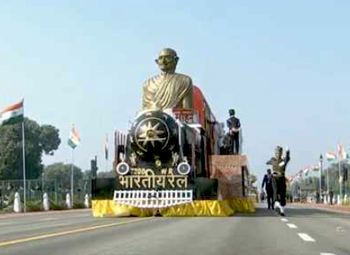
The Railways ministry, whose tableau made a come back at the Republic Day parade after three years, depicted the "transformation of Mohandas Karamchand Gandhi to Mahatma Gandhi" and highlighted the yet-to-be-launched bullet train and Train 18.

The tableau highlighted the incident in 1893, when the young Mohandas was thrown out of a "European only" compartment at Pietermaritzburg railway station in South Africa which acted as a catalyst for him to practice ''Satyagrah''.

The front portion of tableau showcased a steam engine on whose top was perched a bust of Mahatma Gandhi which is similar to the bust installed in June 2018 at the Pietermaritzburg railway station of South Africa.

Incidentally, South African President Cyril Ramaphosa was the chief guest at the Republic Day parade. He became the second South African president to be invited to the event as the chief guest. Former South African president Nelson Mandela was the chief guest for the prestigious event in 1995.

The theme for Andaman and Nicobar's tableau was "Role of Gandhiji on inmates of Cellular Jail in Andaman". The tableau showcased the effect that Mahatma Gandhi had amongst the inmates of the historic jail.

Gujarat with the "historical Dandi March" theme depicted the great movement which shook the foundation of the British Empire by lifting a handful of salt.

Similarly, the theme for Karnataka tableau was the "Gandhiji and the Belagavi Congress session", whereas the theme for Maharashtra was the Quit India movement.

The theme for Goa's tableau was "Unity in Diversity", while for Tripura it was "empowerment rural economy in Gandhian Way".

The tableau of Tamil Nadu will have "transformation of dress code of Mahatma Gandhi" as theme.

While the Punjab tableau had "Jallianwala Bagh" theme, Sikkim had "agricultural and environmental non-violence" theme.

The Central Public Works Department (CPWD) tableau showcased the non-violent struggle by Gandhi, which led to freedom of India. The tableau was crafted in natural flowers. The front part of the tableau showed Gandhi, the middle part showed his non-violent followers while the rear portion depicted the message given by him for world peace and unity.

The tableau by the ministry of Power represented the flagship scheme "Saubhagya" with the front portion showing Gandhi's Talisman of serving poorest and weakest sections of society as the inspiration behind the Saubhagya scheme.

The four-year old journey of the "Swachh Bharat Mission" was demonstrated by the ministry of drinking water and sanitation with the front part of the tableau paying a tribute to Gandhi, who was the first champion of sanitation in India.


Comments

Add new comment

  • Coastaldigest.com reserves the right to delete or block any comments.
  • Coastaldigset.com is not responsible for its readers’ comments.
  • Comments that are abusive, incendiary or irrelevant are strictly prohibited.
  • Please use a genuine email ID and provide your name to avoid reject.
News Network
December 19,2025

Saudi Arabia has abolished fees on expatriate workers employed in licensed industrial establishments, signaling a strong push to empower national factories and enhance the Kingdom’s global industrial competitiveness. The move reflects the leadership’s commitment to building a sustainable and resilient industrial economy under Saudi Vision 2030.

The decision was approved by the Council of Ministers, chaired by Crown Prince and Prime Minister Mohammed bin Salman, following a recommendation from the Council of Economic and Development Affairs (CEDA). It forms part of a broader strategy to support, modernize, and strengthen the industrial sector.

By removing fees on foreign workers, industrial establishments gain greater operational flexibility and relief from financial pressures. This is expected to help factories expand production, improve efficiency, and compete more effectively in international markets, while reinforcing long-term sustainability.

The initiative aligns closely with Saudi Vision 2030, which identifies industry as a key pillar of economic diversification. A competitive and resilient industrial base is viewed as essential for driving innovation, attracting investment, and sustaining long-term economic growth.

Overall, the fee exemption underscores the Kingdom’s commitment to creating a supportive environment for industrial development and ensuring that Saudi factories remain globally competitive and capable of leading the nation’s economic transformation.

Comments

Add new comment

  • Coastaldigest.com reserves the right to delete or block any comments.
  • Coastaldigset.com is not responsible for its readers’ comments.
  • Comments that are abusive, incendiary or irrelevant are strictly prohibited.
  • Please use a genuine email ID and provide your name to avoid reject.
News Network
December 15,2025

Udupi, Dec 15: What was meant to be a post-pilgrimage gathering turned tragic in Padukere village of Brahmavar taluk, Udupi district, late Sunday night, when a clash among youths escalated into a fatal assault, leaving one man dead.

The victim has been identified as 30-year-old Santosh Mogaveera, a resident of Padukere.

According to preliminary information, the incident took place during a late-night drinking party involving a group of local youths who had recently returned after completing their pilgrimage to the Sabarimala shrine. An argument reportedly broke out among the group and soon escalated into a violent confrontation.

During the ensuing brawl, Santosh Mogaveera was allegedly assaulted and collapsed at the spot after sustaining serious injuries. He was rushed by local residents to a private hospital in Brahmavar, where doctors declared him dead.

On receiving information, senior police officials, including Brahmavar Circle Inspector Gopikrishna, Kota Police Sub-Inspector Praveen Kumar T, Station ASI Manthesh Jabagoudar, and head constables Pradeep and Ashok, visited the spot and conducted an inspection.

Police have taken four youths into custody in connection with the incident. A case has been registered at the Kota police station, and further investigation is underway to ascertain the exact sequence of events leading to the death.

Comments

Add new comment

  • Coastaldigest.com reserves the right to delete or block any comments.
  • Coastaldigset.com is not responsible for its readers’ comments.
  • Comments that are abusive, incendiary or irrelevant are strictly prohibited.
  • Please use a genuine email ID and provide your name to avoid reject.
News Network
December 16,2025

bengal.jpg

The deletion of over 58 lakh names from West Bengal’s draft electoral rolls following a Special Intensive Revision (SIR) has sparked widespread concern and is likely to deepen political tensions in the poll-bound state.

According to the Election Commission, the revision exercise has identified 24 lakh voters as deceased, 19 lakh as relocated, 12 lakh as missing, and 1.3 lakh as duplicate entries. The draft list, published after the completion of the first phase of SIR, aims to remove errors and duplication from the electoral rolls.

However, the scale of deletions has raised fears that a large number of eligible voters may have been wrongly excluded. The Election Commission has said that individuals whose names are missing can file objections and seek corrections. The final voter list is scheduled to be published in February next year, after which the Assembly election announcement is expected. Notably, the last Special Intensive Revision in Bengal was conducted in 2002.

The development has intensified the political row over the SIR process. Chief Minister Mamata Banerjee and her Trinamool Congress have strongly opposed the exercise, accusing the Centre and the Election Commission of attempting to disenfranchise lakhs of voters ahead of the elections.

Addressing a rally in Krishnanagar earlier this month, Banerjee urged people to protest if their names were removed from the voter list, alleging intimidation during elections and warning of serious consequences if voting rights were taken away.

The BJP, meanwhile, has defended the revision and accused the Trinamool Congress of politicising the issue to protect what it claims is an illegal voter base. Leader of the Opposition Suvendu Adhikari alleged that the ruling party fears losing power due to the removal of deceased, fake, and illegal voters.

The controversy comes amid earlier allegations by the Trinamool Congress that excessive work pressure during the SIR led to the deaths by suicide of some Booth Level Officers (BLOs), for which the party blamed the Election Commission. With the draft list now out, another round of political confrontation appears imminent.

As objections begin to be filed, the focus will be on whether the correction mechanism is accessible, transparent, and timely—critical factors in ensuring that no eligible voter is denied their democratic right ahead of a crucial election.

Comments

Add new comment

  • Coastaldigest.com reserves the right to delete or block any comments.
  • Coastaldigset.com is not responsible for its readers’ comments.
  • Comments that are abusive, incendiary or irrelevant are strictly prohibited.
  • Please use a genuine email ID and provide your name to avoid reject.