



New Delhi, Apr 23 : The issue of Gajendra Singh's suicide is expected to figure in Parliament as well today. Several opposition parties, including JD(U) and SP, have moved an adjournment motion demanding discussion on the matter.
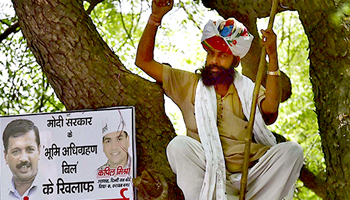
• A team of Delhi Police is heading to Dausa to further investigate the matter of farmer's suicide. It may be recalled that the Delhi Police Commissioner had ordered an investigation into the matter after being instructed by Home Minister Rajnath Singh.
• It is being reported that the Delhi Police had advised the AAP to hold rally against Land Ordinance at Ramlila Maidan instead of Jantar Mantar.
• Delhi CM Arvind Kejriwal has issued a statement on the farmer's suicide at his party's Jantar Mantar rally. It says: “Loss of life of this farmer in distress is an extremely sad incident. Delhi government does not wish to engage in any blame game on this terrible tragedy and no words can fulfill the irreparable loss caused to Gajendra’s family. We will do everything to find out how such an incident took place in full public view.”
“The Delhi government is committed to the well being of farmers and will continue to strive for their betterment. District Magistrate of the area has already begun his probe into the entire incident and the government will await the inquiry report before any further reaction.”
• Satish Kumar Jain, tehsildar of Nangal, says crop damage in the region was below 24%. “We had sent the report to the government. The limit for disbursing compensation is 33%.” Jain adds that Gajendra Singh was financially sound.
• Mortal remains of deceased farmer Gajendra Singh arrive at his residence in Nangal, Jhamarwada, in Rajasthan's Dausa.
• Gajendra's farmer faints while waiting for his son's mortal remains.
• Workers of both the BJP and Congress will today hold protest against Delhi Chief Minister Arvind Kejriwal over farmer Gajendra's suicide at AAP rally.
• He had gone with a hope to get help. We had given him the chit to read it out at the rally, but he did not get an opportunity, says Jaiveer Singh on the suicide note recovered at the rally site.
• Jaiveer Singh, Gajendra's uncle, also reiterates that the deceased farmer was in contact with Manish Sisodia.
• We don’t know what speech was given. We don’t know how he was provoked at the rally and ended up doing this (committing suicide), adds Rajender Singh.
• We have come to know that Gajendra had gone to Delhi Deputy Chief Minister Manish Sisodia's house at around 11 am yesterday, before the rally, says Gajendra's cousin Rajender Singh.
• He was not distressed. He had gone to Delhi to represent us over the crop damage that we had suffered due to unseasonal rains, says Girdhari Singh.
• Was it a jungle where Gajendra committed suicide? Wasn't there anyone who could have saved him? asks Girdhari Singh, a relative of Gajendra Singh.
What happened on Wednesday
An AAP rally attended by thousands against the Land Ordinance on Wednesday turned tragic when a Rajasthan farmer, his crops ruined by untimely rains, hanged himself from a tree in the heart of the capital, shocking India and sparking an ugly political blame game.
"Gajendra (Singh)'s death has saddened the nation," Prime Minister Narendra Modi's office said, referring to the father of three who climbed a neem tree at the Jantar Mantar protest site and died after tying his scarf around his neck to a stout branch.
The statement came hours after the dramatic death when Aam Aadmi Party leader Kumar Vishwas, addressing the mass gathering, suddenly spotted the man on the tree, seemingly precariously perched, and asked police and AAP activists to bring him down.
Three party activists clambered up the tree and untied the scarf. But before they could take a good grip of him, the limp body slipped from their hands and fell with a thud, only to cause chaos at the rally.
Shouting anti-police slogans, some volunteers rushed the man to the Ram Manohar Lohia Hospital, around two kilometers away, where doctors declared him dead.
A hand-written 'suicide note' in Hindi found at the spot said the man was taking his life because rains had destroyed his crops. He ended the note with "Jai Jawan, Jai Kisan, Jai Rajasthan".
In no time, a political war erupted.
Taken aback by the suicide, AAP leaders blamed Delhi Police, saying police did not even respond to their appeals to bring the man down from the tree.
"Police didn't play their role properly. They should have made efforts to save Gajendra Singh. It were AAP activists who put their lives at risk and brought him down and took him to hospital," said Kumar Vishwas.
Asked why the rally was not halted after the incident, AAP leader Sanjay Singh said: "If we had stopped the rally, there would have been a stampede or other law and order problems."
Police denied AAP's charges and said an inquiry was on to find out what happened. The investigation was ordered by Home Minister Rajnath Singh, to whom Delhi Police reports.
The Bharatiya Janata Party hit out at the AAP. Its spokesman Sambit Patra asked: "Why didn't AAP leaders stop the farmer from committing suicide?"
The first to reach the hospital was Congress leader Ajay Maken, who blamed both police and the AAP for the suicide. Congress vice president Rahul Gandhi came calling later.
In Rajasthan, the family of the deceased farmer said Gajendra was shaken after losing his entire wheat crop to untimely rains.
Gopal Singh, an uncle of Gajendra Singh, said that the man was not compensated by the state government.
"He had around 25 bighas (around 2.5 hectare) of land and grew wheat. His crop was destroyed by rains and hailstorm... So far no compensation has been given to us."
The Congress announced Rs 2 lakh as compensation to the dead man's family.
Kejriwal was told of the incident -- it wasn't clear then whether the man was alive or dead -- by some volunteers on the dais. Thinking that the man was probably alive, he said he would call on him after the rally.
In his speech, Kejriwal accused the Narendra Modi government of trying to snatch farmers' land to give it to the "super rich".
"Today farmers have realised that this is not a government of farmers, it is a government of anti-farmers," he said to loud cheers. "This is 'super amiron ki sarkar (a government of the super rich)."
Kejriwal questioned the need to enact an Ordinance to make land takeover easy.
"What is the urgency? Is there a big emergency? What is the compulsion? Is some major project stalled? Our farmers want to know."

Comments
Add new comment