Food safety in India at risk due to egg contamination, reveals study

Agencies
September 12, 2017

New Delhi, Sept 12: Eggs are considered to be the most common breakfast item in every household across the globe, barring pure vegetarians and vegans, of course.

In any way and in any form, eggs can be touted as your daily dose of health. Poached, fried, boiled or scrambled – eggs form a wholesome part of a person's diet.

In India, however, there may be a high risk of egg contamination that's making them unfit for consumption.

Poor rearing practices and lack of technical know-how in Indian poultry farms may lead to contamination of eggs, a research has suggested.

As per the study, there are chances that they could be using contaminated feeds or using feed ingredients without any knowledge of their nutritive value which can effect egg production.

Also unhygienic rearing practices and lack of quality control measures can easily lead to egg contamination. It is not just the poultry farmers but traders, exporters and even consumers are unaware of the health risks of egg contamination.

Developed countries take measures to sterilise the egg surface from contamination especially from Salmonella enteritidis. In India no such measures are taken and risk of egg contamination increases.

"India has become a leading poultry producer but the potential to reach the global markets is not very bright as the quality of the products does not meet international standards. Indian eggs are often rejected for export because of the presence of chemical residues on egg shells," says Dr. Saurabh Arora, Founder of Food Safety helpline and Food Safety Mobile App.

Recently, a number of eggs in the domestic market, in retail shops were collected and tested and were found to contain large amounts of salmonella both on the shell and inside the egg.

However, fresh eggs collected from farms indicated less salmonella contamination. Since most consumers buy eggs from retail outlets the chances of contracting salmonella infection increases.

Lack of food safety procedures, improper storage facilities and poor transportation are some of the other causes of deterioration in eggs. The FSSAI has proposed standards for fresh eggs in the Food Safety and Standards (Food Products Standards and Food Additives) Amendment Regulations, 2017.

These standards will come into force once they are approved. The FSSAI has laid down parameters which state that the eggshells must be free of blood rings, must not be soiled or have faecal matter and they must not be cracked or leaking.

FSSAI has laid down the amount of water, protein, fats and carbohydrates that eggs must contain as also the hygienic parameters and hygienic controls, like time and temperature, that must be observed during production, processing and handling which includes sorting, grading, washing, drying, treatment, packing, storage and distribution to point of consumption. FSSAI has laid emphasis on the storage conditions like moisture and temperature so as to reduce microbial contamination as microbial pathogens are a risk to human health.

Food safety practices for eggs

A number of surveys have been conducted which suggest that consumers have less awareness of food safety risks of eggs as compared to other foods. Most people will follow the hygienic practices when handling chicken meat and fish but will overlook the recommended practices for eggs. It is not a wrong observation that people do not wash their hands after handling eggs or even after breaking raw eggs when cooking.

This is probably because of the perception that eggs are generally safe. They are indeed safe if they have been cooked properly, which means that they must be cooked till their yolks and whites have become firm. Dishes that contain eggs as ingredients must reach an internal temperature of 160o Fahrenheit which is the temperature required for salmonella to be destroyed through cooking.

Besides cooking eggs thoroughly there are other food safety practices that you need to follow when handling eggs to prevent cross-contamination.

• Egg handlers must wash hands with soap and clean surfaces and utensils that have come in contact with raw eggs.

• Containers that have been used to process raw eggs must not come in contact with ready-to-eat food.

• Separate eggs in the grocery bags when shopping and in the refrigerator when storing.

• Temperature of the refrigerator must be maintained at 33 to 40o Fahrenheit.

• If eggs are left outside after refrigeration then they need to be discarded within two hours.

• Refrigerate eggs only after they have been washed.

• Eggs must be consumed within two weeks.

• It is advisable not to eat raw eggs.

Comments

Add new comment

  • Coastaldigest.com reserves the right to delete or block any comments.
  • Coastaldigset.com is not responsible for its readers’ comments.
  • Comments that are abusive, incendiary or irrelevant are strictly prohibited.
  • Please use a genuine email ID and provide your name to avoid reject.
News Network
December 2,2025

Mangaluru, Dec 2: Mangaluru International Airport responded to a medical emergency late on Monday night. Air India Express flight IX 522, travelling from Riyadh to Thiruvananthapuram, was diverted to Mangaluru Airport after a passenger in his late 30s experienced a medical emergency on board.

The Airport’s Operations Control Centre received an alert regarding the passenger’s health condition. The airport activated its emergency response protocol, mobilising the airport medical team and coordinating with stakeholders including CISF, immigration, and customs. 

Upon landing, airport medical personnel attended to the passenger, assessed his condition, and arranged to shift him to a local tertiary-care hospital for further treatment. The passenger’s relatives accompanied the passenger, who incidentally received necessary medical care on board, which helped stabilise the situation.

Following the handling of the emergency, the flight departed for Thiruvananthapuram at 2:05 am on Tuesday.

"We appreciate the cooperation of all parties involved, and this incident reaffirms our ongoing commitment to prioritising passenger safety and readiness to respond to unforeseen emergencies with professionalism and care," the Airport spokesperson said. 

Comments

Add new comment

  • Coastaldigest.com reserves the right to delete or block any comments.
  • Coastaldigset.com is not responsible for its readers’ comments.
  • Comments that are abusive, incendiary or irrelevant are strictly prohibited.
  • Please use a genuine email ID and provide your name to avoid reject.
coastaldigest.com news network
November 28,2025

roadshow.jpg

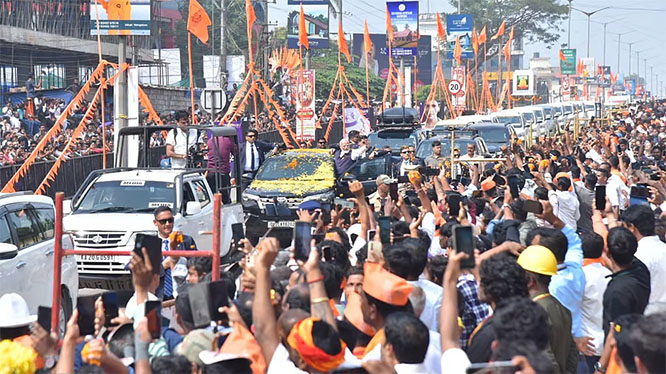
Udupi district transformed into a sea of saffron and celebration on Friday, November 28, as Prime Minister Narendra Modi’s roadshow swept through the coastal temple town. Thousands of residents lined the streets, turning the event into a vibrant public spectacle filled with cheers, flags, and festive energy.

The procession route—from the helipad to the historic Sri Krishna Math—was decked with buntings, saffron flags, and multilayered security barricades. One of the district’s largest-ever security deployments was put in place for the high-profile visit, with over 3,000 police personnel on duty. The arrangement included ten SPs, 27 DSPs, 49 inspectors, 127 sub-inspectors, 232 assistant sub-inspectors, 1,608 constables, and 39 women staff.

Six platoons of the Karnataka State Reserve Police, six Quick Response Teams, bomb detection units, and dog squads were stationed across Udupi. Enhanced surveillance covered Adi Udupi, Bannanje bus stand, and the Sri Krishna Math parking zone, with combing operations carried out along the roadshow corridor.

At the 800-year-old Sri Krishna Math, preparations reached a ceremonial peak. Paryaya Puttige Math seer Sugunendra Teertha Swamiji said the Prime Minister would take part in the Laksha Kantha Geetha Parayana, a mass chanting of the Bhagavad Gita by one lakh devotees, and inaugurate the new Suvarna Teertha Mantapa.

“He will first offer floral tributes to saint-poet Kanakadasa and then unveil the golden covering over the Kanakana Kindi,” the seer said.

The Prime Minister will also receive a Poorna Kumbha welcome and have darshan of Lord Sri Krishna, Mukhyaprana Devaru, and the Suvarna Paduke. Union Minister Pralhad Joshi, Karnataka Governor Thaawarchand Gehlot, Minister Bairathi Suresh, Dharmadhikari D. Veerendra Heggade, and seers from the Ashta Maths are expected to join the ceremony.

Ahead of his arrival, the Prime Minister posted on X that he felt “honoured” to attend the spiritually significant gathering. “This is a special occasion that brings together people from different sections of society for a recital of the Gita. This Matha has a very special significance in our cultural life,” he wrote, noting the institution’s long-standing legacy rooted in the teachings of Sri Madhvacharya.

roadshow2.jpg

Comments

Add new comment

  • Coastaldigest.com reserves the right to delete or block any comments.
  • Coastaldigset.com is not responsible for its readers’ comments.
  • Comments that are abusive, incendiary or irrelevant are strictly prohibited.
  • Please use a genuine email ID and provide your name to avoid reject.
News Network
December 4,2025

Mangaluru: Chaos erupted at Mangaluru International Airport (MIA) after IndiGo flight 6E 5150, bound for Mumbai, was repeatedly delayed and ultimately cancelled, leaving around 100 passengers stranded overnight. The incident highlights the ongoing country-wide operational disruptions affecting the airline, largely due to the implementation of new Flight Duty Time Limitations (FDTL) norms for crew.

The flight was initially scheduled for 9:25 PM on Tuesday but was first postponed to 11:40 PM, then midnight, before being cancelled around 3:00 AM. Passengers expressed frustration over last-minute communication and the lack of clarity, with elderly and ailing travellers particularly affected. “Though the airline arranged food, there was no proper communication, leaving us confused,” said one family member.

An IndiGo executive at MIA cited the FDTL rules, designed to prevent pilot fatigue by limiting crew working hours, as the cause of the cancellation. While alternative arrangements, including hotel stays, were offered, about 100 passengers chose to remain at the airport, creating tension. A replacement flight was arranged but also faced delays due to the same constraints, finally departing for Mumbai around 1:45 PM on Wednesday. Passengers either flew, requested refunds, or postponed their travel.

The Mangaluru delay is part of a broader crisis for IndiGo. The airline has been forced to make “calibrated schedule adjustments”—a euphemism for widespread cancellations and delays—after stricter FDTL norms came into effect on November 1.

While an IndiGo spokesperson acknowledged unavoidable flight disruptions due to technology issues, operational requirements, and the updated crew rostering rules, the DGCA has intervened, summoning senior airline officials to explain the chaos and outline corrective measures.

The ripple effect has been felt across the country, with major hubs like Bengaluru and Mumbai reporting numerous cancellations. The Mangaluru incident underscores the systemic operational strain currently confronting India’s largest carrier, leaving passengers nationwide grappling with uncertainty and delays.

Comments

Add new comment

  • Coastaldigest.com reserves the right to delete or block any comments.
  • Coastaldigset.com is not responsible for its readers’ comments.
  • Comments that are abusive, incendiary or irrelevant are strictly prohibited.
  • Please use a genuine email ID and provide your name to avoid reject.