Geopolitics allow Myanmar govt to cover up Rohingya massacre

Ameen Izzadeen
September 10, 2017

A humanitarian crisis of near genocidal proportions is taking place in Myanmar’s Rakhine State, yet the world’s reaction is confined to mere condemnation instead of sanctions or direct intervention.  Although international journalists are not allowed to visit the troubled province that has for the past five years been witnessing state-sponsored terror against the hapless Rohingya, a Muslim ethnic minority living in Rakhine bordering Bangladesh, information pours in through social media. It indicates that another Rwanda or Srebrenica or Darfur is in the making. 

If the international community and the United Nations had reacted at the first signs of the troubles, one  million minority Tutsis would not have been massacred by the Hutu dominated regime in Rwanda from April 7 to mid-July 1994, more than 8,000 Bosnian men and boys would not have been executed by Ratko Mladic’s Serb army a year later, and more than 300,000 people would not have perished in Darfur from 2003 to 2010.

Post-conflict measures such as taking the perpetrators to war crime tribunals may serve as a warning to killer regimes. Post-conflict UN reports lamenting the world body’s failure to protect civilians caught up in war cannot bring back to life the innocent people killed for the simple reason that they had a different identity to that of the majority within a state.

But immediate intervention under the responsibility to protect (R2P) principle can save life though the concept is highly abused. Powerful states have taken cover behind R2P to justify their self-centred interventions.  Yet, a UN-led R2P initiative is the best option available to save the Rohingyas.
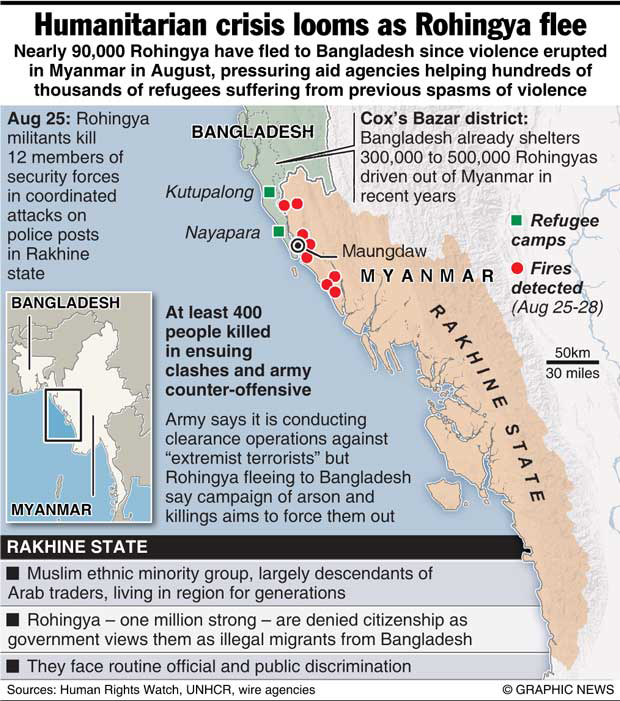
The Rohingyas have faced severe persecution and violence at the hands of the state for decades. They have been stripped of their nationality in terms of a 1982 law, though they have been living in Myanmar for generations. They have no access to state education and employment.  Successive Myanmar governments have denied the existence of the Rohingya as an ethnic group, calling the most oppressed people on Earth “illegal Bengalis” instead. However, Bangladesh strongly disputes Myanmar’s claim.  

Myanmar’s strategic importance gives it licence to violate international humanitarian laws and still call itself a fledgling democracy. In other words, geopolitics undermines R2P.

The United States, China and India are in a competition to bring Myanmar under their sphere of influence. They were like three men on their knees proposing to one damsel. They would not mind that she has reddened her lips by sucking the blood of Rohingyas and darkened her eyebrows with charred remnants of Rohingya’s wooden huts.  

Geopolitics is why the US condemnation is not commensurate with the crime being committed against 1.3 million Rohingyas.  Myanmar during the latter part of military strongman Than Shwe’s administration (1992-2011) adopted an equidistance policy vis-à-vis China, the US and India, after being under China’s economic protection for decades.  The visit of the then US President Barack Obama to Myanmar took bilateral relations to a new level where human rights abuses are largely ignored, and if they warrant a mention, the criticism appeared mere routine.  With the aim of reducing Myanmar’s economic dependency on China, the US has increased economic aid to Myanmar following the country’s transition to democracy.  

Entangling the Rohingya case in big power politics is China’s bid to build a deep sea port at Kyauk Pyu in the troubled Rakhine state – close to Maungdaw -- and an oil pipeline extending from there across Myanmar upto China’s hinterland – a shorter energy supply route that circumvents the arduous Malaca Strait.  China has won the contract for the port, but is negotiating for an 85 percent stake in the project instead of the 50 percent that formed the basis of the negotiations.  The Chinese port project together with an industrial park has ruffled feathers in India’s security circles as the port is overlooking India’s northeast. Also, Rakhine is believed to be rich in resources, including natural gas.

It was to counter China’s strategic foothold in Myanmar that India’s Prime Minister Narendra Modi was in Myanmar this week. This is why India has not condemned Myanmar’s atrocities against the Rohingyas.  Throwing human rights principles into the dustbin of self-centred politics,  Modi during his visit sought to enhance cooperation on intelligence sharing amid politically motivated s claims that linked Rohingya rebels with ISIS terrorists following the August 25 rebel attack on police posts.  India and Myanmar are also to ink a deal on a 1640 km highway project that would connect India with Myanmar and Thailand – a highway which India describes as its gateway to Southeast Asia and its response to China’s One-Belt-One-Road initiative. 

With big powers in a scramble to improve relations with Myanmar, the new government which came to power promising to strengthen democracy and uphold human rights, finds itself in a comfort zone from where it could spurn international criticism on the armed forces’ oppression against the Rohingyas, whom Pope Francis in a speech in February described as “our brothers and sisters”, while calling on Myanmar to stop the persecution.

It is while sitting in this comfort zone of crime that Myanmar is counting on China to block moves to bring the Rohingyas issue before the UN Security Council, and Myanmar’s de facto leader Aung San Suu Kyi could dismiss international criticism and irrefutable video evidence as “fake news”.   The story being churned out by the Suu Kyi’s government is that the Rohingyas killed Rohingyas.  Journalists who were taken on a guided tour on Wednesday under police escort were told the Rohingyas fled because the Rohingya rebels were burning their villages. The hard-to-believe story does not provide answers to questions over refugees who bore gunshot wounds, women who were raped and mutilated bodies found in Rakhine jungles.

Suu Kyi’s government has blocked UN aid agencies from delivering vital supplies of food, water and medicine to the besieged Rohingyas.  A few months ago, a dozen Nobel peace prize winners signed a petition calling on fellow Nobel laureate Suu Kyi to protect the Rohingyas. This week, the youngest Nobel Peace Prize winner, Malala Yousafzai, in a statemnent called Suu Kyi to condemn the “tragic and shameful treatment” of the Rohingyas.

But Suu Kyi’s conduct is unbecoming of a Nobel laureate. On the one hand she refuses to defy the military, which is the ultimate power in Myanmar -- a situation that makes the so-called transition to democracy a charade. On the other, if she acts against the perpetrators, she runs the risk of being labelled unpatriotic by the military and extremists led by monk Ashin Wirathu.  She failed to act against the extremists, though she had an opportunity in May this year when the Sangha Maha Nayaka Committee, Myanmar’s highest Buddhist authority, issued a declaration ordering Wirathu and his Ma Ba Tha organisation to end their activities. Unperturbed, Wirathu continues his hate campaign, while Suu Kyi plays politics with the lives of the Rohingyas.

The Rohingyas crisis is a humanitarian issue. It is not a Muslim issue, though Myanmar’s persecution of the Rohingyas has triggered a series of protests in the Islamic world, with Turkey, Pakistan and other Muslim countries issuing strong statements. 

Humanitarianism is beyond race, religion and other considerations. If Myanmar cannot solve the Rohingya crisis in a civilized manner, then the international community should intervene.  Let the R2P initiative begin with an international conference on the Rohingya crisis.

(The writer is social justice activist, lecturer in journalism and international affairs and deputy editor of Sri Lanka based Sunday Times)
Courtesy: Daily Mirror

Comments

Add new comment

  • Coastaldigest.com reserves the right to delete or block any comments.
  • Coastaldigset.com is not responsible for its readers’ comments.
  • Comments that are abusive, incendiary or irrelevant are strictly prohibited.
  • Please use a genuine email ID and provide your name to avoid reject.
News Network
December 4,2025

indigoflight.jpg

Domestic carrier IndiGo has cancelled over 180 flights from three major airports — Mumbai, Delhi and Bengaluru — on Thursday, December 4, as the airline struggles to secure the required crew to operate its flights in the wake of new flight-duty and rest-period norms for pilots.

While the number of cancellations at Mumbai airport stands at 86 (41 arrivals and 45 departures) for the day, at Bengaluru, 73 flights have been cancelled, including 41 arrivals, according to a PTI report that quoted sources.

"IndiGo cancelled over 180 flights on Thursday at three airports-Mumbai, Delhi and Bengaluru," the source told the news agency.

Besides, it had cancelled as many as 33 flights at Delhi airport for Thursday, the source said, adding, "The number of cancellations is expected to be higher by the end of the day."

The Gurugram-based airline's On-Time Performance (OTP) nosedived to 19.7 per cent at six key airports — Delhi, Mumbai, Chennai, Kolkata, Bengaluru and Hyderabad — on December 3, as it struggled to get the required crew to operate its services, down from almost half of December 2, when it was 35 per cent.

"IndiGo has been facing acute crew shortage since the implementation of the second phase of the FDTL (Flight Duty Time Limitations) norms, leading to cancellations and huge delays in its operations across the airports," a source had told PTI on Wednesday.

Chaos continued at several major airports for the third day on Thursday because of the cancellations.

A spokesperson for the Kempegowda International Airport (KIA) in Bengaluru said that 73 IndiGo flights had been cancelled on Thursday.

At least 150 flights were cancelled and dozens of others delayed on Wednesday, airport sources said, leaving thousands of travellers stranded, according to news agency Reuters.

The Directorate General of Civil Aviation (DGCA) has said it is investigating IndiGo flight disruptions and has asked the airline to submit the reasons for the current situation, as well as its plans to reduce flight cancellations and delays.

It may be mentioned here that the pilots' body, Federation of Indian Pilots (FIP), has alleged that IndiGo, despite getting a two-year preparatory window before the full implementation of new flight duty and rest period norms for cockpit crew, "inexplicably" adopted a "hiring freeze".

The FIP said it has urged the safety regulator, the DGCA, not to approve airlines' seasonal flight schedules unless they have adequate staff to operate their services "safely and reliably" in accordance with the New Flight Duty Time Limitations (FDTL) norms.

In a letter to the DGCA late on Wednesday, the FIP urged the DGCA to consider re-evaluating and reallocating slots to other airlines, which have the capacity to operate them without disruption during the peak holiday and fog season if IndiGo continues to "fail in delivering on its commitments to passengers due to its own avoidable staffing shortages."

Comments

Add new comment

  • Coastaldigest.com reserves the right to delete or block any comments.
  • Coastaldigset.com is not responsible for its readers’ comments.
  • Comments that are abusive, incendiary or irrelevant are strictly prohibited.
  • Please use a genuine email ID and provide your name to avoid reject.
News Network
December 3,2025

indigo.jpg

IndiGo, India’s largest airline, is battling one of its worst operational disruptions in recent years, with hundreds of delays and cancellations throwing domestic travel into chaos.

Government data on Tuesday showed its on-time performance plunging to 35%, an unusual dip for a carrier long associated with punctuality.

By Wednesday afternoon, airports in Delhi, Mumbai, Bengaluru and Hyderabad had collectively reported close to 200 cancellations, stranding travellers across the country.

Crew Shortage After New Duty Norms

A major trigger behind the meltdown is a severe crew shortage, especially among pilots, following the rollout of revised Flight Duty Time Limitation (FDTL) norms last month.

The rules mandate longer rest hours and more humane rosters — a shift IndiGo has struggled to incorporate across its vast network.

Sources said several flights were grounded due to lack of cabin crew, while some delays stretched upwards of eight hours.

With IndiGo controlling over 60% of India’s domestic aviation market, the ripple effect has impacted airports nationwide.

IndiGo Issues Apology, Lists “Compounding Factors”

In a statement, IndiGo acknowledged the large-scale disruption:

“We sincerely apologise to customers. A series of unforeseen operational challenges — technology glitches, winter schedule changes, adverse weather, system congestion and updated FDTL norms — created a compounding impact that could not have been anticipated.”

To stabilise operations, the airline has begun calibrated schedule adjustments for the next 48 hours, aiming to restore punctuality. Affected passengers are being offered refunds or alternate travel arrangements, IndiGo said.

What the FDTL Rules Require

The FDTL norms, designed to reduce pilot fatigue, cap duty and flying hours as follows:
•    Maximum 8 hours of flying per day
•    35 hours per week
•    125 hours per month
•    1,000 hours per year

Crew must also receive rest equalling twice the flight duration, with a minimum 10-hour rest period in any 24-hour window.

The DGCA introduced these limits to enhance flight safety.

Hyderabad: 33 Flights Cancelled, Long Queues Reported

Hyderabad’s Rajiv Gandhi International Airport saw heavy early-morning crowds as 33 IndiGo flights (arrivals and departures) were cancelled.

The airport clarified on X that operations were normal, advising passengers to contact IndiGo directly for latest flight status.

Cancellations included flights to and from Visakhapatnam, Goa, Ahmedabad, Delhi, Bengaluru, Chennai, Madurai, Hubli, Bhopal and Bhubaneswar.

Bengaluru: 42 Flights Disrupted

Bengaluru’s Kempegowda International Airport recorded 42 cancellations — 22 arrivals and 20 departures — affecting routes to Delhi, Mumbai, Chennai, Hyderabad, Goa, Kolkata and Lucknow.

Passengers Vent on Social Media

Irate travellers took to X to share their experiences. One passenger stranded in Hyderabad wrote: “I have been here since 3 a.m. and missed an important meeting.”

Another said: “My flight was pushed from 1:55 PM to 2:55 PM and now 4:35 PM. I was informed only three minutes before entering the airport.”

Delhi Airport Hit by Tech Glitch

At Delhi Airport, the disruption deepened due to a slowdown in the Amadeus system — used for reservations, check-ins and departure control.

The technical issue led to longer queues and sluggish processing, adding to delays already worsened by staff shortages.

Comments

Add new comment

  • Coastaldigest.com reserves the right to delete or block any comments.
  • Coastaldigset.com is not responsible for its readers’ comments.
  • Comments that are abusive, incendiary or irrelevant are strictly prohibited.
  • Please use a genuine email ID and provide your name to avoid reject.
News Network
November 30,2025

The United Nations Committee against Torture (CAT) has condemned the Israeli regime for enforcing a policy of “organized torture” against Palestinians.

In a report published on Friday, CAT stated that the occupying regime enforces a deliberate policy of “organized and widespread torture and ill-treatment” against Palestinian abductees, particularly since October 7, 2023, when Israel launched its genocidal war on Gaza.

The committee expressed “deep concern over repeated severe beatings, dog attacks, electrocution, water-boarding, use of prolonged stress positions [and] sexual violence” inflicted on Palestinians.

Palestinian prisoners were degraded by “being made to act like animals or being urinated on,” systematically denied medical care, and subjected to excessive restraints, “in some cases resulting in amputation,” the report added.

CAT also condemned the routine application of “unlawful combatants law” to justify the prolonged detention without trial of thousands of Palestinian men, women, and children.

More than 10,000 Palestinians, including women and children, are currently held in Israeli prisons, according to Palestinian and international human rights groups, with 3,474 Palestinians in “administrative detention,” meaning they are imprisoned without trial for indefinite periods.

The report highlighted the “high proportion of children who are currently detained without charge or on remand,” noting that while Israel sets the age of criminal responsibility at 12, even younger children have been abducted.

Children designated as security prisoners face severe restrictions on family contact, may be subjected to solitary confinement, and are denied access to education, in clear violation of international law.

The committee further suggested that Israel’s policies across the Occupied Territories constitute collective torture against the Palestinian population.

“A range of policies adopted by Israel in the course of its continued unlawful presence in the Occupied Palestinian Territory amounts to cruel, inhuman or degrading living conditions for the Palestinian population,” the report said.

On Thursday, the Palestinian resistance movement Hamas condemned the systematic killing and torture of Palestinian abductees in Israeli prisons, urging international action to halt these abuses.

Citing human rights data, Hamas stated that 94 Palestinians have been killed in Israeli prisons since the start of Tel Aviv’s genocidal war on Gaza.

“This reflects an organized criminal approach that has turned these prisons into direct killing grounds to eliminate our people,” the resistance movement said.

Hamas called on the international community, the UN, and human rights organizations to immediately pressure Israel to end crimes against prisoners and uphold their rights as guaranteed by all international conventions and norms.

Comments

Add new comment

  • Coastaldigest.com reserves the right to delete or block any comments.
  • Coastaldigset.com is not responsible for its readers’ comments.
  • Comments that are abusive, incendiary or irrelevant are strictly prohibited.
  • Please use a genuine email ID and provide your name to avoid reject.